Secure yet Censored: The National Security Rationale Driving Trump’s Crackdowns on free speech and their Implications
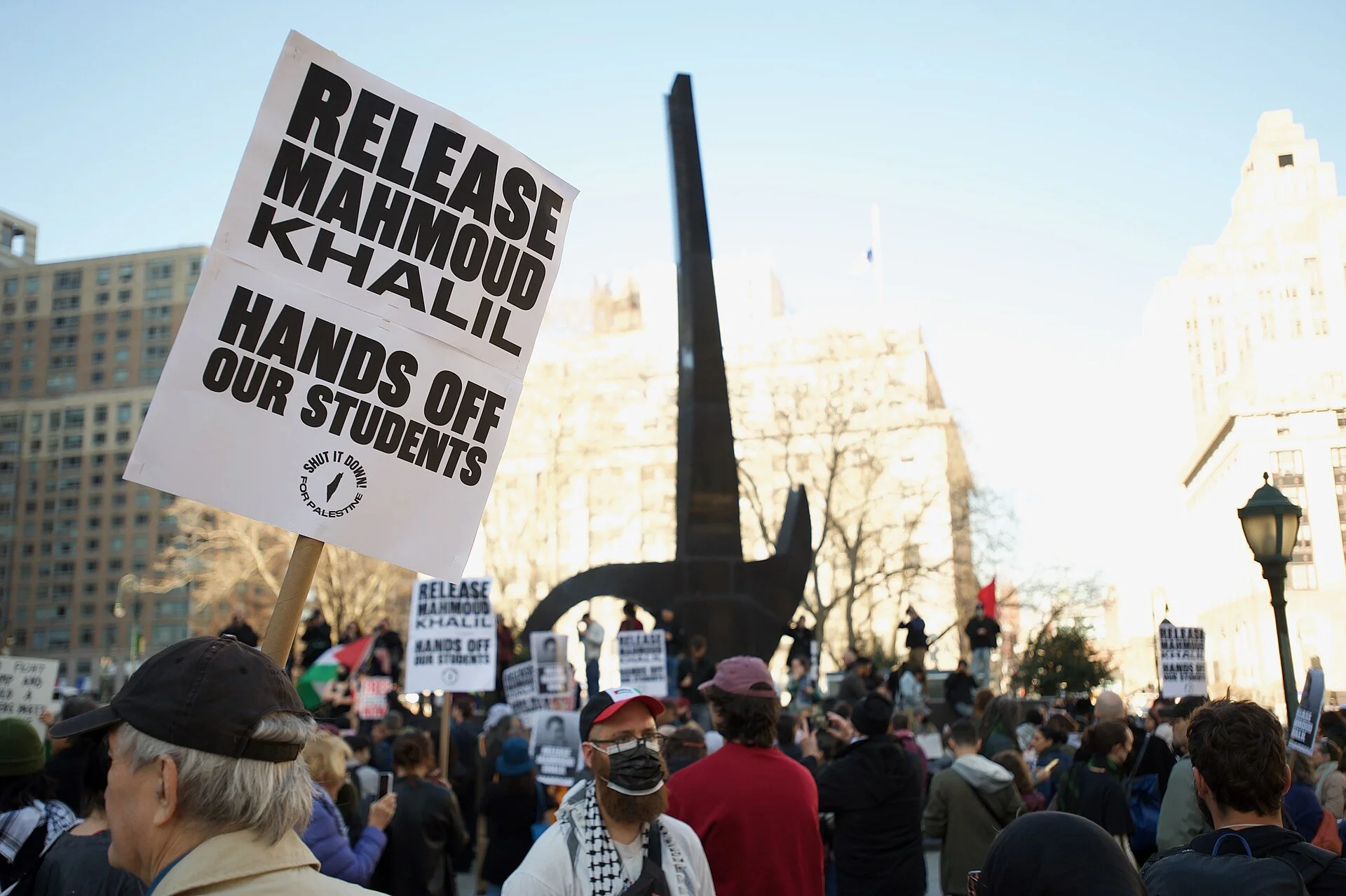
In New York, protestors call for the release of Mahmoud Khalil, a former Columbia University grad student and pro-Palestine activist arrested by Immigrations and Customs Enforcement (ICE) in March of 2025. Many view the administration’s arrests as an attempt to silence the speech of pro-Palestine activists, prompting concerns for freedom of speech.
Photo credit: SWinxy
On his first day in office, United States (U.S.) President Donald Trump issued two executive orders: Executive Order 14149 and Executive Order 14161. The former declared his desire to “restore[] Freedom of Speech and end[] federal censorship.” This prevents federal officials from “engag[ing] in or facilitat[ing] any conduct that would unconstitutionally abridge the free speech of any American citizen.” Executive Order 14161 proclaimed that the U.S. will “protect its citizens from aliens who intend to commit terrorist attacks, threaten our national security, espouse hateful ideology, or otherwise exploit the immigration laws for malevolent purposes.” By notably limiting these protections to citizens, these orders foreshadowed the nation’s recent immigration actions, deemed by many as a crackdown on noncitizen speech.
Citing “foreign policy” or “national security” concerns, the government has detained and deported (or, at least, attempted to deport) numerous legally present noncitizens. The targets of these actions are often those speaking out against Trump and/or supporting Palestine in the recent conflict in the Middle East. But can the administration legally carry out these actions? And if so, what dangers does this precedent pose for the civil liberties, particularly freedom of speech, for citizens and noncitizens alike?
In March of 2025, the U.S. government arrested and detained Mahmoud Khalil at Columbia University and Rümeysa Öztürk at Tufts University, as well as Badar Khan Suri, a scholar at Georgetown University. The government claimed it will revoke the visas and/or green cards of those supporting Hamas to justify the arrests. All three of these individuals, and many others arrested and detained without due process, vocally supported Palestine. The Department of Homeland Security (DHS) claimed that these individuals were affiliated with Hamas and spread antisemitic content, thus abusing their student visas.
As grounds for these arrests, the government invoked the Immigration and Nationality Act (INA). § 237(a)(4)(C) states that “an alien whose presence or activities in the United States the Secretary of State has reasonable ground to believe would have potentially serious adverse foreign policy consequences for the United States is deportable.” Before Trump, § 237(a)(4)(C) had only been used 15 times in the past 35 years. In 1996, a District Court criticized this section for being vague and violating the fifth amendment’s due process clause. Furthermore, the INA includes a provision in § 212(a)(3)(C) that prevents the government from wielding this act to remove someone from the U.S. for their “past, current, or expected beliefs, statements, or associations” so long as these are in the country legally. This provision requires the Secretary of State to prove the individual’s continual presence “would compromise a compelling [U.S.] foreign policy interest,” imposing a high standard of protection. Many activists believe that the administration has not met this standard. Rather, they believe officials are unjustly targeting activists to chill speech, as the arrests prompt citizens to censor themselves, fearing repercussions.
David Loy, the Legal Director of the First Amendment Coalition, a nonprofit organization defending freedom of speech and of the press, maintains that free speech concerns aren’t unique to Trump’s presidency. However, the intensity and frequency of such crackdowns are alarming, especially the arrests seeking to preempt speech the administration finds distasteful.
“Every administration, every politician from everywhere across the political spectrum, sooner or later, has thrown the First Amendment under the bus when it suited them. Censorship is one of the last true nonpartisan causes,” Loy said. “That being said, I do believe the current federal administration has turned it up to 11 in its open, notorious and blatant assault on freedom of speech across the board. [These are] naked attempts to intimidate and prevent dissent on a qualitatively different level than any other administration.”
Many federal courts are currently reviewing the legality of the administration’s deportations. For example, near the end of 2025, Judge William G. Young ruled on the legitimacy of the administration’s actions in the case of American Association of University Professors (AAUP) v. Rubio in the United States District Court for the District of Massachusetts. In the case, AAUP, a labor union composed of faculty and graduate students, sued Marco Rubio, the U.S. Secretary of State, among other government officials. The AAUP sought to block the Trump administration from carrying out its string of arrests and deportations against noncitizen students and faculty based on their viewpoints, which they argue violates their First Amendment rights. Young affirmed that non-citizens lawfully present here in the United States actually have the same free speech rights as citizens. Mytili Bala, the founder of Sitara Human Rights Law and a human rights attorney, said while the case is on appeal, it serves as a strong sign of resistance against the current administration’s actions.
“There was a week long bench trial over not just [Öztürk’s] case, but the practice of detaining and attempting to deport on national security grounds, international students who had spoken primarily, I think, exclusively, against Israel's war in Gaza. The government did invoke §237 of the INA, national security reasons, to revoke visas. It was rejected by Judge Young in the District of Massachusetts. It is a case that remains pending and up on appeal. But there’s a pretty forceful ruling kind of rejecting the flimsy reasons given to arrest and then try to deport certain students on national security grounds,” Bala said.
Young’s ruling doesn’t mark the end of this saga. As expected, the administration appealed his decision. The Department of Justice (DOJ) attorneys hold that the District Court is not the right remedy, and that these decisions must be brought to immigration court. The administration has also reaffirmed its mission to deport noncitizens for their “antisemitic” behavior, and that this power is well within its authority. Senior Ninth Circuit Judge Mary Margaret McKeown acknowledges that the balance of powers between the three branches, as well as the deference given to the executive to conduct foreign relations, complicates these matters. However, as experienced during 9/11, the courts must weigh national security and foreign policy concerns against other matters, such as civil liberties.
“There’s always a dance between the courts and the executive because the war powers belong to Congress, foreign relations… belong to the executive. But, whether national security can trump everything has really been a burning question in the courts. And the answer is no. It has to be a legitimate national security business. Particularly after 9/11, we saw a whole spade of new laws that were passed in the interest of or under the guise of national security,” McKeown said. “In the courts, we were inundated during that period. We put some shape and parameters on these challenges, so it’s not that the executive can act with complete abandon, without any standards. But those are really hard areas. We are seeing it again and we will continue to see it. It’s one of those things that it’s easy to say, but not as easy to analyze.”
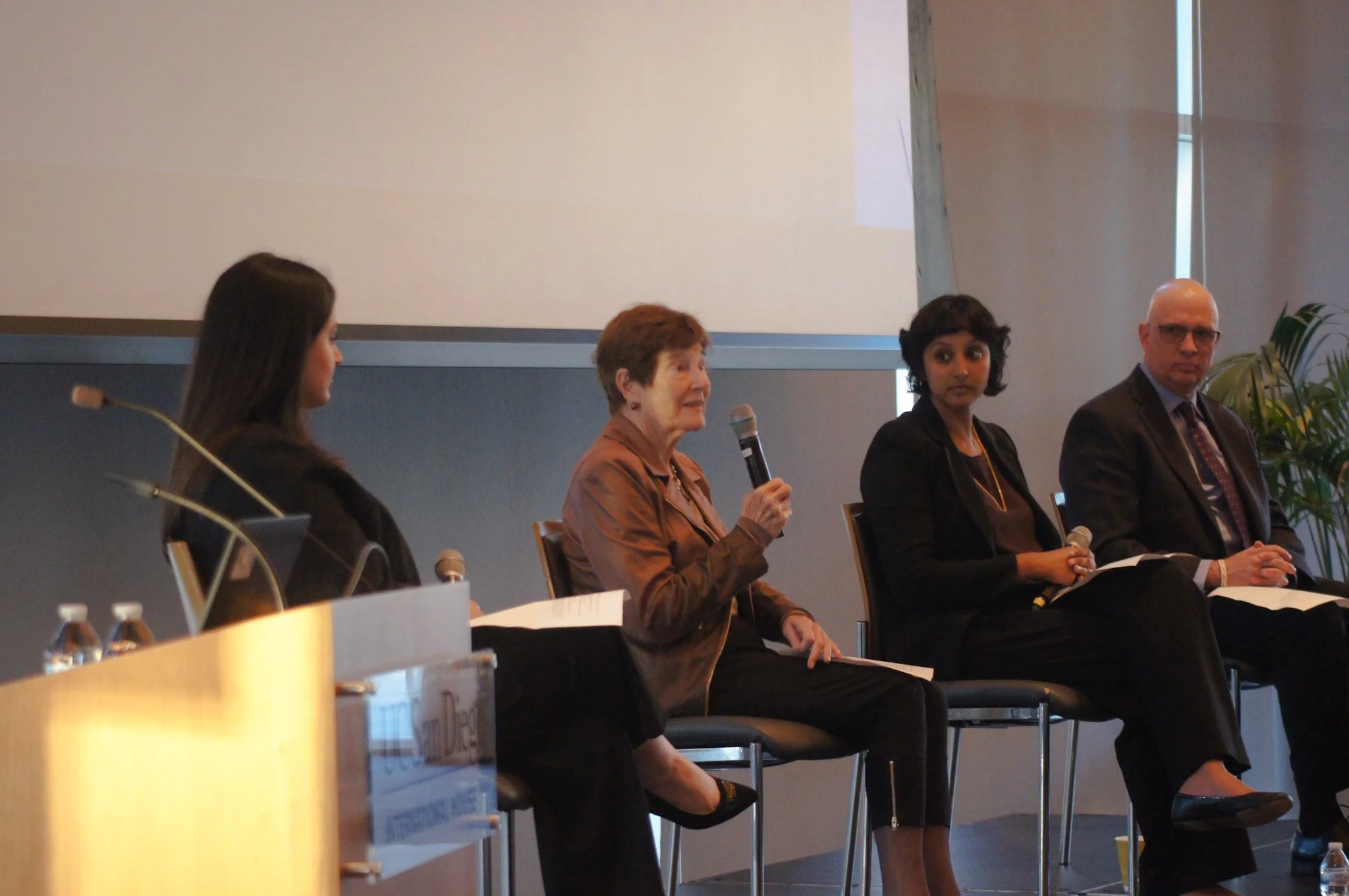

Judge McKeown answers questions from the audience. From left to right, Sadia Habib, the Communications Director at Afghanistan Law and Political Science Association, McKeown, Bala and Loy spoke at a Free Speech and Due Process event organized by International House at the University of California San Diego. All four speakers also spoke with Prospect before the event.
Photo Credit: I-House
While Young states that the judiciary has “robustly rebuffed the President and his administration” so far, the efficacy of court orders depends on their enforcement. Young voiced concerns that the President “meets dissent from his orders in those other two branches by demonizing and disparaging the speakers, sometimes descending to personal vitriol.” Combined with the President’s prevailing willingness to disregard precedent and legality, this raises concerns for many that these rulings may not be followed in the future. Young also questioned the court’s ability to provide and enforce an effective remedy, given how the role of the Executive has evolved under the current administration, as well as Trump’s established desire to skirt the law. McKeown said that judges are performing to the best of their ability, especially amidst an escalation in threats and vitriol aimed at the court. But, their role as defenders of civil liberties depends on a government and an American public that abides by their rulings.
“The number of threats just in the last 24 months has escalated geometrically. The judges are doing their best to operate, even, in the face of these threats. But we've never seen, really, the degree of threats that we have now to safety. And one of the consequences, I think, is the rhetoric. It's just heated to beyond any imaginable degree, and then it gets amplified on the internet,” McKeown said. “So, one of the beauties of the American system has been, over time, the ability for judges to enter orders, and for those orders to be followed. And that takes trust in the public. So when you start popping off, kind of irrationally, about judges and calling them names, I think it really erodes the public trust. So we're in this situation where we need to ensure the public's trust. But that is what's being stress tested right now.”
Given the continuous crackdowns, as well as the uncertainty surrounding the administration’s adherence to judicial rulings, concern over civil liberties comes to the forefront yet again. In his ruling, Young stressed that Trump is aware that he can break civil laws unless someone calls him out. The judge expressed his worries that Trump may be assuming that “the American people are so divided that today they will not stand up, fight for, and defend our most precious constitutional values.” As many activists and organizations have stressed, this underpins the urgency of fighting against the administration’s actions before they become normalized.
For Habib, who sought refuge in the United States from Afghanistan, the importance of standing up for one’s rights, especially when under siege, is tantamount. Despite the Afghan constitution’s affirmation of rights for both men and women, Habib witnessed the degradation when citizens did not stand up to rights violations.
“Afghanistan is one clear example of how a lack of civic engagement and widespread knowledge of constitutional rights can weaken democratic systems. It's the state's responsibility to protect the Constitution and oversee and protect the Constitutional rights of its citizens. However, the government is not the sole guardian of the constitution. When they fail to do it, it is the most informed and actively engaged public that becomes the most powerful force for accountability. So the lesson learned in the case of Afghanistan is that the constitution is not powerful merely because it exists. Its power comes from an informed and actively engaged public who are willing to defend it when need be,” Habib said.
Freedom of speech infringements are not unique to the Trump administration; they occur across the world, and don’t automatically end when a new leader comes to power. This has reaffirmed the need for citizens and noncitizens alike to stand up and defend one’s civil liberties, whenever and wherever they are threatened. As the administration’s decisions continue to play out in the courts, these concerns remain paramount.