The Battle Over AI Data Centers
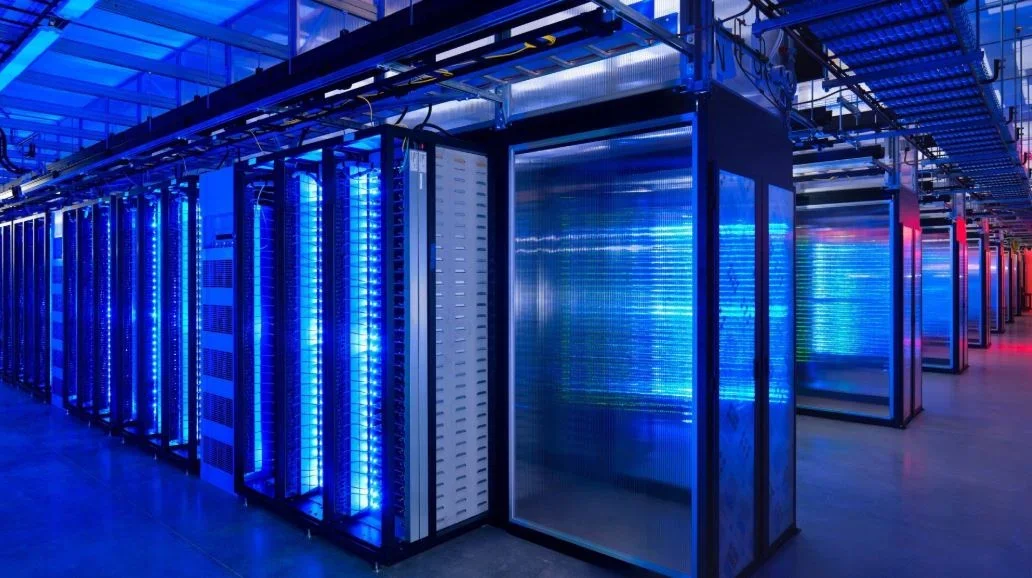
Data centers are crucial infrastructure for geopolitical competition over AI development. Traditional data centers utilize hundreds of server racks organized into different aisles in order to effectively cool down the system.
Photo Credit: Latam FDI
On August 21, the State Council of China released “AI+,” a plan to broadly increase artificial intelligence (AI) development and integration. This comes nearly a month after the United States (U.S.) released its AI Action Plan on July 23, which aims to decrease government regulation of AI and incentivize private sector innovation. These initiatives reveal how the AI arms race has become political, as China and the U.S. have hedged their bets that the country who makes the most significant breakthrough in AI first will control AI norms.
Both countries have different ideas of what victory in the AI race means. China has prioritized practical adoption of AI in all realms of society. In “AI+,” the Chinese Communist Party (CCP) pledged to increase usage of AI assistants in technical research, industrial development, e-commerce, people’s wellbeing, and governance.
According to the CCP’s projections, AI is set to become so integrated into society that it will drive 90% of the Chinese economy by 2030. While the economic impact of AI remains nebulous, the State Council described “AI+” as the avenue by which China would achieve “socialist modernization,” showing how the CCP has staked AI integration as a way to further its political agenda.
Despite this anti-capitalist message, Chinese regulations on AI development don’t take the form of environmental regulations and restrictions. Rather, achieving carbon neutrality has become a goal to be conquered via technological innovation. China has set an explicit goal via the 2022 East–West Computing Resources Transmission Project (EWCRT Project), stating that data centers must source 80% of their energy inputs from renewables. While the EWCRT Project is still in its infancy, scholars have projected that 9500 megatonnes (Mt) of carbon emissions could be removed over the course of the three decades.
The U.S. approach is completely different. The AI Action Plan is itself a rearticulation of Executive Order 14179, which was released on January 23. Executive Order 14179 focused on accelerating market-driven AI development by eliminating “burdensome” restrictions. While some federal restrictions emphasize reducing human biases within models, the majority of restrictions center the environmental impact that AI development incurs. For instance, a provision within Executive Order 14179 ordered the National Environmental Protection Agency (NEPA) to relax its guidelines stated within the Clean Air Act, Clean Water Act, the Comprehensive Environmental Response, Compensation, and Liability Act, the Toxic Substances Control Act and other applicable laws.
That leads to an important question: does rapid technological innovation necessarily require sacrificing environmental regulations?
AI development has become increasingly synonymous with data center development, given that data centers provide the large amounts of computing and processing power necessary for AI systems to train and operate. These facilities require large amounts of electricity since they run nonstop, as well as billions of gallons of water in order to properly cool the system, showcasing disastrous pitfalls behind rapid technological development.
Both China and the U.S.’s AI strategies rely on rapid construction of data centers. In the case of the U.S., this is extremely obvious. Much of the regulations and restrictions lifted by the AI Action Plan and Executive Order 14179 attempt to make it easier for companies to clear out land to make room for more data centers.
Chinese intentions regarding data centres are more vague. To meet the targets listed in “AI+,” the State Council announced that the country would “improve the basic capabilities of AI models, strengthen the innovation of data supply, enhance intelligent computing power, promote the development of open-source ecosystem[s] and reinforce the construction of talent teams.” All of this is only possible with the use of data centers.
However, China and the U.S. differ in their strategy surrounding data center development. Starting in June 2025, China began building data centers in the ocean as a way to combat the environmental effects these centers traditionally face on land. Underwater data centers pump seawater through the facility before directing it back into the ocean, allowing the seawater flowing out of the system to be cooled once it leaves. This reduces the amount of energy needed to cool the system and the amount of heat waste generated by the data center.
Traditional data centers typically rely on fresh water for cooling. While 80% of the used water evaporates, the remaining 20% is sent to wastewater facilities. Given that cooling a single data center requires up to 110 million gallons of water per year, that means at least 22 million tons of wastewater will be produced per data center a year. This leads to an increase in water stress, consequentially raising the price of water for consumers.
There are downsides to underwater data centers. During marine heatwaves, when ocean temperatures rise for an extended period, the facilities expel warmer water with less oxygen for the surrounding marine ecosystem to thrive in. Not only that, but researchers at the University of Florida carried out tests that proved underwater noises can affect marine data centers from only 20 feet away. These sounds destroy data centers by reducing the facilities’ operating speeds, thereby causing overload and reducing reliability.
In spite of these concerns, China has pushed ahead with underwater data centers. The first phase of construction on one such center has already been completed in Lin-gang Special Area, an economic zone in Shanghai. The facility’s power capacity is 24 megawatts of energy, and China has signed plans to build another underwater data center with a power capacity of 500 megawatts. While these plans largely remain concepts, they are evidence of how serious China is about permanent AI integration.
While the U.S. has developed similar carbon-neutral efforts, projects such as Microsoft’s Project Natick have since been discontinued, although there has been no public reason given for why. In Project Natick, researchers tested whether renewable energy could power an underwater data center. The reason behind Project Natick’s discontinuation is likely not because of the project’s failure; of the 855 underwater data centers, only six failed and lost power, while eight of 135 land-based projects failed.
There are few financial incentives for U.S. companies to invent ways to conserve water due to the relatively low price of water. In resource scarce areas, companies can easily foot the bill for rising energy and water costs to support data centers. However, everyday workers would suffer since development projects do not create permanent jobs, creating strains on local communities. Even if the systems necessary for AI development became more efficient, total water consumption would still increase. This results in resource scarce areas becoming targets for development plans, while wealthier areas would have the bargaining power to reject these proposals.
Both China and the U.S. have competing visions for what AI development should look like. While China emphasizes practical, long-term adoption across the entirety of Chinese society, the U.S.’ priorities lie in fast-paced private sector innovation as the quickest way to achieve a breakthrough. However, both countries are innovating and expanding data center development. As a result of these differing visions, data centers are often environmentally detrimental due to a zero-sum game between innovation and regulation. Whichever side wins will determine whether environmental regulations should be embraced or eschewed.