A Path Toward Obliteration: The Social and Economic Factors Driving South Korea’s Daunting Fertility Crisis
In a rapidly aging world, South Korea’s population stands to decrease the most in the shortest period of time, with its fertility rates reaching a record low of 0.72 average kids per woman in 2023. If this trend continues, South Korea may lose around a third of its population by 2100. Although birth rates managed to recover to 0.08 average kids in 2025, partly attributed to the post-pandemic social and economic rebound, the fundamental problem of an aging population persists. The Korean population remains on a long path toward obliteration. So what gives? Nations worldwide are grappling with shrinking populations, but understanding South Korea’s daunting fertility crisis requires a close examination of the country’s history and culture, as the puzzle pieces remain scattered throughout both space and time.
A Slow Recovery and The Miracle of the Han River
The Republic of Korea was founded in 1948 after Imperial Japan relinquished its colonial grip upon the peninsula. However, the Korean War erupted just two years after independence, resulting in nearly five million deaths and a newly divided state. More than half of the deaths were civilian casualties, accounting for 10 percent of Korea’s prewar population. Once South Korea split from its northern sibling state along the 38th parallel, the following decades were a matter of survival rather than prosperity for South Koreans. Under the United States (U.S.)-backed President Rhee Syngman, the nation experienced slow economic growth while its post-war urban population rose.
The nation began its journey of rapid development only after a violent military coup in 1961, the dethroning of Rhee and the subsequent transfer of power to General Park Chung-hee. The 1960s thus marked a period of economic and population stabilization. The adoption of export-oriented industrialization strategies and the aggressive push to establish and expand chaebol companies(family-owned business conglomerates) played a pivotal role in catapulting South Korea onto the main world stage. While Park is remembered as a divisive figure for his dictatorial rule and harsh crackdown on pro-democracy protests, it was his regime that brought about the "Miracle of the Han River.” South Korea went from being one of the world’s poorest countries to a fully fledged member of the Organization for Economic Co-operation and Development (OECD) by 1996, a hallmark of advancement toward an economic power as the nation boasted a “GDP per capita comparable to that of some European countries.”
Expectations that this miraculous growth would be met with consistently increasing GDP per capita, improved living standards (including increased age expectancy and falling child mortality rates) and ultimately a thriving, happy citizenry are not unreasonable, But, they fail to capture the reality of present-day South Korea.
A Tug-Of-War Between the Past and Future
Economics aside, Korean social practices and culture have been deeply affected by Confucianism, an ancient Chinese philosophy that greatly emphasizes notions of hierarchy and filial piety. This manifests itself in the strong familial and patriarchal values that have shaped the sociocultural make up of countries like South Korea. While not embraced as a formal religion, Confucianism has inevitably “pervaded the consciousness” of the Korean people for generations.
These far-reaching values manifest in various ways in Korean culture. One example is the rule of “three obediences,” which posits that a woman possesses the duty to obey her father, then her husband and finally her son. Another example is the Hoju system: the prevailing patrilineal family registration system since the colonial era until its overturning in 2005. The system prioritized male lineage and cast aside female family members as a demographic not worth keeping record of. The maintenance of the family unit and its propagation, according to Confucian tradition, was of utmost importance in popular society, but this philosophy was increasingly at odds with the feminist cultural movement that emerged in South Korea in the 1990s. The ‘90s were a critical juncture for South Korean society — a period in which the nation had to grapple with what to preserve or leave behind when entering the new millennium and solidifying its place in the global arena.
Cultural shifts in conceptions of family, changing state priorities and the introduction of a more modernized, capitalist framework all contributed to the drastic drop in fertility rates. The tension between traditional cultural values and the modern nuclear family was also reflected in the government’s policies. Family planning programs urged families to bear fewer children in exchange for benefits, such as tax breaks. Citizens began participating in the economy in ways unimaginable after the resolution of the Korean War, and women’s role in society shifted to better fit the demands of this system. Korean women were now reaching record highs for educational attainment, with high school completion rates jumping from 20% in 1966 to 99.5% in 1999. Similar patterns are found in the sharp rise of women in the workforce, as women’s labor force participation rate reached 49% by the turn of the millennium.
Despite the fact that economic liberalization necessitated female participation in the economy, Korean women found themselves at the center of an internal tug-of-war. They were constrained by the everlasting cultural expectations placed upon them to fulfill the role of a good worker, but also a good daughter, wife and mother. Balancing these roles demanded self-sacrifice, forcing women to shoulder “dual burdens of both a career and traditional motherhood roles.” Women continue to face significant institutional barriers when attempting to juggle these responsibilities. A 2025 survey of female workers indicated that 47.7% of respondents felt that they could not take maternity leave, closely tied to fears that they will be penalized for doing so. These pressures often intertwine with other startling statistics; South Korea has the largest gender pay gap among OECD nations (rising to 30.7% in 2025), and over 50% of married women quit their job after giving birth to their first child.
South Korea’s intense work culture and systemic gender inequality ultimately fashioned an environment in which women cannot have their cake and eat it, too. One working mother, Chung Woo-sun, said “I had to do both. Juggling work and motherhood felt like an endless battle. It was really painful.” While the pressures to reproduce remain stronger than ever, women are simultaneously cognizant of the economic system that only privileges those who work. And yet, choosing one over the other is not an option. The labor force and motherhood have become two seemingly contradictory life paths as a result of the country’s inability to keep up with intense economic and cultural shifts. This offers a glimpse into why South Korea’s foray onto the international stage did not necessarily prevent the fertility crisis, or even set the right systems in place for a population recovery.
Korea’s Cultural Fragmentation: Gender Wars and the N-po Generation
The fertility crisis is further exacerbated by a cultural fragmentation causing rising tensions among South Koreans. The growing alienation between Korean men and women is known colloquially as the “Gender Wars.” It can be attributed to and exemplified by surging trends in violent digital sex crimes, the proliferation of extremist online forums for male supremacists and radical feminists and continuous debates about what “gender equality” entails. The political divide remains strong in voting patterns as well. South Korea’s 2022 presidential election serves as a concrete example of this, as 74.1% of male voters in their twenties cast their ballots for the conservative candidate, the now-impeached Yoon Seokyul. In comparison, only 35.6% of women in their twenties voted for Yoon, illustrating how such antagonistic attitudes regarding each gender have infiltrated the political sphere.
Though Korean men and women regularly clash along social and political lines, they share a general disillusionment about their future. In the face of high living costs, job uncertainties and a lack of dating prospects, many Korean millennials have simply given up on their future entirely. This younger generation is also known as the N-po generation, a moniker which literally translates to the “generation that has given up” on relationships, marriage, reproduction, home ownership and even maintaining a social life. Many N-po members feel as if they cannot sustain their own lives, instead embracing a “YOLO” mindset that results in them, on average, spending more than they save. Relinquishing their hopes to achieve the basic components of a happy, healthy life due to rising economic pressures and sociocultural issues offers an additional explanation as to why South Koreans have not been able, or willing, to solve the fertility crisis.
The herculean task that remains is figuring out how to grapple with South Korea’s fundamental structural flaws and growing cultural divide. This requires looking outside the confines of the nation for possible answers.
Is The Future Multicultural?
South Korea views itself as undoubtedly homogenous. But more recently, it has charted a path towards multiculturalism, as the foreign resident population hit a record high of 2.73 million (in a country with a population of 51.4 million) in July of 2025. Unbeknownst to many citizens who hold onto the value of ethnic homogeneity, South Korea is actively becoming a multicultural country. The proportion of its foreign population inches closer to the 5% threshold required for such a designation, according to the OECD. This steady increase in migration flows paired with the shrinking fertility rate indicates an important population shift that encompasses greater cultural and ethnic diversity. This newfound reality begs the question: what does it mean to be “Korean” in a world where homogeneity is no longer the norm, but rather an aged, routinely disrupted artifact of the past?
South Korea touts itself as a cosmopolitan country, citing the increasing influence of K-culture that has rapidly expanded into new global markets. Cultural diffusion has enabled the country to focus its efforts on strengthening its soft power — a country’s ability to influence others by utilizing culture rather than overt power — as evidenced by major spikes in tourism before the COVID-19 pandemic. In December, the country welcomed over 18.5 million tourists. Prime Minister Kim stated that the government aims to usher in an average of 30 million tourists a year as they “strive to make an advanced tourist country where the fruits of K-culture bloom.”
While the government readily welcomes booms in the tourism industry, citizens remain skeptical about relinquishing their grip on prevailing ethnocultural nationalist views. Survey data from the East Asian Institute (EAI) found that over half of respondents believe there are limits to accepting foreigners. This general resistance toward multiculturalism is further exhibited by the highly-publicized dispute surrounding a mosque in Daegu, a conservative stronghold city hours away from metropolitan Seoul. Muslim exchange students and elderly Korean residents went head to head in a heated standoff concerning the construction of an Islamic place of worship in 2022. With protesting residents claiming that the mosque would transform their neighborhood into “an enclave of Muslims and a crime-infested slum,” the incident made headlines both locally and internationally and reignited conversations surrounding immigration and cultural diversity.
Lee Hyung-Oh, a major proponent of anti-foreigner sentiment and leader of Refugee Out, a national anti-immigration organization, claims that “we may look exclusionist, but it has made us what we are, consolidating us as a nation to survive war, colonial rule, and financial crises and achieve economic development while speaking the same language, thinking the same thoughts.” Lee’s words ring true for many other Koreans who not only stay wary, but also actively resist perceived threats to ethnic homogeneity. They directly reference the historical and social conditions that have shaped such isolationist tendencies. However, this is ultimately an outdated reaction to the current reality of South Korean society.
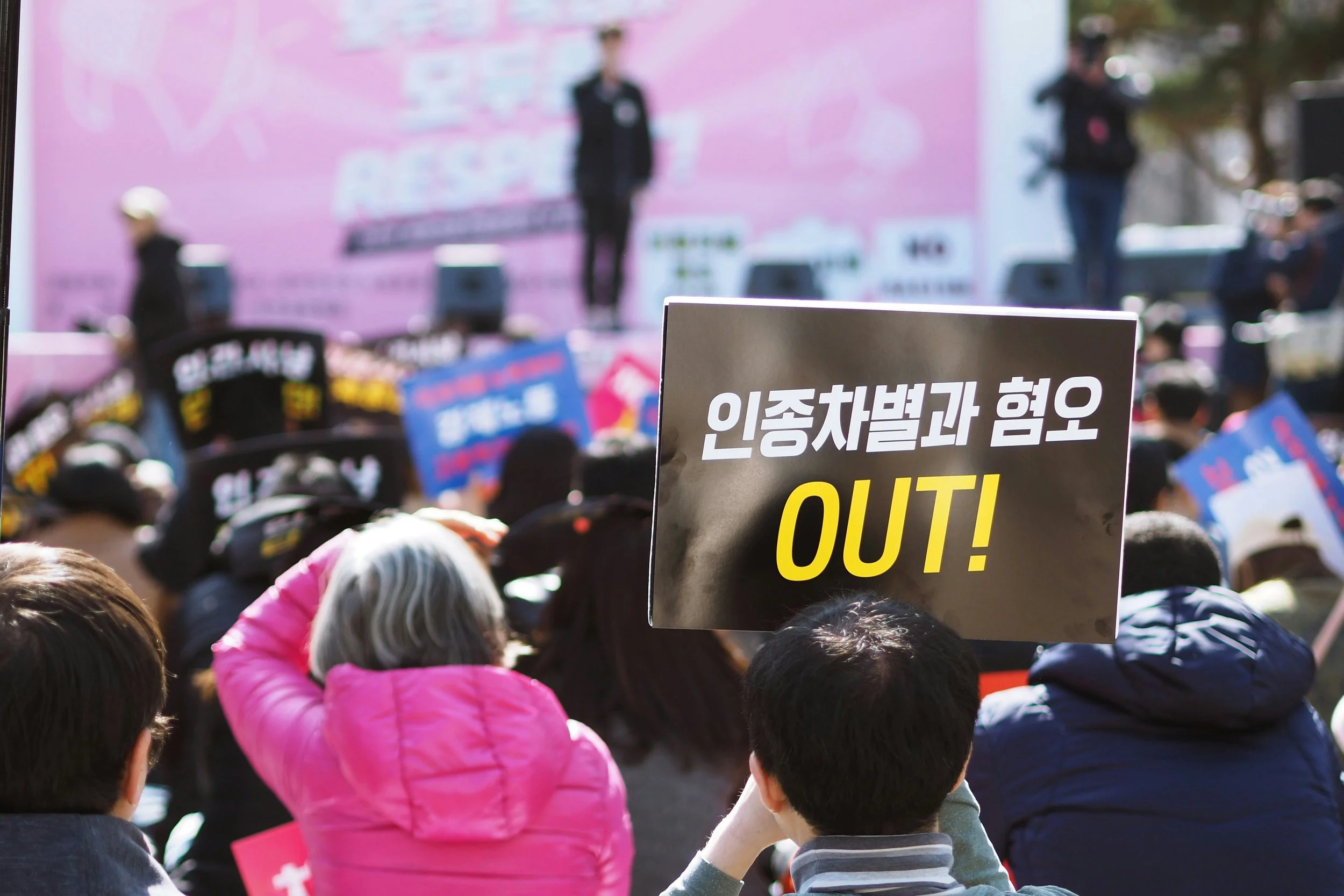
While strong anti-foreigner sentiment exists today in South Korea, so do greater levels of tolerance and acceptance. A protester at a rally holds up a sign saying “Racism and Hate OUT!”
Photo Credit: Ra Dragon
Partly in reaction to declining birthrates and a general trend towards urbanization, the South Korean government has allowed a steady flow of migrant workers and students from foreign countries. This inflow of foreigners has yielded generally positive results for the Korean economy. Migrant workers have solved labor shortages in sectors that Koreans themselves find less attractive, and their incorporation into the domestic labor market has also slowed the aging of the workforce. Despite the growing dependence on foreign migrants to help sustain waning sectors, migrant workers themselves are susceptible to mistreatment, exploitation and complete erasure.
Contrary to what many choose to believe, Korea is becoming increasingly reliant on transnational labor and foreign participation in the economy. Popular sentiment promotes contradictory attitudes about welcoming tourism and shunning migrant workers, but the unshakeable truth is that the country needs to treat multiculturalism as inevitable rather than preventable. Doing so would better equip Korea’s government officials and general population for the implementation of sustainable immigration practices, reforms to strengthen labor rights and enforcement of non-discrimination policies in the workplace and beyond. Creating better conditions for those who serve as the invisible backbone of South Korea would make overall immigration practices safer and more attractive, allowing for a more symbiotic relationship between migrant workers and the Korean economy. In a similar vein, increased acceptance and support for multicultural marriage, coupled with the implementation of comprehensive multicultural policy, may boost family formation and fertility rates among multicultural families.
Clearly, Korean society faces major cultural rifts and an increasingly polarized populace. Fixing these issues will not come easily, as the country must address its current shortcomings in workplace conditions for Korean women and migrant workers, bridge the social gap between men and women and create an environment in which young Koreans feel they can participate as valuable members of society. Escaping the path towards obliteration will be no easy feat, but South Korea can look for answers in the past and present to plan for its future.