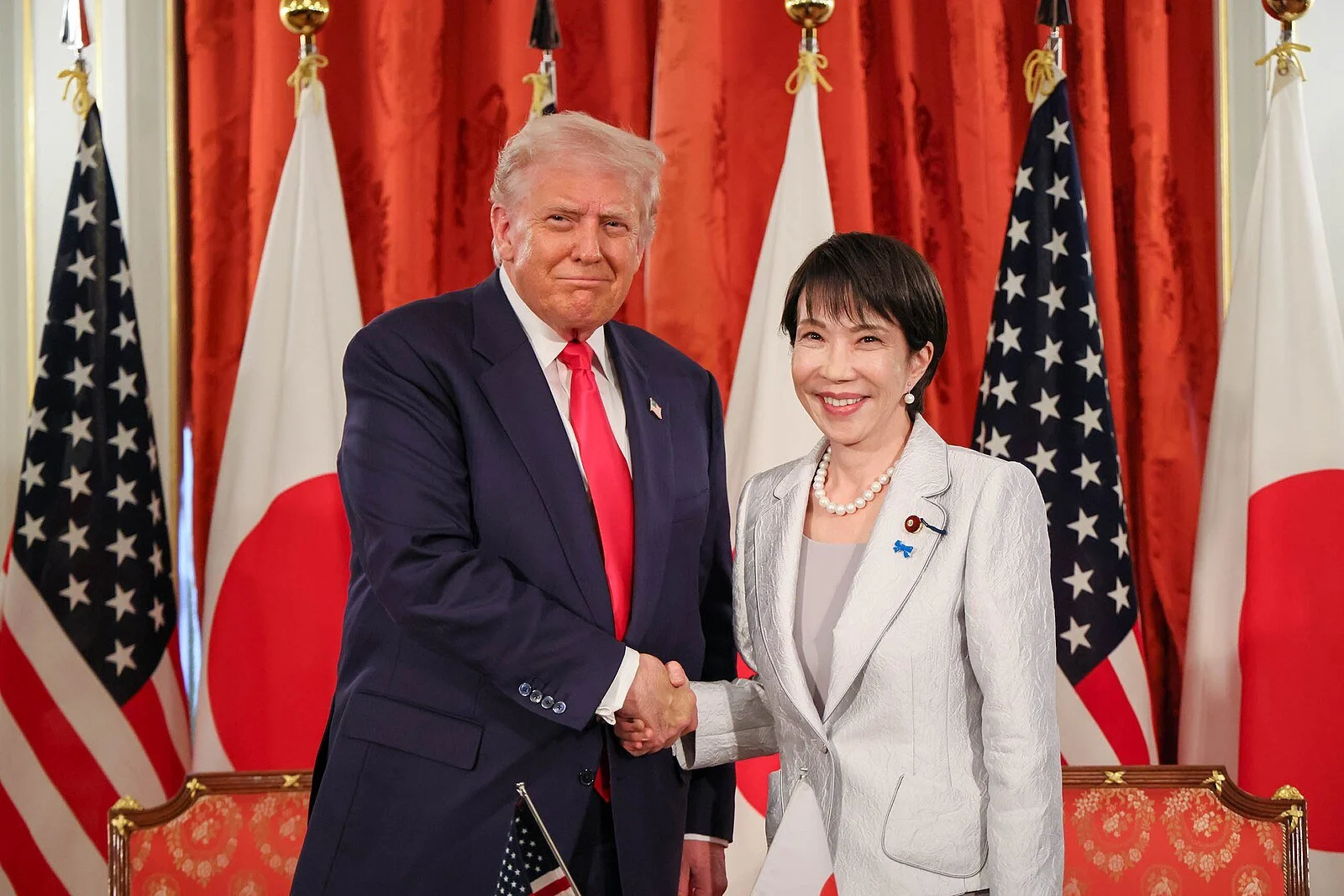
President Trump and Prime Minister Takaichi met at the State Guest House, Akasa Palace, for a summit meeting. This marks the first time that the Takaichi administration hosted another foreign country.
Photo Credit: Government of Japan

On October 28, newly-elected Japanese Prime Minister Sanae Takaichi welcomed the United States (U.S.) President Donald Trump to Tokyo as part of Trump’s week-long tour of Asia.
What followed was a gift exchange heavily personalized to Trump’s tastes, such as golden golf clubs and a golf putter that belonged to previous Japanese Prime Minister Shinzo Abe — Trump’s close friend and Takaichi’s mentor. Takaichi also presented Trump with two hats printed with the words “Japan is Back.” The Prime Minister even announced that Japan would nominate Trump for a Nobel Peace Prize, harkening back to Trump’s campaign promise to bring ongoing geopolitical conflicts, like Russia’s invasion of Ukraine, to an end through negotiation.
Even the lunch menu, spotlighting a risotto dish composed of American short grain rice and Texas-raised beef, reveals the extent to which Takaichi and her administration cajoled Trump’s pro-isolationist, protectionist trade policies. For decades, the Japanese government has heavily protected Japanese rice production by placing a tariff on foreign rice imports. This makes the Takaichi administration’s selection of American rice a clear attempt to appease the U.S. The risotto also illustrated Taikaichi’s commitment to the trade deal that Japan and the U.S. signed in July, which has seen Japan increase imports of rice.
At the end of their talks, both Japan and the U.S. announced plans to go forward with $400 billion worth of investment projects, including the joint construction of nuclear power plants and power infrastructure under Japanese and American companies. The implementation of a $550 billion tariff deal that Japan and the U.S. reached earlier this year was also confirmed to be put into effect in the near future.
Although relations with the U.S. have started off strong, Japanese businesses remain unsure about Takaichi’s leadership. Many are waiting to see how Takaichi will carefully balance security reliance on the U.S. with economic dependence on China.
China is undoubtedly Japan’s largest trade partner, with Japanese exports totaling a staggering $128 billion in 2023. With China representing such a large and willing market for Japanese products, many businesses support increased Japan-China political cooperation, despite rising anti-foreigner sentiment among the Japanese electorate. This means that many Japanese lawmakers must play a tight balancing act between these two opposing interests. Those same businesses represent the interests that Takaichi failed to capture during her two previous campaigns for leadership of the Liberal Democratic Party (LDP), the majority party in Japan, due to her loud hawkish stance against China.
Takaichi’s most recent campaign saw her tone down her anti-China stance in favor of an anti-tourist, pro-domestic focus. However, just as a leopard is incapable of changing its spots, Japanese businesses should remain vigilant and question Takaichi’s willingness to play nice.
Earlier in November, Takaichi commented that Japan would consider a Chinese attack against Taiwan to be a “survival-threatening situation” for both Japan and Taiwan. She is quoted as telling Parliament that, “If [Chinese action] involves the use of warships and the use of force, I believe that this could constitute an existential threat, no matter how you look at it.” While Takaichi never stated that Japan would respond to a potential invasion with military action, many interpreted her statement as suggesting the possibility of use of force.
Such a move would be unprecedented in modern Japanese history. Article 9 of Japan’s constitution only allows the country to engage in self-defense and peacekeeping efforts through the Self Defense Force (SDF) instead of an active military. A change to Article 9 has only occurred in 2015, when the SDF was allowed to participate in international conflicts under the justification of protecting “collective self defense.” Even then, the heavy cultural stigma against warfare within Japan remains, which adds to the severe backlash against Takaichi’s comments. While Takaichi clarified her words weren’t meant to be formal policy, explicitly suggesting Japanese involvement in any potential conflict in Taiwan is a change from Japan’s previous doctrine of strategic ambiguity, which sought to show solidarity through broad slogans like “A Taiwan crisis is Japan’s crisis.”
This drastic shift in rhetoric caused a firestorm of criticism from China. Social media posts like a now-deleted post on X from a state consul in Osaka, Japan, calling for Takaichi to be beheaded were accompanied by an increased Chinese Coast Guard presence around the Senkaku Islands. This territory is situated between both countries, and its surrounding waters are rich in natural resources like oil. While no inherent economic repercussions have occurred, China issued warnings to tourists to avoid traveling to Japan and delayed the release of two Japanese movies in China. The threat of further Chinese action cannot be ruled out.
Takaichi has already committed to increasing defense spending to 2% of Japan’s total gross domestic product (GDP). While Takaichi never cited any explicit rationale behind this decision, given her comments about Taiwan, this move easily aligns with her previously public anti-China sentiment. Additionally, her regular visits to the Yasukuni shrine also sparked heated criticism and questions about how far her stance on China was. Among the dead honored at the shrine are fourteen convicted Class A war criminals, all of whom participated in committing mass atrocities in the Asia-Pacific region during WW2.
The strategic positioning of U.S. interests over Chinese interests by the new Japanese administration is too obvious to be ignored. The U.S. has historically encouraged Japan to invest more into defense in order to reduce reliance on U.S. security guarantees. The aforementioned revision of Article 9 could be read within the context of reassuring the U.S. that Japan could give them something in return for protection. Takaichi’s commitments, both to increasing trade and investment alongside defense, are thus consolation prizes for the U.S. in the case that escalation with China becomes an all too real threat and the U.S. would be pressured into getting involved.
So far, China has shown little interest in relaxing its confrontational approach to relations. How Takaichi intends to thread the needle between the U.S. and China, while ensuring the best for Japan, remains to be seen.