In A “New” Syria, al-Sharaa Promises Peace. Can He Deliver?
The fall of President Bashar al-Assad in December 2024 brought an end to nearly 14 years of devastating civil war and a half century of brutal totalitarian rule in Syria. In the wake of regime change, Syria is attempting to redefine its place on the world stage under the leadership of President Ahmed al-Sharaa. As founder of Hayat Tahrir al-Sham (HTS), an Islamist organization that led the rebel offensive against the Assad regime, al-Sharaa has promised the Syrian people enduring peace and stability. However, bubbling sectarian divisions, a crippled economy and acute funding shortages may challenge al-Sharaa’s ability to deliver on his promises.
Syria’s New Government: A Fledgling Democracy?
President al-Sharaa founded HTS in 2017 as an alliance of five Islamist militias, including his own organization, Jabhat al-Nusra. Jabhat al-Nusra operated as a Syrian affiliate branch of al-Qaeda for five years, but broke with al-Qaeda to focus on Syria and its civil war.
Since its formation, HTS operated as an independent organization, controlling the sociopolitical landscape of northwest Syria during the war, most notably in the Idlib province. HTS was seen as a moderate Islamist organization, emphasizing that its governance would remain compatible with the broader, secular Syrian culture. In contrast to larger, more extreme Islamist organizations like ISIL (ISIS) and the Taliban, HTS did not enforce the harsher impositions of Sharia law, such as requiring women to wear veils or banning public mixed-gender gatherings.
Following the government’s dissolution of all armed factions and political parties, HTS has since disbanded. However, former HTS members maintain a strong presence in the new government; its leaders hold prominent positions in government and former fighters comprise the military ranks and security forces in conjunction with other armed groups.
Furthermore, al-Sharaa has stated that his government’s focus will be to rebuild on “new and modern foundations,” stressing that women will be able to enter the workforce and “free and fair” democratic elections will be held for both the Parliament and the Presidency. Regardless, HTS’s Islamist affiliations have severely impacted its international standing. The UN and many member-states sanctioned both HTS and al-Sharaa as terrorist entities due to their previous affiliation with al-Qaeda.
However, international attitudes toward al-Sharaa and HTS have since shifted following their rise to power. The United States (U.S.), United Kingdom (U.K.) and European Union have all significantly eased sanctions on Syria, with the U.S. and U.K. also removing their terrorist designations. The sanctions relief provides a much-needed crutch with which Syria can prop up its devastated economy and open its doors to trade. But, with the World Bank estimating reconstruction costs at around $216 billion – and that’s a conservative estimate — the path to recovery will be long.
The (Long) Road Ahead
In the largest displacement crisis since World War II, over half of Syria’s prewar population has been forcibly dislocated, both internally and as refugees in other countries, over the course of the war. The UNHCR reported in November 2025 that over 1.2 million refugees and 1.9 million internally displaced persons have returned home since the end of the war. But what is home, when many have nothing to return to?
The U.N. Development Programme reported that over 50% of essential infrastructure in the country is no longer functional, following the collapse of health, education, sanitation, welfare and housing systems. Nine out of ten Syrians live below the poverty line, facing extreme food insecurity and unable to afford or access necessities like energy and housing— a crisis exacerbated by the 200-fold increase in inflation that Syria has experienced since the start of the war.
The easing of sanctions has provided some much-needed relief to Syria’s fractured economy, allowing the nation to reopen its economy to international business, access newly unfrozen assets and gain membership to global financial institutions – including SWIFT, the global network for facilitating international transactions between banks. All of this is done with the aim of promoting global support for Syria’s economic growth.
Yet, Syria remains one of the world’s largest humanitarian crises: 70% of the population requires aid and humanitarian operations for 2025 are only 18% funded. Without adequate funding, restoration efforts are severely endangered, limiting the ability of Syrian refugees to return – and remain – home. In the face of acute funding shortages, Syria requires foreign investment.
Over the last ten months, Damascus has received $28 billion in foreign investment to cover debt relief, reconstruction and development projects. Qatar and Saudi Arabia have pledged to supply the bulk of this aid, alongside companies based in Turkey, Qatar and the United States. Al-Sharaa is also seeking potential trade deals with major global players, like Russia, as his administration takes a pragmatic approach to foreign policy. However, in establishing and redefining relationships with potential international partners, Syria risks threats to its long-term security and stability.
Given Russia’s military presence in geographic areas where Damascus is vulnerable, productive relations with Moscow are imperative to assert Syria’s enduring stability and build its military power. But Russia’s presence also poses a strategic threat to Syrian stability: Moscow has granted asylum to Assad, and an increased Russian presence may be advantageous to the many minority sects opposing al-Sharaa’s Sunni majority government.
Additionally, efforts by Turkey and prominent Gulf states, like Saudi Arabia and Qatar, to aid Syria’s reconstruction reflect a wider, collaborative mission to erode Iranian influence in Syria and ensure greater long-term regional stability. Syria has long been a battleground for a Saudi-Iranian proxy war, but is now posed to be the potential target of a weakened Iran looking to reestablish its Axis of Resistance, a loose coalition of Iran and its allies opposing U.S. and Israeli influence in the Middle East. Saudi investment in Syria could serve as a deterrent against the expansion of Iranian influence in Syria and the broader Middle East.
Furthermore, investment remains a risky endeavor for potential foreign actors. Despite ample opportunities for investment across all sectors, Syria lacks sufficient legal or financial institutions to protect investments, and underdeveloped infrastructure poses higher costs and security challenges. Combined with the already tenuous political climate, investors may be deterred from providing Syria the support it desperately needs to continue rebuilding.
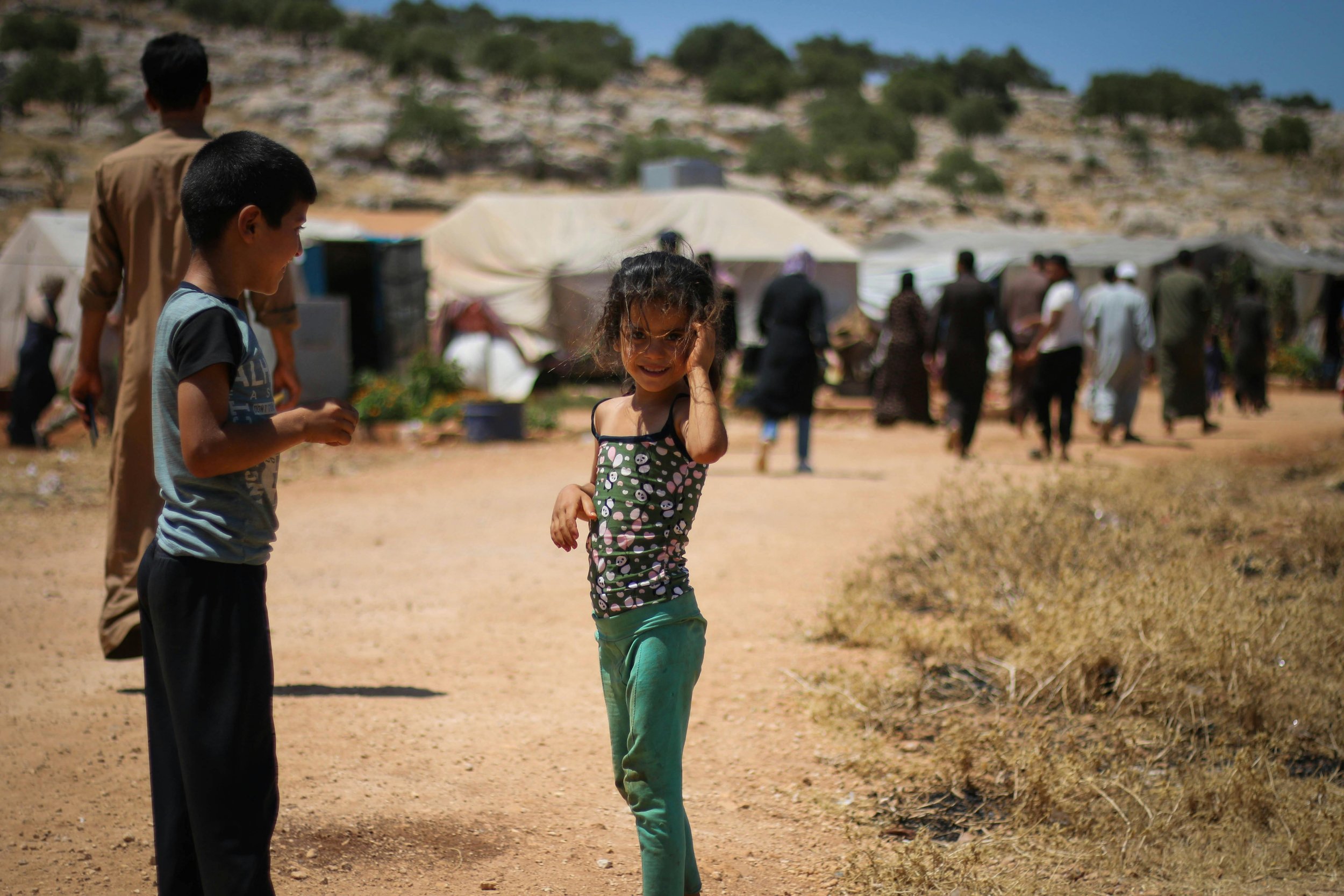
Syrian children in a refugee camp in Idlib Province, Syria. This camp is one of many set up around the country for an estimated 7.2 million internally displaced Syrians, many of whom remain unable to return home a year after the end of the civil war.
Photo Credit: Ahmed Akacha
Sectarian Violence & Domestic Challenges
Syria has long been a melting pot of religions and ethnicities: Sunni Muslims make up an overwhelming 75% of Syria’s population, with the remaining 25% a mix of minorities including Alawites, Druse, Christians, Shia Muslims and Kurds.The Assad regime manufactured and exacerbated deep sectarian divisions amongst these groups over its half century of rule. Leveraging its membership within the Alawite minority, the Assad family routinely justified horrific acts of war, oppression and brutality as necessary to serve minority interests, painting the regime as a necessary “protector” against majority Sunni rule.
These divisions, a remnant of the Assad regime, remain an integral part of the Syrian sociopolitical order. Syria’s new government belongs to its Sunni Muslim majority, marking the first period of majority rule in over 50 years. As such, Al-Sharaa’s rise to power has sparked widespread fear among Syria’s many minority groups, despite his promises to protect them.
These fears came true, to some extent, in March. Violent uprisings on Syria’s coast left 1,400 dead after Assad loyalists launched an attack on local security forces and civilians, carrying out civilian executions and destroying homes. Government forces were called in to quell the violence, but the U.N. Syria Commission verified that government forces played an active role in perpetrating the violence. The Commission also found that the massacres systematically targeted the Alawite community, sparking fear that al-Sharaa’s majoritarian government may not deliver on its promises of peace and security for all.
A similar wave of sectarian violence erupted this summer in the southern province of Sweida, in one of the deadliest such incidents since al-Sharaa took power. Regional conflict initially localized between Druse militias and Sunni Muslim Bedouins escalated into massacres, with the majority of the 2,000 resulting dead belonging to the Druse religious minority. Government and government-affiliated forces were again verified to be involved in the July massacres in coordination with local Bedouin groups, further eroding public confidence and trust in an already unstable sociopolitical climate.
Whether al-Sharaa’s Sunni government is willing and able to protect these minorities will be strongly indicative of whether peace is sustainable – or even viable – in Syria. Without concrete and credible commitments to protect minority groups, Syria will lack the domestic stability imperative for the successful socioeconomic reconstruction, humanitarian development and international partnerships necessary to ensure long-term peace. Al-Sharaa must step up the security guarantees it has promised for minority groups or risk losing the nascent democracy for which Syria has worked long and hard.