The Expansion of Beijing’s National Security State Into Hong Kong: Societal Implications of the National Security Law
A Changed City
Enacted on June 30, 2020, China’s National Security Law (NSL) arrived with speed and force. Drafted behind closed doors in Beijing, the law was implemented into Annex III of Hong Kong’s Basic Law. This law sought to criminalize collusion, secession, and subversion. These crimes were defined broadly, essentially granting authorities total discretion. Five years after its implementation, Hong Kong still feels the effects of this law through its legal, political and cultural impacts. What was once a semi-autonomous political society has now been restricted tightly by Beijing.
In 2019, Beijing proposed an amendment to Hong Kong’s existing extradition laws requiring the Hong Kong government to consider extradition requests from countries without previous surrender agreements. This includes Taiwan, Macau and Mainland China. The proposition sparked controversy, with critics such as The United Nations Working Group on Arbitrary Detention noting that Hong Kong citizens would be subject to arbitrary detention, unfair trials and torture. Further, they worried this would enable Beijing to target activists, journalists and social rights groups who criticized Beijing. The bill was eventually withdrawn due to massive protests, but not without consequences.
When first enacted, Beijing promoted the NSL as a response to protests against the 2019 extradition bill, arguing that Hong Kong was being threatened by separatist forces and foreign interference. Mainland officials described the law as necessary to restore order and protect China’s national sovereignty. Furthermore, many in the mainland saw the law as an overdue formality. They pointed to Article 23 of the Basic Law, a provision requiring Hong Kong to pass its own national security legislation, a process which had stalled for almost two decades. Legal scholars note that the NSL marked a clear shift in the operation of Hong Kong’s legal system. Rather than being enacted through Hong Kong’s own processes, the law was imposed directly through Beijing, bypassing any local deliberations.
A Legal Architecture with Few Limits
The NSL imposed a new governance structure in Hong Kong, including a dedicated Office for Safeguarding National Security staffed by mainland officials. This office operates with full immunity from local jurisdiction. The courts can specially choose judges to handle NSL cases. Furthermore, the presumption of bail, a cornerstone of Hong Kong’s common-law system, has been effectively reversed. Finally, under pressure from Beijing, the Hong Kong Police Force established a National Security Department, equipped with enhanced surveillance and investigatory powers. These changes call into question sovereignty concerns, as they have displaced Hong Kong’s independent institutions with mechanisms that are accountable to Beijing. Institutions such as the Legislative Council and the Court of Final Appeal have seen the blurring of local governance due to executive control from Beijing.
The enforcement of the NSL has been widespread. As of May 1, 2025 an estimated more than 300 people have been arrested under the NSL, with many more already convicted. However, the vast majority of those arrested were within their rights of expression. Trial judges use broad interpretations of what is considered subversive activity or collusion, enabling authorities to treat political mobilization, public speech and civic engagement as potential threats to national security.
Civil Society in Retreat
Following the enactment of the NSL, Hong Kong’s civil society has drastically changed. Media outlets, once a source of pride for a city that boasted of itself as having the freest environment for journalism, have been silenced. The forced closure of Apple Daily in 2021 began a sequence of crackdowns on independent journalism. Facing immense pressure from Beijing, organizations such as Stand News and Citizen News have now also ceased operations, whether voluntarily or involuntarily. Press freedom organizations now rank Hong Kong near the bottom of country rankings, and in an assessment from 2024, Reporters Without Borders described Hong Kong as having experienced an “unprecedented decline” in journalistic freedom.
These crackdowns haven’t been limited to traditional media. Professors have actively avoided mentioning politically sensitive topics, student unions have been forced to shut down and administrators have ensured university events are NSL compliant. Researchers from Georgetown University’s Center for Asian Law found that many of Hong Kong’s NGOs, ranging from civil-rights groups to labor unions, have been shut down due to fear of prosecution. Hong Kong’s once active civil society has now become a shell of its former self.
Furthermore, everyday life has changed. Libraries have removed literature from pro-democracy figures, social media users have noted mass deletion of posts and public events, such as the annual Tiananmen Square vigil at Victoria Park, have been banned. These developments resemble a restructuring of Hong Kong’s information and cultural hubs. Beijing’s narrowing down of what can be said, read or celebrated has redefined what is considered an acceptable cultural identity and collective memory. The weight of government molded ideology may bring about the erosion of civic society as people now live in fear of the costs of speaking out.
Political Transformation Under the Guise of “Patriots Only”
The NSL has paved the way for sweeping changes in Hong Kong’s political institutions. Starting in 2021, Beijing introduced electoral restructuring under the guise of “patriots governing Hong Kong.” Committees were established to test political candidates on their loyalty to the government, which subsequently barred opposition figures from competing. The governing ideal of a “patriots only Hong Kong,” has resulted in the absence of opposition voices, such as pro-democracy legislators, in the Legislative Council and district level governance.
Opposition parties have faced pressure to disband and many political leaders have been jailed, fled abroad or withdrawn from public life. The prosecution of the “Hong Kong 47,” a group of opposition politicians and activists charged with “conspiracy to subvert” for organizing an unofficial primary election, have come to symbolize the repressive reality for Hong Kong. This case has redefined political mobilization, establishing it as a threat to China’s national security.
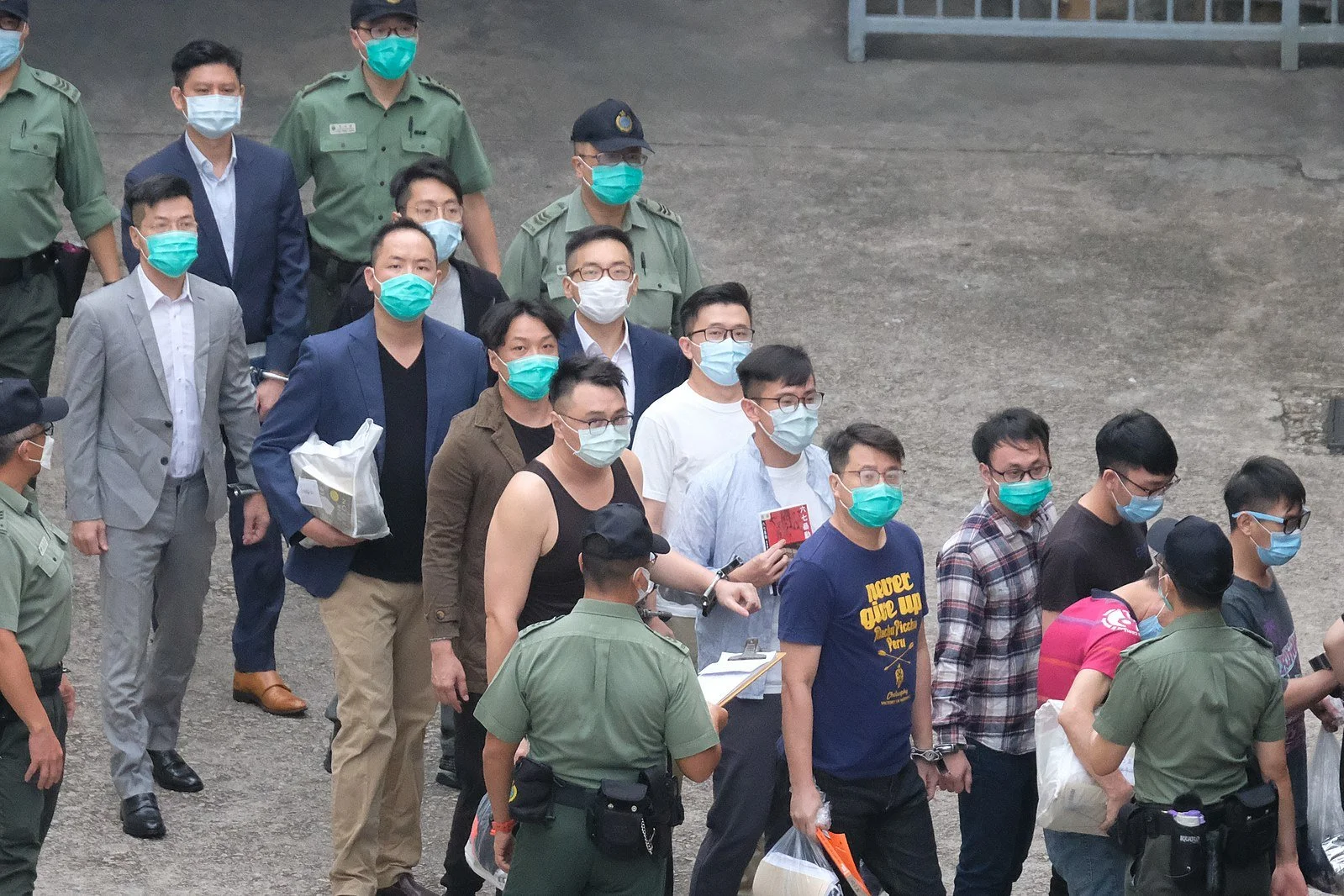
Pro-democracy activists, known as the “Hong Kong 47” are escorted by officers as they are transferred for court proceedings under the NSL, illustrating how political participation has become criminalized.
Photo Credit: inmediahk
Shifting Public Life and a City on the Move
While Beijing officials claim that the NSL has brought about stability, city residents are still adjusting to the law’s transformed social environment. While polling is difficult due to heightened political sensitivity, immigration statistics paint a clear picture: more than 160,000 Hong Kong citizens have relocated to the United Kingdom since the enactment of the NSL, while others have moved to Canada, Taiwan, and Australia. Economists indicate that the resulting demographic shifts have created a brain drain, with long term implications that spell disaster for the city’s economy.
In the business world, reactions have been mixed. Some corporations are happy with the short-term stability offered by the NSL, yet economists warn that a lack of long-term stability will damage Hong Kong’s commercial ecosystem. Declining transparency around financial investigations and regulatory efforts will undermine the systems that once made Hong Kong an international business hub. The erosion of rule of law poses significant risks to investor confidence, both internally and externally.
International Friction and a Global Test Case
The UK has condemned the NSL as a violation of the Sino-British Joint Declaration, a treaty that established Hong Kong’s “high degree of autonomy” for 50 years. Various countries have suspended extradition treaties with Hong Kong, citing concerns over legal fairness. Beijing has rejected these criticisms and denounced them as foreign interference, all while insisting the NSL has clearly restored order and strengthened China’s national security goals following the 2019 protests.
Broadly, the question arising from the implementation of the NSL is whether Hong Kong is a representation of how states will use national security frameworks and rhetoric to quiet dissent. Globally, we’ve seen other states implement their own versions of the NSL. Singapore’s Foreign Interference (Countermeasures) Act of 2021 closely resembles Beijing’s increased government restrictions and policing power. The rhetoric surrounding the justification of the act closely mirrors China, with officials accusing activists and media outlets of being a danger to national security.
The Uneasy Trade-Offs Ahead
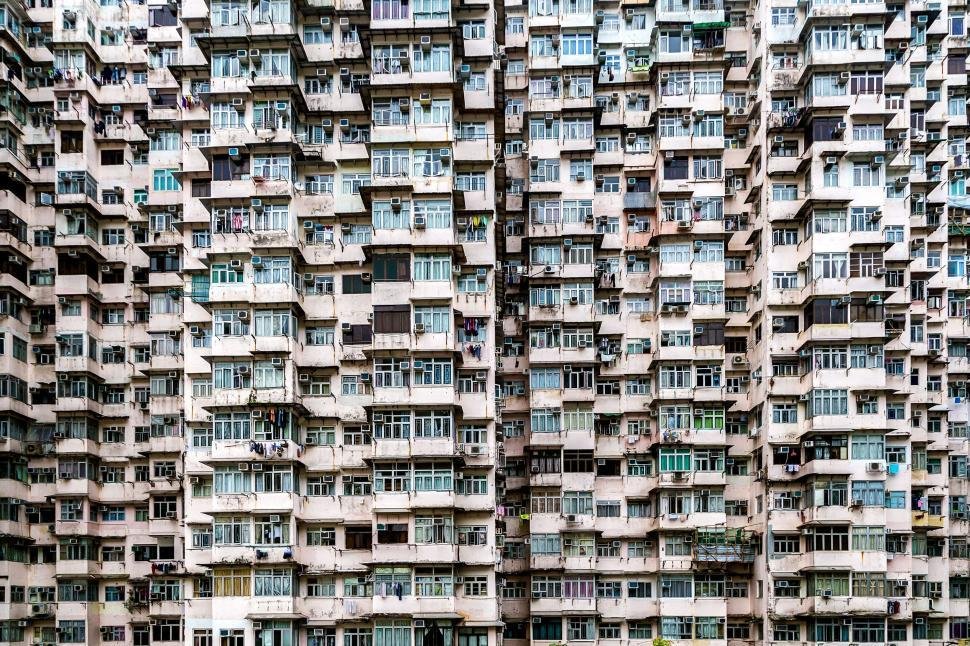

This densely packed residential block in Hong Kong shows the aging and weathered infrastructure that frequents many buildings, reflecting the city's long-standing housing crisis. However, Beijing has neglected these issues in favor of putting resources in achieving their political agenda.
Photo Credit: Brian Sugden
While the government has poured copious amounts of resources into policing ideology through the NSL, many of the city’s most urgent problems, including housing, wealth inequality, and aging infrastructure, remain untouched. The most recent fire at one of Hong Kong’s residential blocks, killing and injuring residents who had lived in unsafe conditions, begs the question: are Beijing’s priorities in the right place? Although China has claimed that the NSL restored stability to Hong Kong, we must question whether that stability comes at the cost of addressing other issues that threaten citizens’ livelihoods. As the smoke rises from another tragedy, it’s worth asking what happens when a government’s priorities shift far away from those of the people it governs.