Curating Memory: International Tourism and Museums
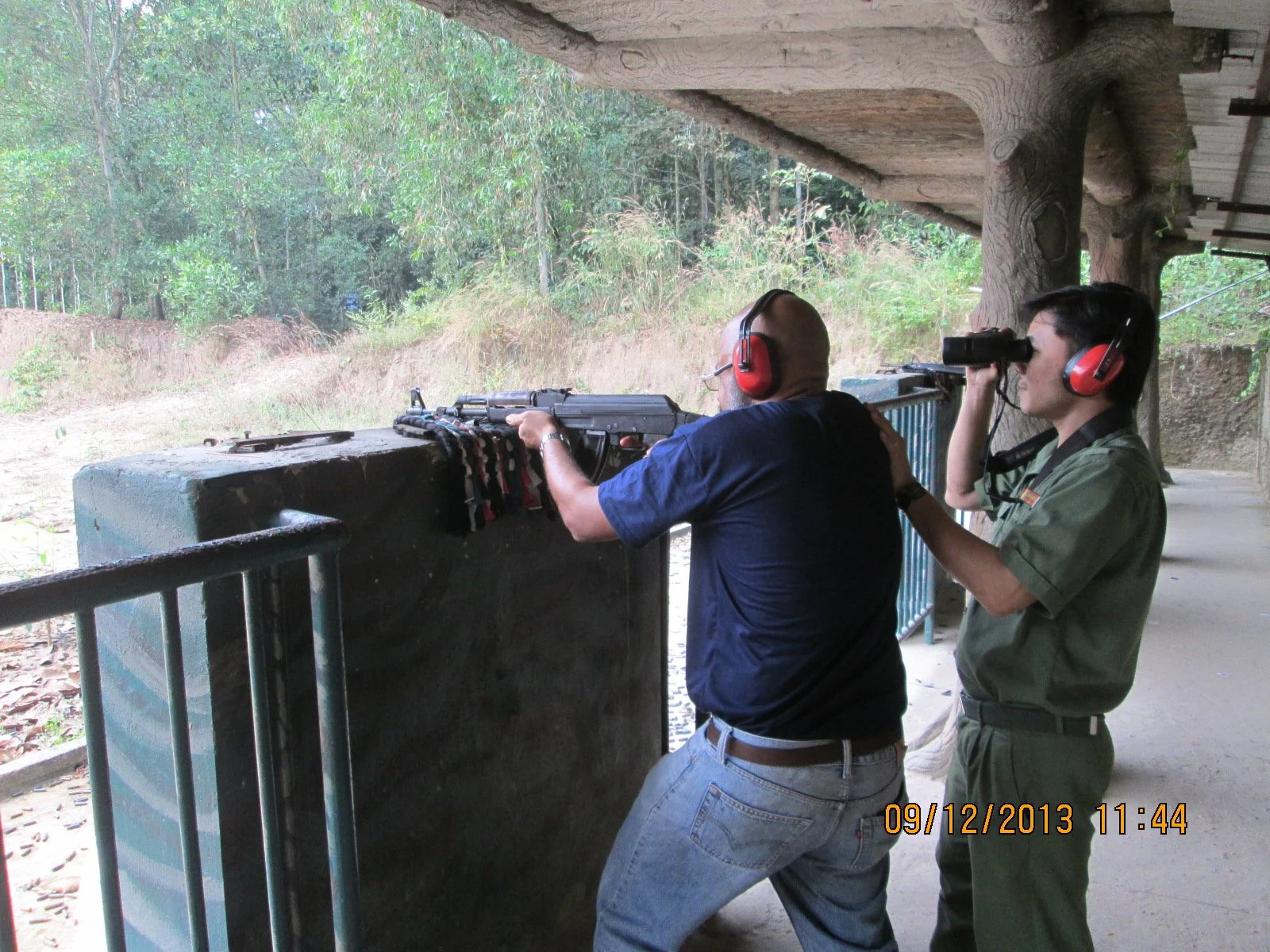
A foreign tourist shoots an AK-47 at a Cu Chi Tunnels shooting range with a Vietnamese guide, typically happening with a tour of the tunnels, which many flock to in order to get the “authentic Vietnam War experience.” This represents a shift in war remembrance in Vietnam–catering to Western tourists.
Photo Credit: Rudolph.A.Furtado
Museums are sites of learning and contemplation, but most of all, they can impart subtle messaging about the cultures and countries they represent. While many might consider a museum to be a neutral space, free from political polarization and bickering, others understand the power it holds in the minds of international visitors who look at its exhibits. Museums promise preservation, but they also practice selection. What a nation chooses to display is rarely accidental.
In March of 2025, United States (U.S.) President Donald Trump signed an executive order deriding the Smithsonian Institution and the National Park Service for promoting “ideological indoctrination and distorted narratives” of American history. The order mandated a review of existing sites and institutions to ensure focus on “the greatness of the achievements and progress of the American people.” Examples of objectionable items and exhibits include: a Statue of Liberty depiction “holding a tomato in her right hand instead of a torch, and a basket of tomatoes in her left hand instead of a tablet,” and the National Museum of African Art’s exhibit of paintings that depicted an “underwater kingdom populated by the children of pregnant women who had been thrown overboard or jumped into the ocean during the Middle Passage.”

This screenshot of an exhibit panel from the National Museum of the American Latino from the White House website is one of the examples given of objectionable material.
Photo Credit: National Museum of the American Latino
While the Smithsonian submitted some historical and conceptual materials for review in September of last year, a December open letter from the White House expressed dissatisfaction with the lack of substantive detail, especially with a large America 250 exhibition in the works to commemorate U.S. history from 1776 to the present. Beyond the U.S., museums have served important roles in preserving and influencing the reproduction of key historical periods — creating spaces where foreign affairs and domestic memory intersect as part of a broader global struggle over who controls public memory.
The U.S. has intervened in many foreign wars, notably the “Hot Wars” during the Cold War. While these events are acknowledged in American public discourse, they typically remain framed in a way that focuses primarily on the American mission to contain communism, the experiences of American soldiers and the domestic anti-war protests and subsequent political divisiveness. Museums in the United States often reinforce these narratives; historical sites abroad perform a similar function.
This contrast becomes clearest in how the Vietnam War is remembered in the U.S. and Vietnam. Museums like the War Remnants Museum in Ho Chi Minh City or the Military History Museum in Hanoi shed light on American and French atrocities, and highlight Vietnamese resilience and victory. As a staff member from the Hanoi museum noted in prominent researcher Christina Schwenkel’s extensive ethnographic study of transnational memory, “You [Americans] don’t have the same history. Who has invaded your country? So we are very proud to have won our wars. And we were right to fight them. That is the difference with the United States. While you have many pictures of death, we celebrate our victory.” Exhibits here depict both the long-term suffering of families from Agent Orange and napalm, and scenes of love and everyday life during wartime — a marked difference from the American emphasis on death and suffering. In doing so, the Vietnamese government can also use these spaces as public education, motivating younger people who grew up after the country’s economic transformation to remember the sacrifices of previous generations.
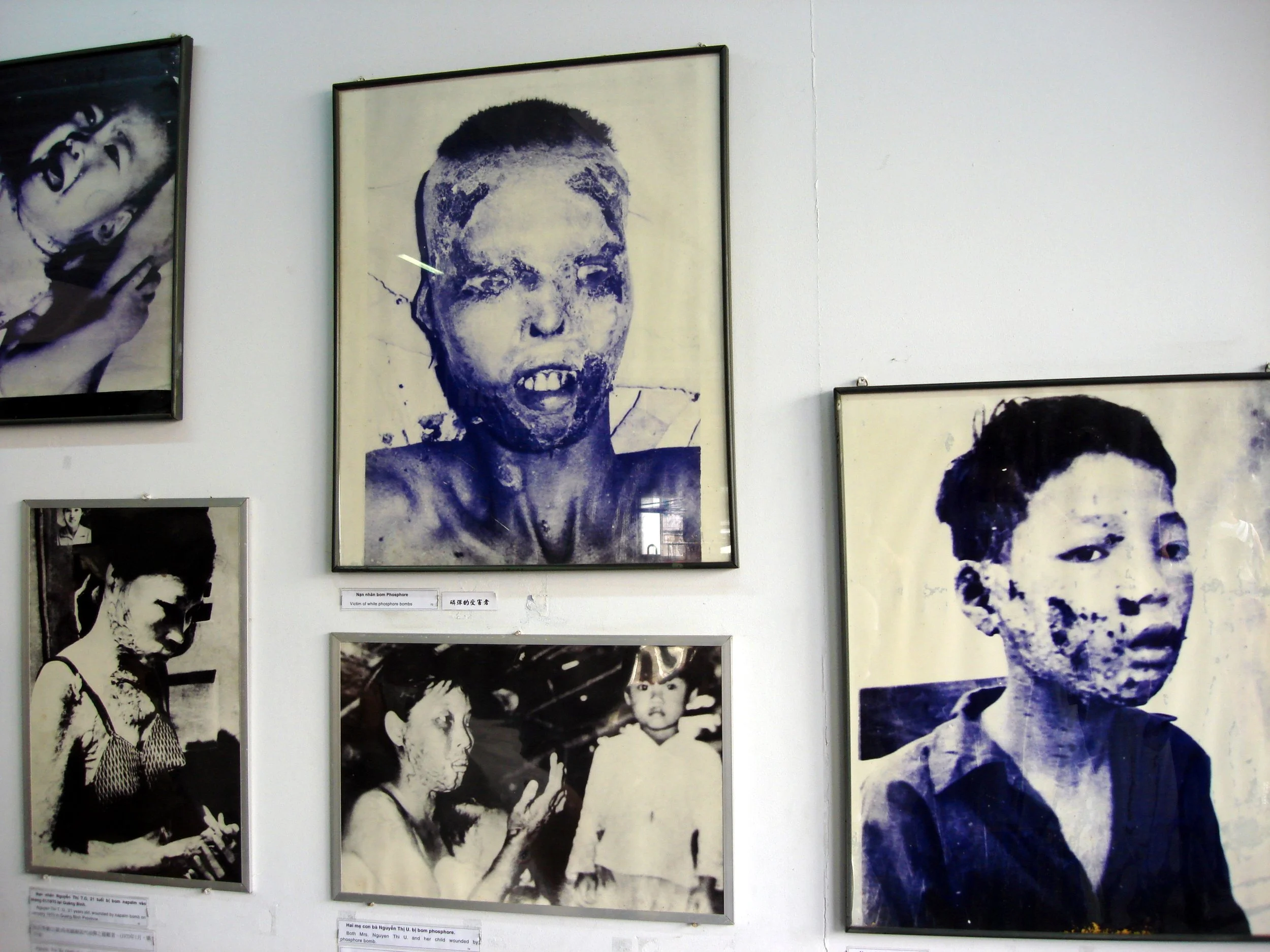

“Vietnamese affected by Agent Orange (and other chemical defoliants), napalm and phosphorus bombs.” These photos are displayed in the War Remnants Museum in Ho Chi Minh City, Vietnam as part of an exhibit that specifically discusses long-term effects of chemical warfare during the Vietnam War.
Photo Credit: Jorge Láscar
However, tourism is becoming a more prominent part of the Vietnamese economy, presenting new challenges for historical sites to appeal to multinational audiences. Following the normalization of US-Vietnam relations in 1995, and then the upgrade to a strategic partnership in 2023, more Americans than ever are visiting Vietnam and its sites regarding the war. The War Remnants Museum, named the “Exhibition House for War Crimes and Aggression” prior to 1995, has drawn criticism from American visitors who see it as communist propaganda and derisive to the experiences of American soldiers who fought in the war. In recent years, the museum has adopted a more reconciliatory tone reflective of its mostly international 10,000 visitors a day. Exhibits now highlight anti-war demonstrations in the U.S. and U.S. Agency for International Development (USAID) efforts to clean up Agent Orange from countryside soil.
Furthermore, tourism is also reshaping pseudo-historical sites. So-called “dark tourism,” or the visiting of sites associated with death, suffering or the macabre, is growing. Southeast Asia in particular is becoming more popular as tourists flock to sites of atrocities and violence, like the Killing Fields and Tuol Sleng Museum in Cambodia, and the Cu Chi Tunnels, used by the Viet Cong, in Vietnam. With the tunnels specifically, guests are invited to experience pseudo-violence, rather than think beyond it. A typical tour includes an English-speaking guide and the opportunity to shoot era-accurate guns at targets, while eating lunch or chatting with friends. The shift towards a commodification and normalization of conflict alongside leisure, especially packaged for a Western tourist who wants to see the “authentic” guerilla experience, raises questions about how these types of attractions “educate” tourists in ways outside of state-sanctioned spaces.
While museums present themselves as guardians of the past, content to not explicitly interact with the present, they are still an integral part of the shaping of collective memory — editing the past into a vision for the future. The current politics surrounding institutions like the Smithsonian reveal that the struggle over historical narrative is hardly confined to any one country, but rather an issue shared by many across the globe.