Can Centrism Make a Comeback? A Dutch Analysis
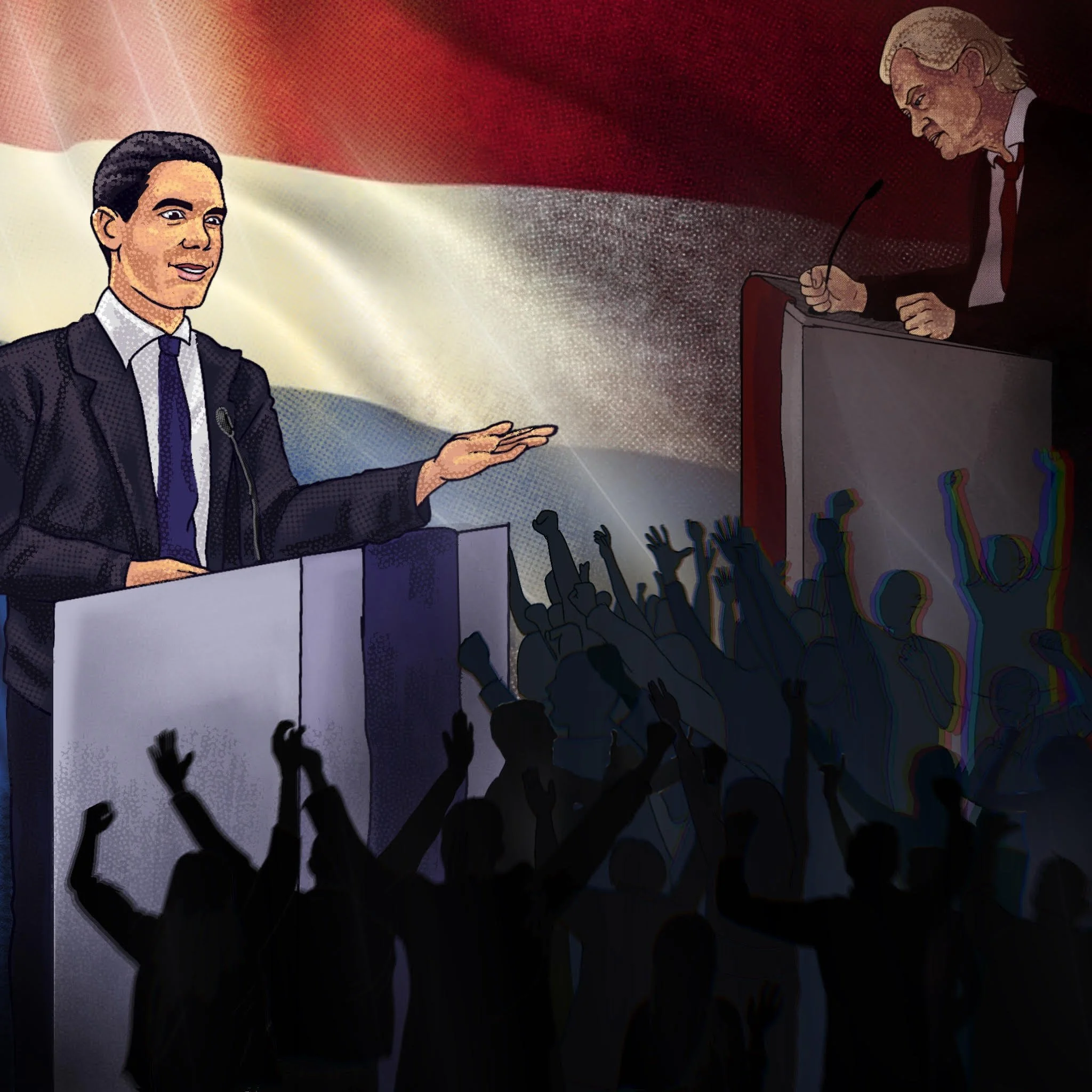
Does Dutch D66 leader Rob Jetten (left) have the formula needed to steer Europe away from far-right populists like Geert Wilders (right)?
Art by Illustrator Aava Ghorbanian
Technocratic political parties often have technocratic leaders. Rob Jetten, leader of the Dutch Democrats 66 (colloquially known as the D66), is no exception. In a political debate, GreenLeft-Labour leader Frans Timmermans was quick to frame Jetten as burdened with an “accountant mentality.” The Dutch media once labeled the D66 leader “Robot Jetten.”
Yet, during a tumultuous two years of right-wing populist government led by the PVV (Party for Freedom), Jetten was able to revitalize his image. While he did land the job as prime minister by portraying himself as a safe pair of hands, he also broadened his appeal by replacing his stodgy image for one more energetic. It is a marked contrast from fellow centrist European leaders; many of whom have come across as rather gray and inert figures.
Campaigning on an optimistic slogan, het kan wél (directly translated to it is possible), Jetten and his D66 are a convincing force. Safe, empirical government provides stability during a time of immense global change, while smooth communications help the government show its progress on policy issues. Jetten’s magnetic leadership then smothers the largest trump card of most radical parties: charisma.
Jetten and the D66 seem to have cracked an elusive code that has beleaguered his European colleagues. Or has he?
Populist Trends in Europe
The latest edition of the PopuList, a dataset that aggregates support for populist parties, states that the vote share for populist parties as a whole, regardless of their position on the left–right ideological continuum, was 32% in 2022. This is a 10% shift from the vote share of populist parties in the 1990s, where 12% was the high watermark.
PopuList uses a definition of populism created by academic Cas Mudde. Mudde presents populism as a binary between the “pure people” and the “corrupt elite” without the deep ideological convictions of other political philosophies, such as liberalism or socialism. Instead, populist ideology latches onto selected concepts that are resonant to the “pure” in their pursuit against the interests of the “elite.”
In the context of Geert Wilders and his party, the “pure” were the Dutch people allegedly displaced by immigrants and radical Islamists. And, it was the political “elite” in The Hague and Brussels who were responsible for this displacement.
Wilders was selling the Dutch electorate a populist ideology fueled by nativism. Splitting from the legacy conservative-liberal VVD, the People’s Party for Freedom and Democracy, to form the PVV in 2006, Wilders slowly sold his anti-Islamic views to voters, gradually raising the PVV’s seat and vote share each election. Seventeen years later, Wilders finally penetrated the all-powerful VVD of Mark Rutte. Populist, nativist ideology left the fringes and was about to enter government.
A Year of Government Tumult
Coalition governments are almost inevitable in the Netherlands. It is common for three to four parties to ink deals in the pursuit of power. Although Wilders and the PVV managed an impressive result at the 2023 election, finding willing and ideologically congruent partners for government was a daunting challenge. Cobbling together an eccentric group of parties, consisting of the VVD, the right-wing agrarian Farmer-Citizen Movement (BBB) and a new centrist party called New Social Contract (NSC), governing was in reach, but sans Wilders as prime minister.
Neither Wilders nor any of the other governing party leaders could become prime minister under the coalition agreement. In a first for Dutch politics, an outsider was installed, former spy chief Dick Schoof. Fittingly for such an anti-establishment government, Schoof was a former member of the Labour Party, who later lapsed his membership after no longer associating with the party’s views.
After a tumultuous coalition formation, problems began to pour in for this right-wing, ex-spy chief led government. Members of the NSC began to resign on issues ranging from financial disclosures to discomfort over racist comments made by cabinet. Then, Wilders himself pulled the plug.
Immigration, the central cause during Wilders’ political career, proved to be his downfall. His patchwork coalition refused to sign onto the 10-point immigration plan central to the PVV’s election win. Incapable of compromise, Wilders saw no other option but to leave a government that barely lasted a year.
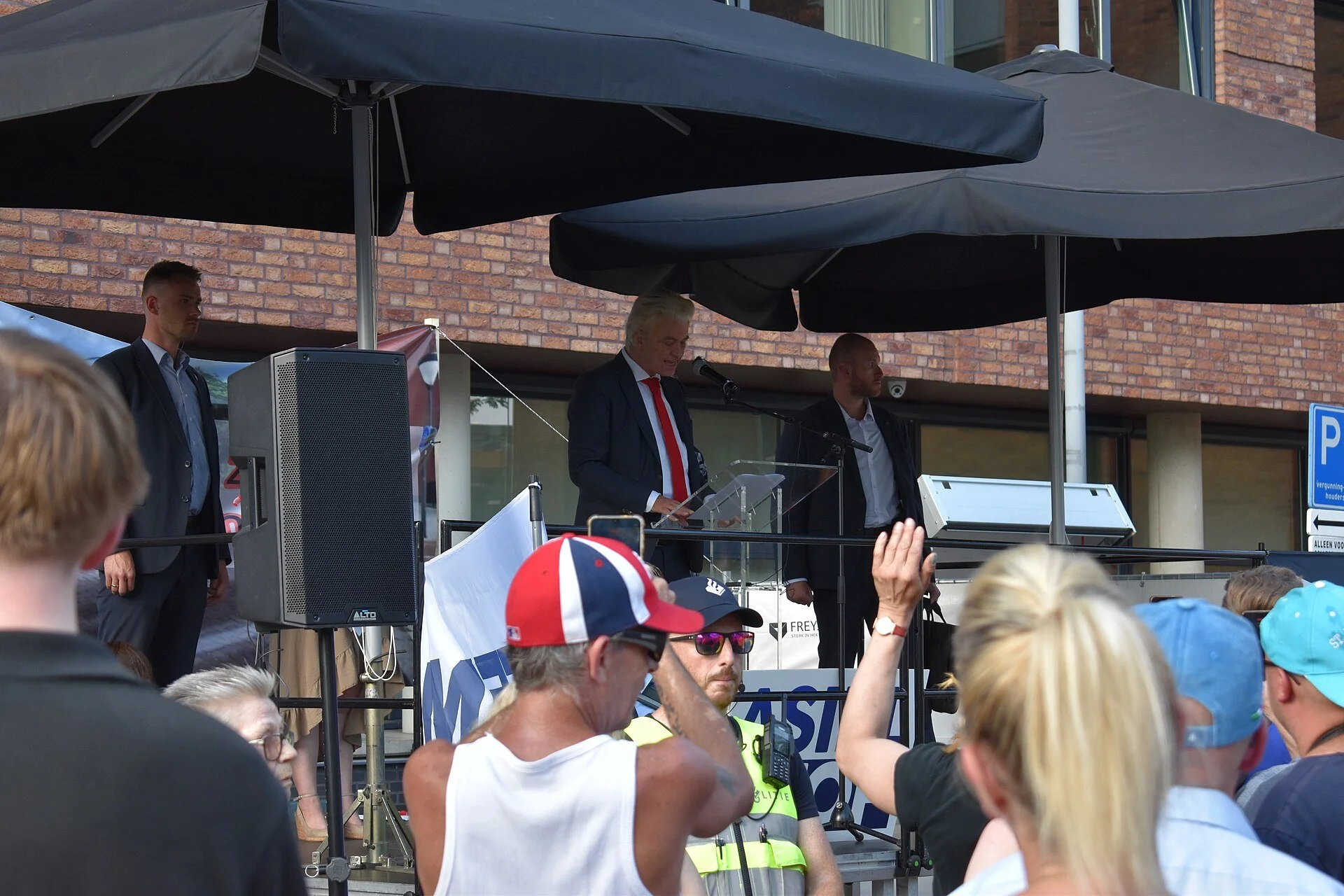
A month after his government collapsed in June of 2025, Geert Wilders continued his anti-immigration crusade, including this demonstration against an asylum center in the Dutch city of Helmond.
Photo Credit: S. Perquin
_(3).jpg)
A Centrist Revival
The Oct. 29 election saw a revitalization of the political center. Once dominant parties, such as the Christian Democratic Appeal (CDA), rose back to relevance. But, the most notable victor was the D66, led by Rob Jetten, tipped to be the youngest and first openly gay Dutch prime minister. Netting 17 seats, the party ended with its best result ever. It was a major reversal in fortune; Jetten and his party only won nine seats in the previous election.
Despite a chaotic and short-lived PVV-led, Schoof-run coalition, Wilders and Jetten ended with an identical seat share. The D66 only eclipsed the PVV as the largest party because they had a marginally higher share of the vote.
Even if the inverse were true, the likelihood that the PVV would have another crack to form a coalition would be slim. Fresh memories of a particularly unproductive legislative session were in the minds of other party leaders. Thus, there would only be a natural aversion towards anything Wilders or PVV.
The vanquishment of Wilders and the subsequent rise of Jetten is reflective of the Dutch electoral system and its emphasis on coalition building. With the composition of political parties after the 2023 election, it was always going to be an uphill challenge for Wilders to form a stable, ideologically congruent coalition. Differently, for Jetten, there were infinitely more deals to be made. As a center-left political party, the D66 could partner with other centrist political forces; hence why they formed a coalition with two center-right forces, the VVD and CDA.
Wilders and the PVV would only regain the upper-hand if the Dutch political landscape becomes awash with right-wing parties, which is unlikely with a proportional electoral system. Thus, there is a case to be made that the Dutch electoral system has delivered for centrist parties, especially if they adopt a cordon sanitaire, an imposed political isolation, against the PVV.
Centrist Adaptation to a New Media Ecosystem
Jetten and Wilders use social media as a tool to achieve different objectives. For the D66 leader, social media was first and foremost meant to polish an otherwise stodgy image, later pivoting towards hammering down hope as a campaign message. The PVV leader has used social media as a way to plaster anti-immigration and anti-Islam messaging, while maintaining everyman Dutchman bonafides. Suffice it to say, social media takes divergent paths with the two leaders.
Of the two men, Wilders may have the online advantage. To maximize profits, social media companies prioritize the most controversial and anger-inducing content in order to keep the clicks flowing. Wilders is controversial, and to some, anger-inducing, making him a perfect subject for the money-making objectives of social media executives. The PVV leader is further aided by an increasingly right-wing and libertarian echelon of tech CEOs; for instance, he and Elon Musk are on good terms.
Through social media’s decentralization of political communications, Wilders has benefited by coming across as authentic for tackling the immigration issue in a way true to his own beliefs. It plays to his advantage as it marks a contrast between him and a political elite that has struggled with delivering effective policy and communications towards Wilders’ strongest issue.
Rob Jetten has less of an advantage. He is the political elite — especially when he is advocating for enlargement of the Dutch House of Representatives and proliferation of libraries in neighborhoods. However, optimism goes a long way, and the D66 leader has effectively shed his robot image for one more suave. Jetten captured the public’s eye with his het kan wél slogan and even his advancement to the finals of the Dutch trivia game show “The Smartest Person.” Perhaps so did his romance with Argentinian field hockey player Nicolas Keenan, drawing comparisons to the recent hit show Heated Rivalry.
Although immigration was buried at page seven of the election program, Jetten may have benefited by shifting to the right on immigration. Under his leadership, the D66 has hardened its policies on asylum claims, calling for the process to occur outside the EU. This stance is elucidated by the Overton window model, which explains how public perception influences policy choices. For parties of the left and center, the Overton window has slid in favor towards the right on immigration, and the feeling of crisis has only been compounded by the sensationalization of social media. Thus, electorally, this rightward shift makes sense.
However, for Mudde, whose definition of populism is used in the PopuList database, it is alarming to see the willingness of other parties to change their principles to stave off the populist-right. Although not the only party he mentions, Mudde incriminates the D66’s rightward shift on immigration as “normalis[ing] and rationalis[ing] the far right.”
Can the Progress of the D66 Be Sustained?
The new Dutch government is set to be inaugurated shortly. The D66 leader, Rob Jetten, will become prime minister, while his VVD counterpart, Dilan Yesilgoz, will hold both the role of deputy prime minister and minister of defense. Interestingly, the third coalition leader, Henri Botenbal, has not entered cabinet — although, other members of his party have.
This D66-VVD-CDA coalition rounds the corner of an experiment held two years ago where the Dutch electorate dabbled in right-wing, nativist populism. Dutch political institutions, both formal and informal, have prevented the PVV-led, Schoof-run coalition from doing major damage. But, as Mudde opines, the populist-right still wields power by pressuring centrist parties to take more hardline positions.
So has centrism made a comeback? In the case of the Netherlands, Rob Jetten and the D66 are an inspiring force, but only time and success in government will determine whether they have the miracle drug that so many centrist parties need across Europe.