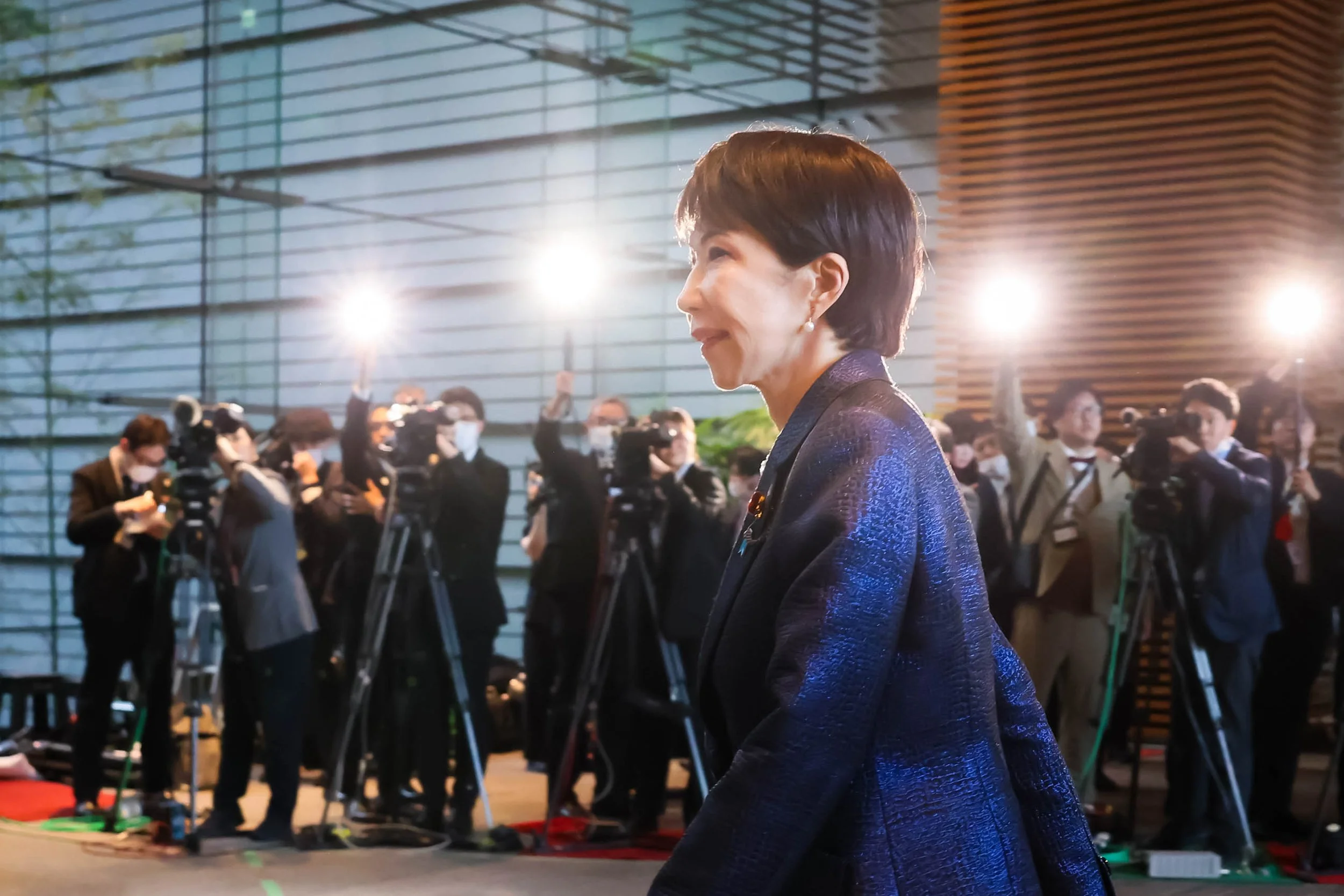
Caption: Prime Minister Sanae Takaichi enters the Prime Minister’s official residence. This follows the LDP landslide victory in Japan’s snap elections and formation of the Second Takaichi Cabinet.
Photo Credit: Prime Minister’s Office of Japan
On February 8, Japan concluded a historical series of snap elections. By unexpectedly dissolving the House of Representatives, the lower house in Japan’s legislative branch, voters took to the polls to cast their ballots for a new government. This was a calculated move initiated by the first female Japanese Prime Minister in history, Sanae Takaichi, to reassert the Liberal Democratic Party's (LDP) authority after the party’s slump in recent polling. The plan succeeded overwhelmingly, with the LDP seizing a supermajority of 316 seats in the House of Representatives, Japan’s lower house.
The significance of this LDP victory allows Takaichi to enact her conservative agenda to an unprecedented degree, as a strengthened LDP can pass legislation through the house with minimal pushback. Her agenda includes increasing defense spending, instituting “responsible fiscal expansion,” keeping interest rates low and resolving the domestic demographic crisis brought on by the years of postwar prosperity and the ensuing Lost Decades.
Showa Reign, Post WWII-Era Reconstruction
Following World War II, Japan was left economically crippled and demographically shattered. Most of the nation’s industrial capacity was rendered non-functional due to constant firebombing from the United States (U.S.). Population-wise, around 4%of Japan’s pre-war population was killed during the war. Such losses made it rational for the transitional government to accept the MacArthur Constitution.
This transformed Japan’s government to fulfill a Western model, similar to the U.S.’s government structure. The Constitution highlighted the transition of executive power from the Emperor to the people, implementation of a bicameral legislature, and creation of an independent judicial branch. This Constitution’s defining clause, Article 9, renounces war and embraces pacifism. Essentially, the postwar constitution created the foundation for Japan’s western alignment and style of government.
However, due to American concerns about the spread of communism, Japan was let off easier than the other Axis nations. Following tensions in Europe over Germany and the Korean War, Japan was propped up as the U.S.’s bulwark in Asia against communist China, North Korea and the Soviet Union. This influenced Japan’s politics in the following decades, as the nation balanced pacifism with military rearmament under Article 9.
LDP Formation and Dominance
As a result, Japanese conservative politics flourished, culminating in the formation of the LDP in 1955 as a merger of two mainstream conservative parties. With this new dominant force in politics, Japan experienced an incredible economic miracle as the LDP was able to push its agenda without much backlash. LDP leaders created an export-based economy with low tariffs and taxes, influenced heavily by the government through the Iron Triangle, a relationship between business conglomerates, bureaucrats, and the government.
LDP policies were extraordinarily effective for the Japanese economy, averaging 10% GDP growth from 1950 to 1973 before slowing to 3.2% GDP growth from 1973 onwards. This slowdown was due to a global oil crisis sparked by the Yom Kippur War. In an attempt to return the economy to pre-crisis growth, the LDP enacted economic expansion plans through extremely low interest rates and reckless bank lending, ultimately creating an economic bubble that would burst in 1990, ushering in the Lost Decades.
Lost Decades and Ensuing Instability
Japan’s economy would stagnate following the bubble’s burst. GDP growth averaged around 1% annually, lagging behind many other developed economies. The government hesitated to address the banking crisis until it adopted a poorly executed strategy involving heavy stimulus that ballooned the national debt in 2008. The government also continued to support failing banks—actions taken too late to stop the economic downturn. Japanese negligence in solving the banking crisis would sustain this economic downturn, as the government continued to support banks that should have either recapitalized or declared bankruptcy. By the time Japan restructured its banking system, the damage had been done. A large chunk of the economy was now made up of non-performing companies, a scar left by the failed banking system.
With an unstable economy, social instability followed. An entire generation of young working people, disheartened by the effects of the Lost Decades, has become one of Japan’s poorest demographics. As a result, this group has higher rates of social withdrawal, contributing to the ever-declining Japanese birth rate and demographic crisis.
In the political scene, the LDP had to undergo rapid brand shifts. As the power in charge during the bubble’s burst, liberal and left-wing parties took the ruling seat in the government, resulting in the LDP not being the leading party for the first time since the party’s conception. When they reasserted themselves as the dominant force within Japanese politics, the party’s leadership underwent a nationalist, right-wing and populist rebrand to win back their dissatisfied voter base. Additionally, they broke their traditional patronage network of the Iron Triangle, changing their economic policiesmultiple times before arriving at contemporary “Abenomics,” a blend of Keynesian spending and supply-side structural reform introduced by former Prime Minister Shinzo Abe’s second cabinet.
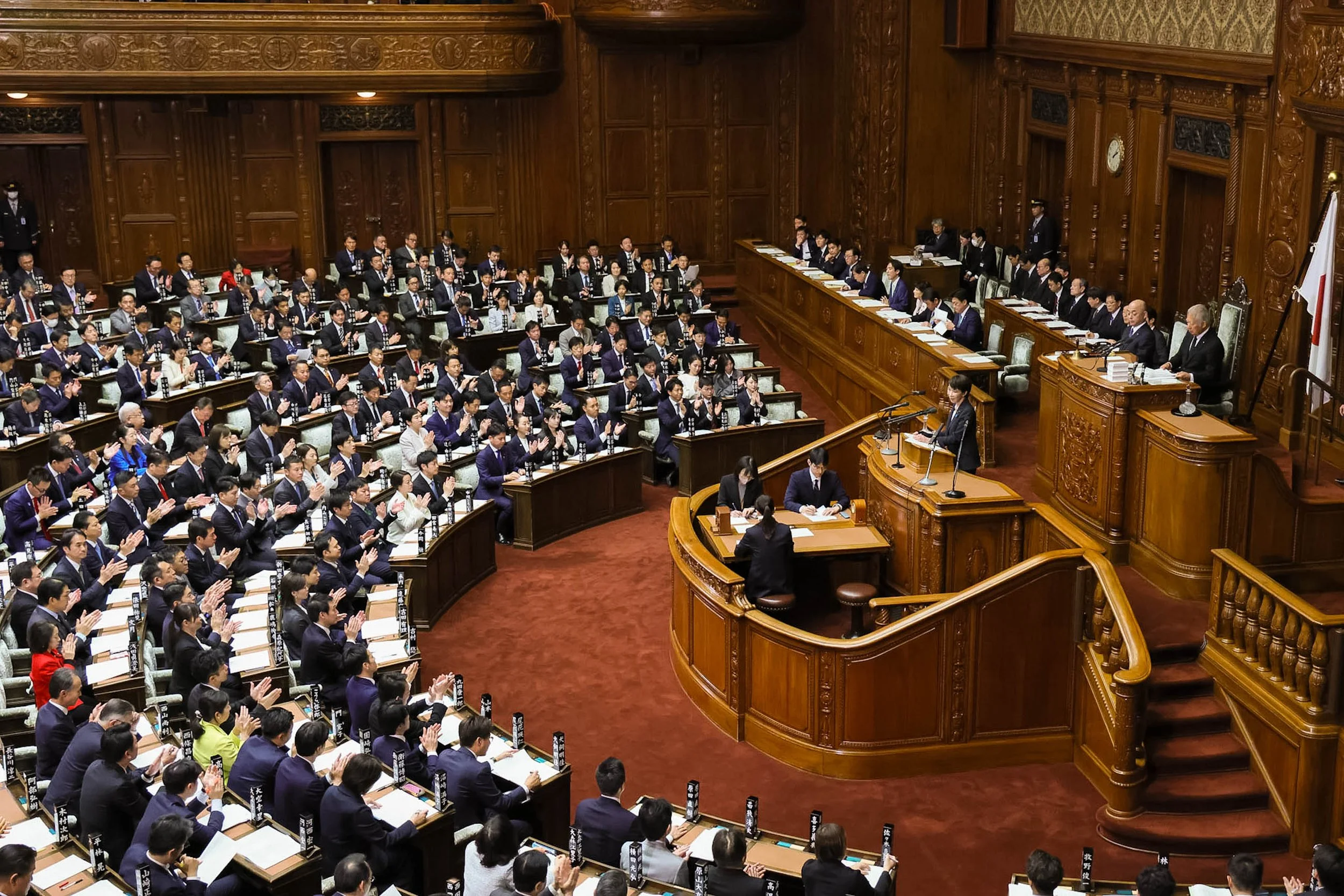
Caption: Takaichi delivers her policy speech to the House of Representatives.
Photo Credit: Prime Minister’s Office of Japan
Takaichi’s Policy
Takaichi’s current policies heavily reflect the LDP’s brand shift. As a protégé of Shinzo Abe, who was considered “Japan’s Donald Trump,” her social media branding appealed to young voters who sought a modern Japanese revival. Her economic policies of fiscal expansion and growth through government spending, reduced taxes and increased military spending are influenced by Abenomics. Takaichi’s social policies emphasize anti-immigrant, pro-natalist and financial child-bearing incentives to revitalize Japanese culture and address the demographic crisis.
In foreign policy, Takaichi seeks to increase Japan’s role in regional politics. Her manifesto includes revising Article 9 in Japan’s post-war constitution and increasing military spending. This bravado is directed towards countering Chinese coercion in Asia and Oceania, following and accelerating Shinzo Abe’s vision of a “free and open Indo-Pacific” with Japan as a key player.
End of the Lost Decades?
After decades of economic downturn and political paralysis, 2026’s snap elections give Japan the greatest opportunity to end their Lost Decades. With a prime minister dedicated to a hardline vision for rejuvenating Japan and a supermajority in the House of Representatives, it will be easier than ever for Takaichi and the LDP to drag Japan out of stagnation and back onto the global stage.
Japan may be able to regain its footing with rediscovered political stability, but the Takaichi administration still has challenges it needs to resolve. Takaichi’s aggressive spending and cutting proposals could worsen inflation rather than stimulate growth, driving the nation deeper into the rabbit hole. Externally, hardline defense and immigration policy will shrink Japan’s labor force and access to rare earth minerals needed to fuel its advanced economy.
While Japan may now have a clear vision under Takaichi, the road to recovery is filled with uncertainties and challenges. Takaichi’s success may see Japan ensure stability internally and across the Indo-Pacific, while her failure may see Japan become less relevant in global politics as China becomes the predominant power in the Indo-Pacific, subjecting the nation to become more reliant on its alliance with the U.S.