India’s Goldilocks Moment: Becoming a Global Power in a Post-Trump Trade Landscape
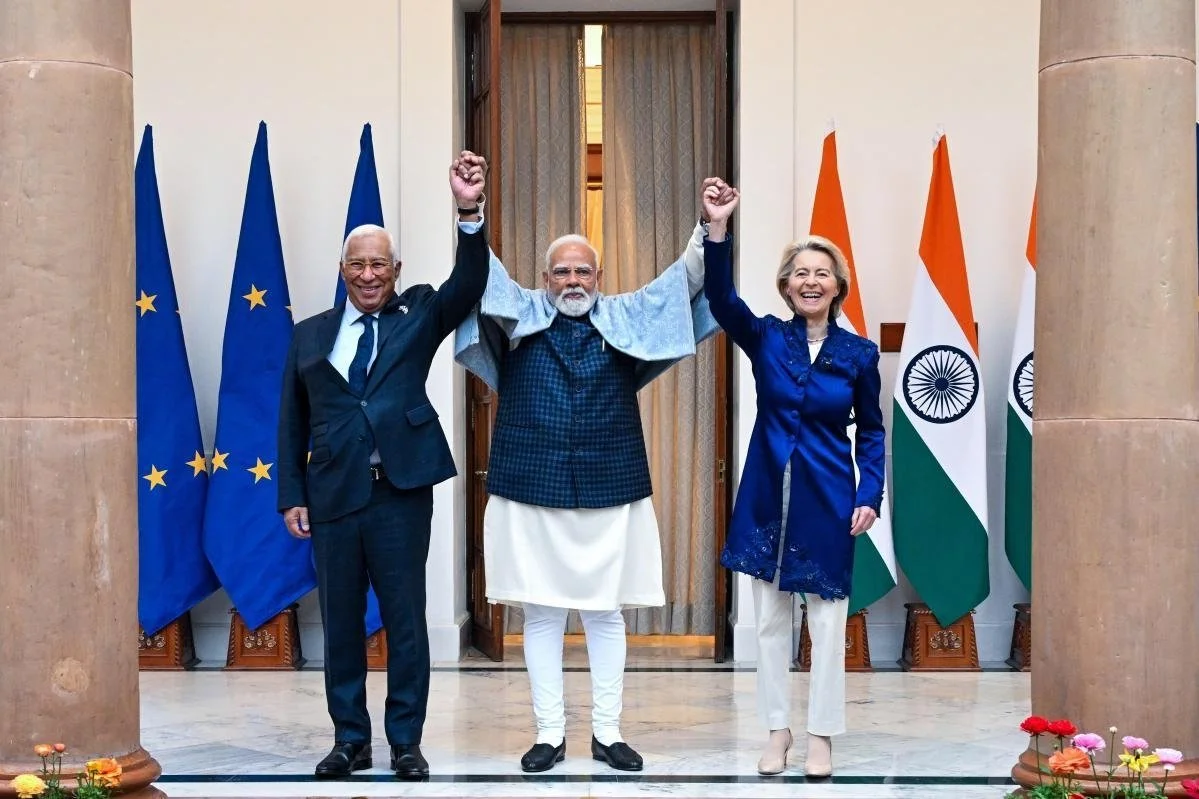
Indian Prime Minister Narendra Modi (center) with European Council President António Costa (left) and European Commission President Urusla von der Leyen (right) celebrating their recently finalized Free Trade Agreement, which establishes the largest free trade zone in the world.
Image Credit: European Union
India, the world’s recently-crowned fastest-growing major economy, is stepping up.
After nearly two decades of intermittent negotiations, India finalized a historic free trade deal with the EU in late January — “the mother of all deals,” according to European Commission President Urula von der Leyen. The long-awaited partnership establishes the largest free trade zone in the world, reducing tariffs by over 95% on both sides. The two entities jointly account for nearly 25% of both the world’s population and GDP, and one-third of global trade.
In addition to the EU deal, New Delhi finalized an agreement with New Zealand that is expected to double bilateral trade output to $5 billion in the next few years. Virtually eliminating tariffs on both sides, the deal also includes a promise that New Zealand will invest $20 billion in the Indian economy. Auckland has hailed the agreement as a “once-in-a-generation” opportunity — and it is, for a nation as historically protectionist as India.
These deals are just two examples of a total about-face in New Delhi’s trade outlook. In the past year alone, India has drastically diversified its trade footprint. The nation has concluded talks for at least eight free trade agreements (FTAs) encompassing 37 developed economies, and six more in active negotiations. For instance, New Delhi recently finalized an “enhanced comprehensive strategic partnership” with Vietnam that sets a staggering trade target of $25 billion by 2030, and another FTA with the United Kingdom that projects a $34 billion increase in bilateral trade by 2041.
For a country as precedently protectionist as India, this level of trade openness is revolutionary. However, if India wants to meet its goal of becoming a fully developed nation by 2047 under its Viksit Bharat (Developed India) initiative, an increased trade footprint is absolutely imperative.
Ditching “Make in India”
India has historically maintained some of the highest trade barriers across emerging market economies since its independence in 1947. The License Raj system of regulation aimed to prop up nascent Indian industries against established foreign competitors, completely insulating India’s economy from foreign involvement. Astronomically high import duties and tariffs — typically well over 100% — sought to reinforce India’s burgeoning industrialization efforts. However, this isolationism proved largely counterproductive; the resulting overvaluation of the rupee rendered Indian goods uncompetitive on the global market, and the nation’s economic growth stagnated at around 4% by the early 1990s.
A severe currency crisis in the 1990s, owing largely to the nation’s heavily restricted market, brought on a wave of liberalization efforts that catapulted India into the global economy. Extensive trade reforms dismantled the License Raj, devalued the rupee and privatized state-controlled industries, pushing India from the brink of severe crisis to a globally competitive economy.
When the Bharatiya Janata Party (BJP) party ascended to power in 2014, these liberalization programs were reversed. Prime Minister Narendra Modi introduced his “Make in India” initiative, which pushed India back onto a protectionist track, raising tariffs on over 3,500 products in an effort to strengthen domestic manufacturing. India’s average tariff rate has nearly doubled over the past decade, with a trade-weighted average tariff rate of 12% in 2024 compared to 6.48% in 2014. New Delhi also increased its use of Quality Control Orders (QCOs), which mandate that both domestic and foreign producers must meet certain quality standards to manufacture or sell goods on the market. QCOs act as non-tariff barriers, restricting or otherwise delaying the flow of foreign goods, reflecting India’s hopes to sustain itself on domestic demand alone.
However, Make in India was unable to deliver on Modi’s promises; manufacturing has decreased from 16% to 13% of India’s GDP since his rise to power, far below fellow developing economies. Likewise, employment in the manufacturing industry has plummeted, which is striking for a country with the world’s largest working-age population.
If Modi wants to reach the ambitious GDP targets outlined in Viksit Bharat — between $30 to $40 trillion, almost 10 times the nation’s current GDP of $4.15 trillion — Make In India, and Modi’s staunch commitment to protectionism, won’t cut it. India’s entry to the world of free trade is essential to realizing its development goals.
The Iran War & New Setbacks
Despite minimal opening to the global market, India remains the world’s fastest-growing major economy, with growth up to 7.6% from 2025. However, the ongoing Iran War may hinder India’s economic momentum; the World Bank projects growth to fall to 6.6% in the next year amid rising inflationary pressures.
India’s retail inflation rate hit its highest in over a year at 3.48% in April. Though it remains under the Reserve Bank of India’s 4% target, continued supply disruptions suggest the beginnings of a global recession that could upend that trend, according to the International Monetary Fund.
India has felt this tumult most acutely, with its heavy reliance on Gulf energy. The broader Middle East accounts for 55% of India’s crude oil imports — almost all of which pass through the Strait of Hormuz — and 17% of its total exports. Additionally, India is the world’s second-largest importer of liquid petroleum gas – 90% of which comes from the Gulf – and the fourth-largest of liquid natural gas. As the Strait of Hormuz enters its third month of effective closure, running at just 10% of its pre-war activity levels, Indian supply chains have been devastated.
The war doesn’t just raise Indian energy concerns. Nearly 40% of the country’s remittances come from the Gulf, where some 10 million Indians live and work, supplying $125 billion to the economy each year. Remittance income, especially in high quantities from the Gulf, is vital to cutting India’s merchandise trade deficit. With most of the Indian Gulf diaspora employed in industries vulnerable to the war — oil services, retail, construction and hospitality, among others — India risks losing a source of purchasing power absolutely critical to its economic stability and continued growth.
Global Trade After Trump: India’s Goldilocks Moment
As India grapples with its internal growth, United States (U.S.) trade policy is providing the nation with ample room to assert itself externally and work toward its long-held goal of becoming a great power.
U.S. President Donald Trump’s expansive “America First” tariff regime — which has changed more than 50 times since the beginning of his second term — has alienated allies and adversaries alike. A Gallup poll for 2025 saw global disapproval of U.S. leadership soar to a record-high 48%, and the Trump administration’s approval rating fall to 31%. Comparably, China’s disapproval rating stagnated around 37%, and its approval rating surpassed the U.S.’, at 36%. This came in the same year that the U.S.’ actual average effective tariff rate hit 7.7%, its highest since 1947 and over three times its rate in 2024.
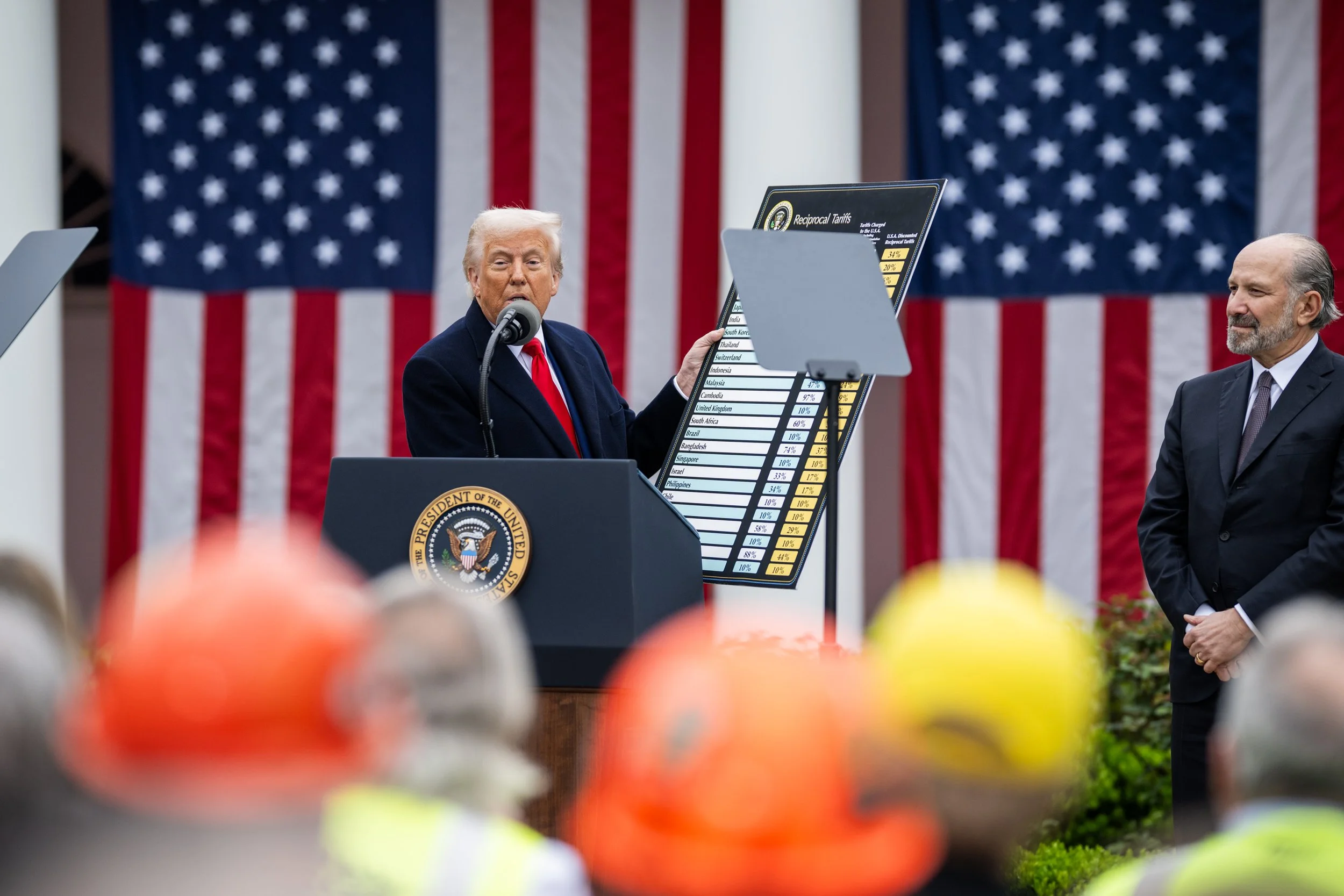
U.S. President Donald Trump announces his “Liberation Day” tariffs on April 2, 2025, levying a global “reciprocal” tariff on all of the U.S.’ trading partners. The Supreme Court recently ruled Trump’s 10% minimum global tariff illegal under the International Emergency Economic Power Act (IEEPA). Trump has since launched trade investigations into over 15 economies, including India, ostensibly to replace the IEEPA tariffs.
Image Credit: The White House
Trump’s policy is shifting the locus of global trade. No longer willing to bow down to an increasingly mercurial U.S., countries are attempting to reduce their economic reliance on the U.S. through diversification. India is just one example of that shift; Canada and China struck a trade deal in early January, and China has eliminated tariffs on all African countries but Eswatini, which retains affiliation with Taiwan. Additionally, the EU and four MERCOSUR countries — Brazil, Argentina, Paraguay and Uruguay — provisionally adopted a partnership agreement this month that removes tariffs on 91% of exports between the two entities. MERCOSUR, or the Southern Common Market, a trade bloc that encompasses most of South America, is also active in trade talks with Canada. Ultimately, U.S. economic leverage is waning, and with it, their ability to unilaterally decide the terms of trade.
According to Boston Consulting Group, the U.S. share of world trade is expected to plummet to 9% by 2034, compared to 12% in 2024. Conversely, the BRICS+ share, of which India is part, is forecast to rise to 10% by 2034, up from 9% in 2024. BRICS+, the Global South trade bloc seeking to establish itself as a counter to Western dominance in global institutions, comprises 11 countries and counting. As the world realigns — or re-globalizes — without the U.S., India is in a prime position to step up.
With more than 1.4 billion people, India is the world’s most populous country. Those 1.4 billion people are, on average, getting wealthier, creating an influx of domestic demand and attracting foreign investors. In 2025, the World Bank reported that India has lifted 171 million people out of extreme poverty over the last decade. The middle class is the fastest-growing segment of its population, growing at 6.3% per year, currently comprising 400 to 500 million people. With this radical growth comes equally radical increases in consumption; household consumption rose between 7.5% and 7.8% over the last year, and gross consumer spending is projected to nearly triple over the next decade. The middle class will drive over half of that consumption.
India’s decades-long quest to position itself as the leader of the Global South may finally be bearing fruits. India reached the 40-point threshold for “Major Power” status in the Lowy Institute’s 2025 Asia Power Index (API), ranking third behind China and the U.S., which the API ranks as “superpowers.” Notably, India also surpassed China to become the second-largest attractor of inward investment; foreign actors are already capitalizing on India’s wealth of potential.
However, the API report did find that India underperformed relative to its host of available resources, with India’s Power Gap score widening to its largest-ever deficit of 4.0 points. This is glaringly evident in India’s historic underutilization of its labor force and consistent underspending of public funds. If India wants to reach its development goals, external changes must be accompanied by internal systemic reforms. No amount of FTAs and “strategic partnerships” can change the fundamentally protectionist principles on which India’s governance is predicated.
The question is not whether India has the capacity to develop; New Delhi has proven that it has the means and methods to assert itself as a leading global power. In a global landscape looking further and further from the U.S., it is a question of whether India has the will to fulfill its “Bold Vision, Brighter Future” for a Viksit Bharat.