Nuclear-powered submarines for seoul: The developing relationship between the United states and south korea
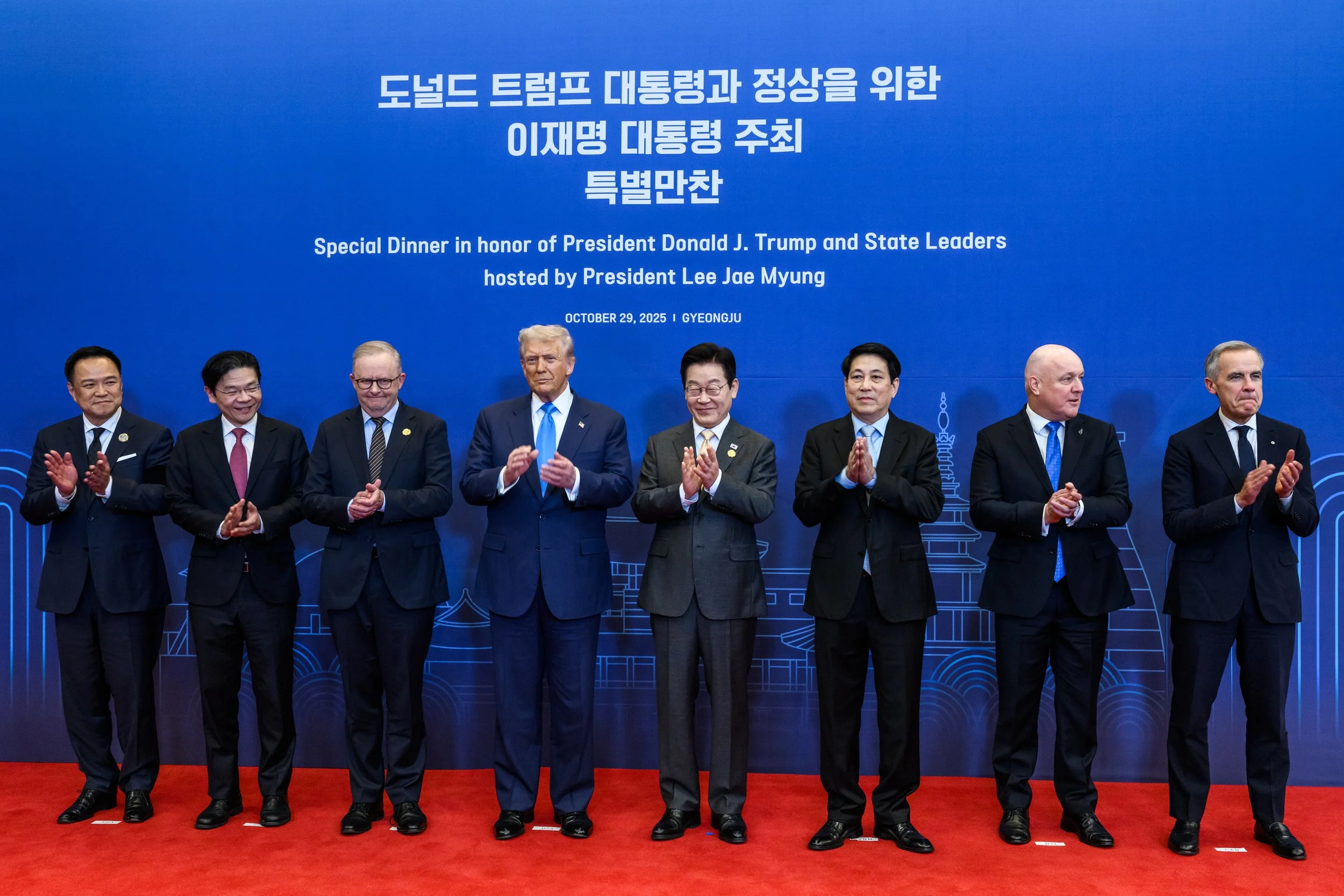
South Korean President Lee Jae Myung hosted a dinner honoring United States President Donald Trump in Gyeongju South Korea on October 29, 2025.
Photo Credit: Official White House Photo by Molly Riley
On October 30, 2025, United States (U.S.) President Donald Trump announced he had approved plans to share technology with the Republic of Korea (ROK), also known as South Korea, that will allow them to build their own nuclear-powered submarine. The U.S. giving access to this tightly controlled technology is a sign of the ROK’s increasing leverage in their relationship. The U.S has only shared this technology with two other countries, the United Kingdom (U.K.) and Australia, making the news a striking development in the ROK-U.S. relationship.
The announcement came one day after Trump and South Korean President Lee Jae Myung finalized a trade deal. The ROK promised $150 billion in investments in the U.S. shipbuilding sector and $200 billion into “bilateral science and technology collaboration,” including AI, quantum computing and other technologies. In return, the U.S. is decreasing tariff rates on the ROK. These economic and military commitments build upon the decades-long alliance between the two countries.
Previously, the U.S. had declined to give the ROK nuclear-powered submarine technology, as it was seen as unnecessary and posed issues for the Treaty on the Non-Proliferation of Nuclear Weapons (NPT). The NPT is an agreement by nuclear and non-nuclear states to limit the “spread of nuclear weapons and weapons technology” and to eventually achieve complete nuclear disarmament. In a released fact sheet the White House stated that the U.S. will provide “avenues to source fuel” and support “the process that will lead to [South Korea]’s civil uranium enrichment and spent fuel reprocessing for peaceful uses.” The ROK intends to develop their submarines with low-enriched uranium, which is not usable in nuclear weapons and is acceptable under the NPT.
Globally, most submarines operating today are diesel-electric submarines, which must surface often because they need air to operate. Nuclear-powered submarines are more stealthy because they only need to surface for the food and water needs of the crew. Currently, only the U.S., U.K., India, France, Russia and China have operational nuclear-powered submarines. In the 1950s, the U.S. gave this technology to the U.K. Until 2021, when the U.S. and U.K. entered AUKUS, a trilateral security agreement with Australia, no other country had received this technology from the U.S.
Since the Korean War, U.S. presence in the ROK has served to deter major military threats from North Korea. On March 8, North Korean Leader Kim Jong Un revealed that the nation was constructing a “nuclear-powered strategic guided missile submarine.” Unlike the ROK’s future vessel, this submarine would also carry nuclear weapons, according to the Associated Press. Some analysts believe that it is highly likely that North Korea received assistance from Russia in their naval nuclear-propulsion program. From Washington’s perspective, ensuring ROK military capabilities can balance against North Korea will maintain the precarious peace on the peninsula and limit the influence of rival powers in the region.
The U.S. Sphere of Influence In East Asia
Much of the U.S.’s power projection across the Pacific is contingent on its presence in the ROK. This is likely a significant incentive for the U.S. in sharing nuclear-propulsion technology. U.S. General Xavier T. Brunson—commander of the ROK-U.S. Combined Forces Command, the United Nations Command in the ROK and United States Forces Korea—described the two strategic advantages of U.S. military presence in the ROK. Firstly, he explains that from Beijing’s perspective, American military installations in the ROK “appear not as distant threats requiring complex power projection, but as immediately proximate capabilities positioned to achieve effects in or around China.” Gen. Brunson suggests that these installations allow the U.S. to effectively balance against China and would function as the staging grounds for potential military operations in a regional conflict. Secondly, US forces stationed in the ROK are an essential part of the “strategic triangle connecting Korea, Japan and the Philippines” that have collective potential beyond being three individual bilateral relationships. A "strategic triangle” would allow U.S. access to vital sea lanes in East Asia and allow “cost-imposition capabilities” against both China and Russia in a potential military conflict.
Since the devastation of the Korean War, the ROK has developed into a significant regional power. The ROK’s GDP per capita has grown a hundredfold since the 1950s. The nation is now the world’s 14th largest economy. Operating nuclear-powered submarines may contribute to the ROK’s status as a regional power. Partially as a result of its economic development, the ROK’s security relationship with the U.S. has evolved over time. While the ROK-U.S. relationship was once a “donor-recipient” dynamic, the U.S. has increasingly benefited from ROK technologies, like semiconductor production. Prospect Journal spoke to Jean Lee, the Presidential Chair of the East-West Center, a think tank that promotes research and dialogue between the U.S. and nations in Asia and the Pacific. According to Lee, the ROK is currently “the world's number two shipbuilder after China,” surpassing the U.S. Naval power is essential to U.S. power projection in East Asia, and Washington has become increasingly reliant on the ROK’s industrial capacity.
That ROK-U.S. negotiations on nuclear-propulsion technology were intertwined with broader trade discussions suggests a reason why this previously protected technology is being shared now. It indicates that the ROK has more leverage in the relationship than even before. Lee points to Trump’s recent deals with other countries like Japan, where the U.S. received investment in exchange for lower tariff rates. “President Trump really wanted both South Korea and Japan to serve as templates or examples. So if he was able to get a solid deal with those two major economies, that's like a feather in his cap,” Lee said.
This economic and military deal is one indicator the U.S. now sees the ROK as an ally that can play a more active role in protecting Washington's interests in the region. The power balance in East Asia will be affected not only by the ROK’s new weaponry, but by the evolution in the ROK-U.S. relationship, signaled by these recent deals.