Democracy by the Barrel: Venezuela and America’s Oil Imperative

U.S. Army Sgt. Mark Phiffer stands guard duty near a burning oil well in the Rumaylah Oil Fields of Southern Iraq in 2003, waiting for it to be extinguished. Venezuela’s oil could soon see a similar fate at the hands of the U.S.
Photo Credit: Arlo Abrahamson
The United States’ (U.S.) long relationship with oil conquest embodies the exploitative practice of resource imperialism. Such a practice involves exerting pressure on volatile states by controlling natural resources in order to fuel the U.S. economy, as was exhibited in the Middle East in the early 2000s. Resource imperialism disguised as democratization during the U.S.’s tenure in the Middle East, namely in Afghanistan and Iraq, has taken on a new victim: Venezuela. As Venezuelans under the thumb of President Nicolás Maduro celebrate his capture and overthrow by U.S. President Donald Trump, U.S. taxpayers mourn the loss of the administration’s promised anti-interventionist foreign policy. Rather, citizens see yet another forever war in their future.
Throughout the Cold War, U.S. foreign policy toward the Gulf states was centered around containing and weakening the Middle East militarily, economically and politically, often at the expense of peace in the region. Following 9/11, the American invasion of Iraq in 2003 and subsequent domination of Iraqi oil by foreign firms demonstrated that the West had no altruistic intention of a peaceful democratic transformation of the region. Key sources in the Iraq War like General John Abizaid, the former head of U.S. Central Command and Military Operations in Iraq, confirmed that the primary concern was the violent overthrow of the state’s existing oil export structure. “Of course it’s about oil; we can’t really deny that,” General Abizaid said in 2007. U.S. foreign policy has not always been about energy, gas and oil, but it has been a defining motivator since the end of the Cold War.
Venezuela may soon see a similar fate as the Gulf states. As the holder of the world’s largest oil reserves, Venezuela has become a petrostate, a state with an economy almost singly dependent on oil and gas exports. Venezuelan oil is largely exported to countries such as China, Russia and Turkey, with the noteworthy exclusion of the United States. The U.S. has imposed sanctions on Venezuela since 2005, initially on the grounds of insufficient cooperation with anti-narcotic and anti-terrorism laws. More recently, the sanctions were justified under concerns of democratic backsliding and corruption under former President Hugo Chavez and his successor, Maduro. These sanctions prevented the U.S. from importing vast amounts of Venezuelan oil. However, as the Trump administration harps on the importance of maintaining oil-based infrastructure, Venezuela has become an easy target. The state’s position as an authoritarian regime leaves it vulnerable to becoming a scapegoat for yet another bout of American resource imperialism.
The initial capture and subsequent indictment of President Maduro was explained as an attempt to fight Venezuelan narco-terrorism, a key tenet of the Trump administration’s promotion of anti-immigration policies. Tying Maduro to Venezuelan drug trafficking gangs, like the infamous Tren de Aragua, helped the U.S. prop up anti-Venezuelan and immigration rhetoric. However, claims of collusion between the gang and Maduro’s government have been repeatedly falsified by CIA and NSA intelligence. This may be a valiant effort from the Trump administration to deflect attention from their desire to leverage the country’s oil reserves. The transparency and predictability of this façade is hauntingly reminiscent of former President George Bush’s “Weapons of Mass Destruction" justification for the invasion of Iraq — a controversial rationale that rested on disastrous and ultimately false assumptions of Iraq’s weapons capabilities made by the U.S. intelligence community.
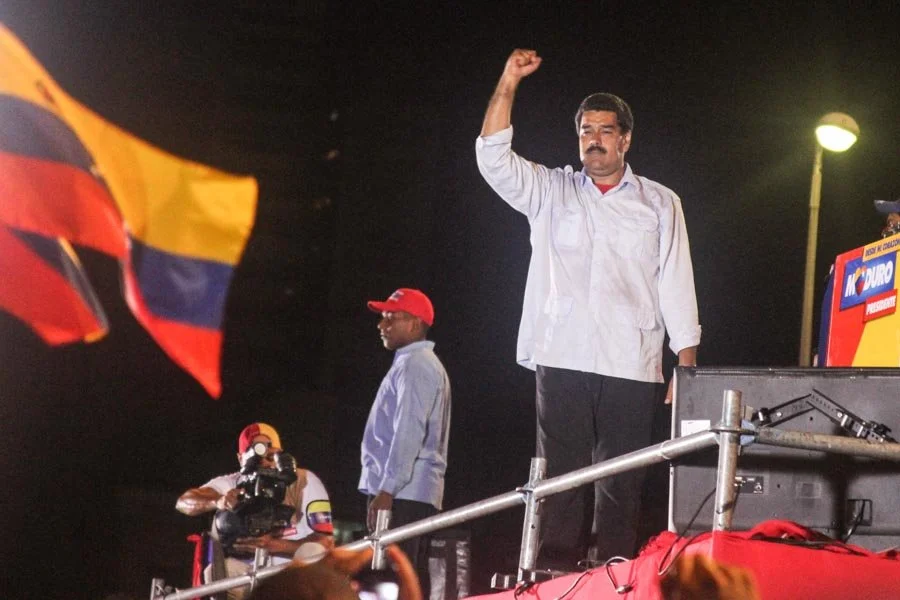

Nicolás Maduro was captured on January 3, 2026 by the Trump administration. The political uncertainty and instability that the country faces allows the U.S. to take advantage of the country’s volatile oil market and exploit Venezuelan oil reserves.
Photo Credit: Joka Madruga
If history has not taught the international community enough, as of January 6, the U.S. and Venezuela have reached a deal in which Venezuela is to release $2 billion worth of crude oil to the U.S. The agreement was made between interim President Delcy Rodríguez, largely seen as a sympathetic ally to the U.S., and President Trump just days after Maduro's capture. This conveniently follows the alleviation of the U.S. blockade that has prevented oil exports to China and beyond.
President Trump stated on Truth Social that "this Oil will be sold at its Market Price, and that money will be controlled by me, as President of the United States of America, to ensure it is used to benefit the people of Venezuela and the United States!" If one had a hard time discerning President Trump’s decision to capture the leader of another sovereign state, this quote is evidence enough that the U.S. has a long road to go down before it reaches the end of its oil conquests.
Though President Maduro was an authoritarian leader, U.S. regime changes have historically yielded disastrous results. Attempting to democratize nations is a noble effort, but the collapse of the American-backed leadership in Afghanistan in 2021 led to the insurgency of the Taliban, an internationally recognized terrorist organization, as well as 20 years of wasted American resources and manpower in the country. Libya also experienced political and economic instability following U.S. intervention. Former President Barack Obama’s ousting of Libyan leader Muammar Gaddafi in 2011 during the Arab Spring threw the country into chaos and squashed hope for the democratization of Libya. Yet, the complex geopolitics and nuances in the Middle East are much different than in Venezuela. The transition away from authoritarianism could be successful for the Venezuelan government, but if the U.S. entrenches itself in yet another 20 year foreign commitment, democratization may never occur. If the U.S. continues to employ coercive foreign policy strategies, Venezuelans may end up exactly where they started, with the addition of a fabricated dependence on the U.S. for oil imports.
Although the future of the U.S.-Venezuela relationship is up in the air, diplomatic ties between the two countries could be mended given President Trump’s enthusiasm to control Venezuela’s oil. But, the international trade implications of this relationship may be more than what he bargained for. It remains unclear how the geopolitical consequences of Maduro’s capture will unfold, as Venezuela’s future in trade, foreign policy and democratization hangs in the balance. If U.S. involvement follows patterns consistent with its approach in the Middle East, that future may be far less hopeful than many Venezuelans anticipate.