Over One Year Later: The Unfinished Story of Serbia’s Protests
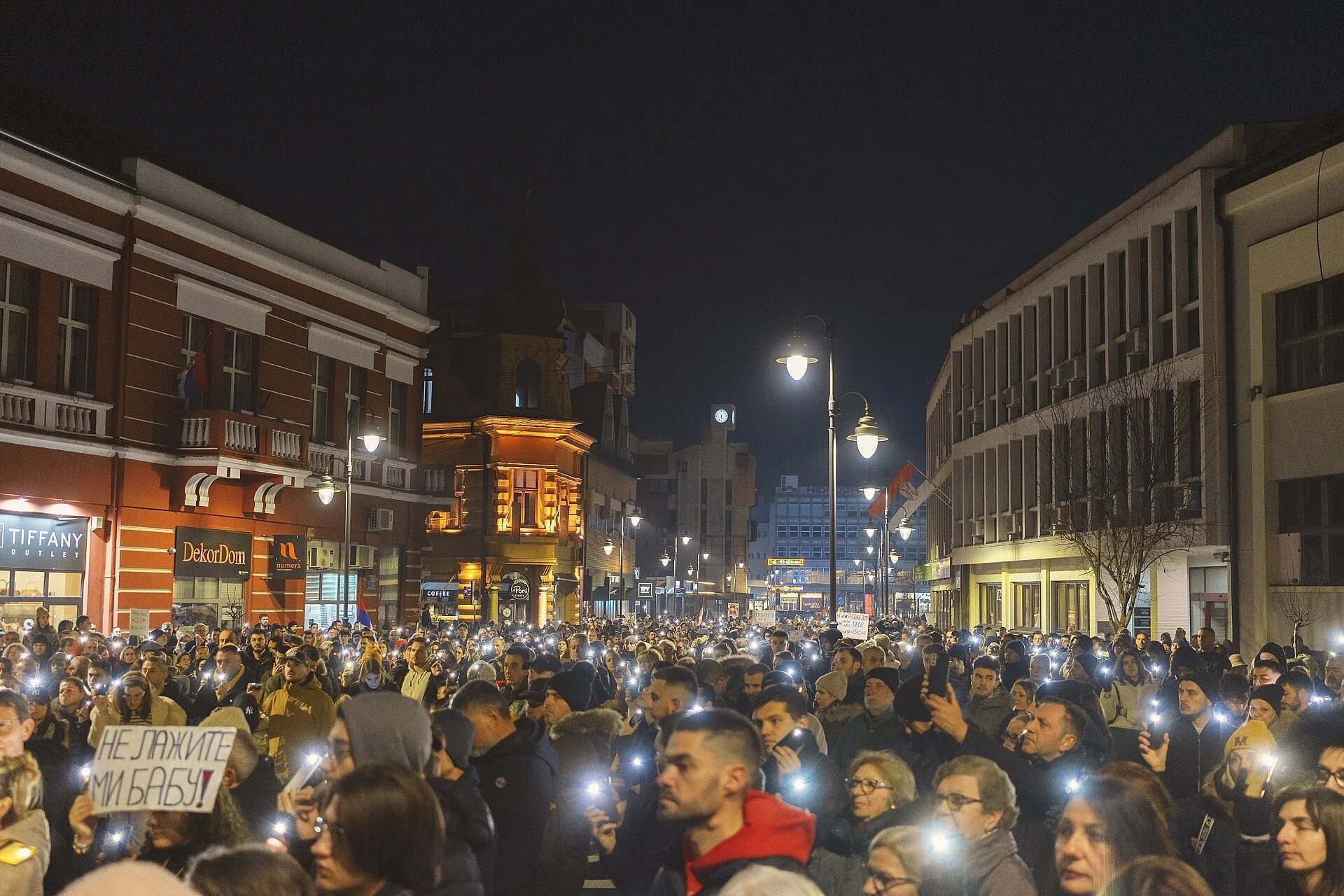
Thousands of Serbians gathered for protests in Čačak in the aftermath of the railway station collapse on February 2. Protesters are objecting to police brutality and standing in solidarity for the victims of corruption.
Photo Credit: Dejan Krsmanovic
On November 1, 2024, the concrete roof of a newly renovated railway station in Novi Sad, one of the most populous cities in Serbia, collapsed and killed 16 people. This sparked an anti-government protest movement, an all-level education boycott and the nominal resignation of the prime minister. Serbian President Aleksandar Vučić in particular has come under fire for supporting poorly done construction in order to make a profit.
The first protest occurred on November 22, 2024, when students and teachers of Belgrade University’s Faculty of Dramatic Arts walked out of class for 15 minutes of silence to pay respect to the victims. During this initial protest, students and teachers reported physical and verbal harassment from the police, which set in motion the organization of mass student protests. Universities across Serbia unified to declare a continuous boycott of educational facilities until the government yielded to their demands of transparency for all public endeavors. One of these demands was the release of legal documentation regarding the reconstruction of the railway to ensure no corners were cut, which has still not been released in its entirety.
After witnessing the students’ oppression by the authorities, the general public began joining in on vast, organized popular demonstrations throughout the nation. For example, every day from 11:52 am to 12:07 pm, the exact time of the railway collapse, Serbians went on the streets to participate in absolute silence. Aleksandra Marinkovic, a Belgrade resident, described this call to action in an interview with Prospect Journal. “When you see young people trying to do something and make a difference, the only way you can react is to try to help them because you are living the same shit for 30 plus years… and when they start waking up in a way, the only thing that you can do is support them,” Marinkovic said.
The structure of these protests has been dubbed “leaderless resistance” because of the highly decentralized and democratic nature of their organization. Protestors held informal meetings nightly to debate and vote on protest strategies and actions in a discussion-based format. Additionally, students utilized their media literacy to disseminate their agenda to the public, using social media algorithms to share their stories and circumvent censorship. Students also made their own symbolic demonstrations to gain international attention, such as delivering a cry for help letter to the European Union via a 16-day bike ride from Belgrade to France. New Year’s Eve marked another occasion for demonstration, reflects Marinkovic. “They went out on the streets on the 31st to celebrate New Year’s. They even had 15 minutes of silence. It was really moving to see young people who celebrated the new year in silence, like complete silence,” Markinovic said.
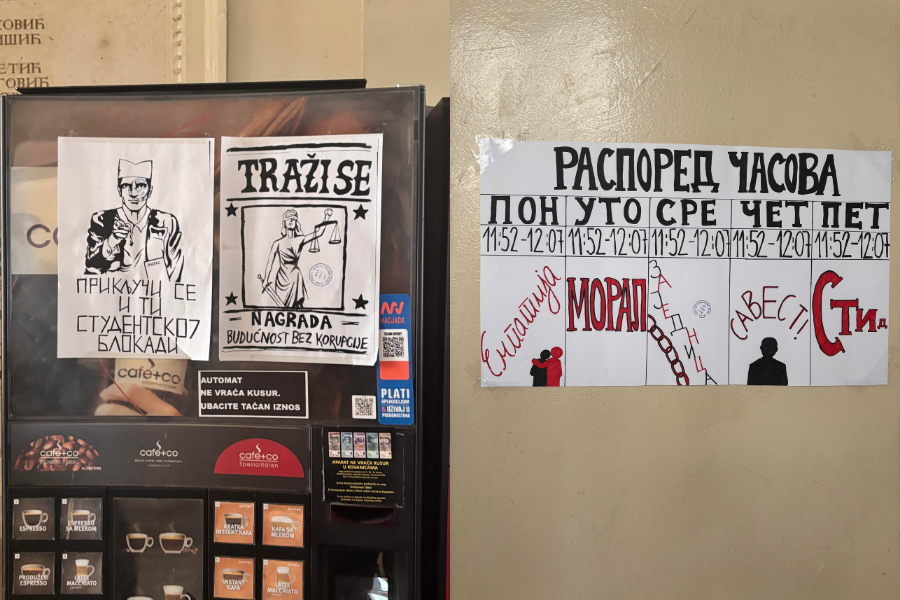
Numerous posters cover the then-closed University of Belgrade with messages encouraging students to join in the protests and emphasizing citizens' moral duty to stand up to government corruption.
Photo by Mila Kalezic
In January 2025, a counter-protest movement arose in response to the educational blockade. This group set up tents in front of the President’s Office and National Assembly, under the guise of students supporting the re-opening of schools. Independent investigative efforts revealed that Vucic’s administration was paying these protesters, and they were not in fact students at all. This group of fake students became known as “ćaci,” after a now infamous piece of graffiti misspelled “đaci” (meaning students in serbian) as ćaci. After the backlash, the “students” set up camp in front of the parliament building in white tents and have remained there since, accommodated by a catering service hired by the President. This place, known as Ćaciland, has continued to be used as a weapon against the protest movement.
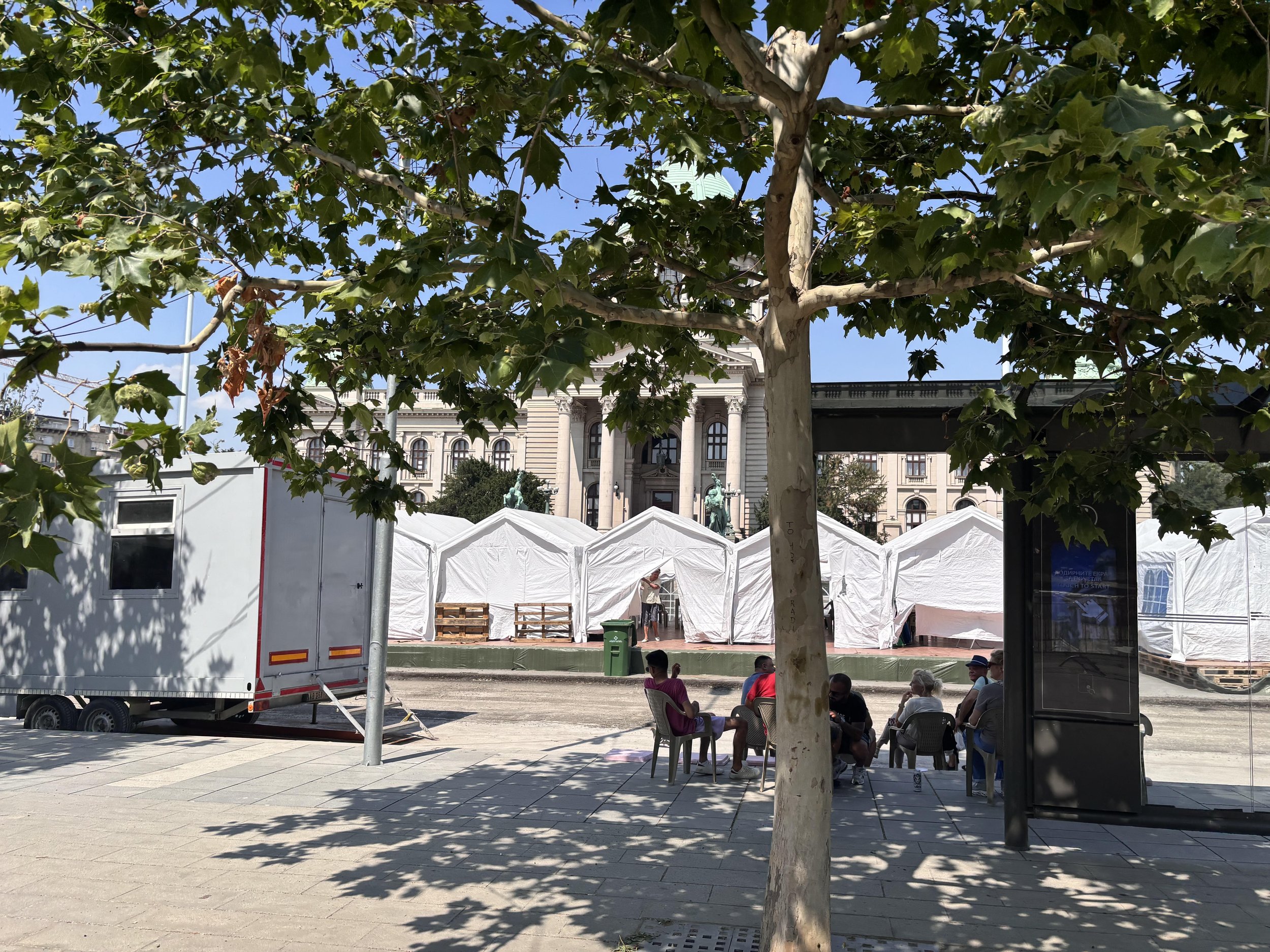

Encampments of white tents surround the National Assembly of Serbia. This area is called Caciland by critics– referencing the pro-government protestors who are rumored to be compensated to stay on site.
Photo by Mila Kalezic
The protest movement reached its peak on March 15 with the largest demonstration in the history of the country. This protest amassed 325,000 people (one twentieth of the total population of Serbia), who stood together on the streets of the capital in solidarity for the victims. As monumental as this day was, it also saw a shift in the government’s response toward violence. Although officially denied by the government, many eye-witnesses report the blasting of a sonic weapon. It was reportedly fired near the capital boulevard and let out a deafening sound, causing many protestors to faint and others to describe symptoms such as nausea, extreme disorientation and severe headaches. Even with long range acoustic devices being officially banned in Serbia, the government admitted to possessing such a device after photographic evidence surfaced, but still refute using it on civilians during the protests. Allegations were brought before the European Court of Human Rights, but no final rule has been reached despite circulating video evidence of the incident.
The government overseeing this crackdown is the Serbian Progressive Party (SNS), which has been in complete control of the Serbian government since 2014. After the break up of Josip Tito’s socialist dictatorship in Yugoslavia in 1991, a series of arrests and assassinations of Serbian presidents has made the government extremely unstable. The SNS formed as an opposition party against corruption and gained strong support under the pro-EU administration at the time. While in power, the SNS have taken over media censorship; most major news outlets such as Pink, PRVA TV, B92 and others are either owned by the party, broadcast its propaganda, or conduct smear campaigns against its detractors. Recently, the biggest opposition news outlet, N1, received pressure from Vucic to dismiss their executive chief. The President has already removed N1 from Serbia’s television satellite network because of their coverage of the student protests.
These protests have continued for over a year, but are facing increasingly harsher responses from authorities. Police have arrested citizens throughout the protests, but since August, reports have indicated more physical violence from the authorities. One physics student told a RadioFreeEurope reporter that while protesting, his head was pushed onto concrete by multiple policemen. Increased aggression from supporters of the SNS, in addition to this police brutality, have exacerbated tensions, as videos of their violent behavior have circulated.
Although the protests are still ongoing, universities in Serbia and Novi Sad have slowly reopened, starting in September 2025. Aleksandar Rajčić, a lifelong Belgrade resident and parent of children who attended Serbia’s public universities, expressed concern about the educational blockade in an interview with Prospect Journal: “If students do not attend a year regularly and do not meet the requirements for enrollment the following year, they lose the right to free, [government-]budget-funded studies, but become self-financing students, who have to pay their own tuition.”
The consequence of these protests has led to political turmoil. Despite nominally resigning in early 2025, Serbian Prime Minister Milos Vučević is still in office and shows no sign of surrendering his power. Additionally, election-rigging accusations heightened tensions during the local elections in June for seats in parliament. The Center for Research, Transparency and Accountability, a nongovernmental organization that monitored Serbian elections for over 10 years, reported widespread irregularities at the polling stations, around many of which there was visible police presence. Almost a quarter of locations examined failed to properly authenticate their ballots and a full third photographed ballots once they were cast.
The last Serbian movement this widespread was the toppling of the communist dictatorship of Slobodan Milosevic in 2000. As Serbia navigates these protests, the prospect of another revolution looms on the horizon. Even over a year after the accident, the movement against government corruption is in full swing. The people of Serbia have not forgotten the transgressions of President Vucic, and as their demands reach international attention, the future of Serbia grows more and more uncertain.