The Selective Censorship of Political Satire under the Trump Administration
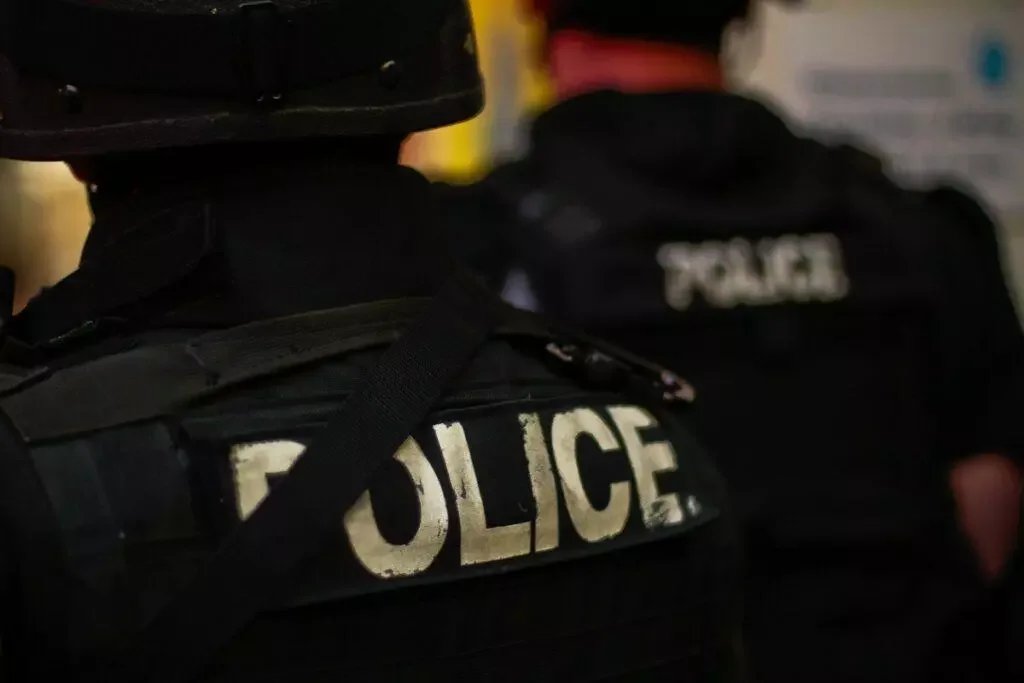
In 2025, law enforcement officers were involved in multiple cases of the repression of free speech on the internet.
Photo Credit: Matt Hecht
Former Tennessee police officer Larry Bushart found himself behind bars in September for posting a meme to Facebook. The meme in question criticized a vigil for right-wing political activist Charlie Kirk by juxtaposing it with a 2024 quote of United States (U.S.) President Donald Trump dismissing the tragedy of a school shooting by crudely saying “We have to get over it.” Just one day after posting the meme, Bushart was arrested under charges of “threatening mass violence at a school” under Tennessee Code § 39-16-517. However, the county authorities behind the arrest admitted to understanding the meme as a political commentary rather than a threat. Bushart was released after spending 37 days in jail but had lost his job and, critically, his comfort participating in online political conversations. The Foundation for Individual Rights in Education (FIRE), an organization focused on defending free speech on college campuses, is currently working with Bushart to sue the local county court and sheriff. When defending their decision to work on Bushart’s case, FIRE declared that “Free societies don’t jail people for posting political memes on social media.”
Bushart’s arrest is only one incident in a greater trend towards mass censorship and legal punishment of comedy under the current administration. Norwegian tourist Mads Mikkelsen was denied entry into the U.S. in June for, he claims, having saved on his phone an image of the widely circulated meme edit of a bald, baby-faced Vice President JD Vance. Mikkelsen told BBC that “the [immigration] agent seemed to be very antagonized by the image,” to which Mikkelsen responded “It’s just a piece of comedy.” Vance himself has taken such disparaging comedic representations in stride.
Tricia McLaughlin, who is in charge of the U.S. Department of Homeland Security’s public outreach, refuted that Mikkelsen was barred from entering the country “for his admitted drug use.” The immigration paperwork, however, cites Mikkelsen “attempting to engage in unauthorized employment” as the reason. Mikkelsen maintains that he was only intending to go on vacation.
The reason behind U.S. immigration denying entry to Mikkelsen remains contested. But, his once outlandish claim that a political meme got him turned away at the border has become believable in today’s environment, particularly in light of Bushart’s arrest and other recent incidents. The events illuminate a startling new era of political censorship in the U.S. in which inflammatory right-wing speech is allowed to circulate while its leftist counterpart is repressed.
In another example, comedian Jimmy Kimmel’s show “Jimmy Kimmel Live!” was temporarily suspended by its network, ABC, in September following his commentary on Kirk’s death. NPR’s senior political correspondent Domenico Montanaro explains that critics of the suspension see Trump “using Kirk's death to operationalize a retribution campaign, rebalance the media and squash speech and dissent.” He also points out the hypocrisy of conservatives silencing Kimmel’s pointed comments on Kirk when Kirk’s own career was built on what he believed was his right to say “outrageous things.”
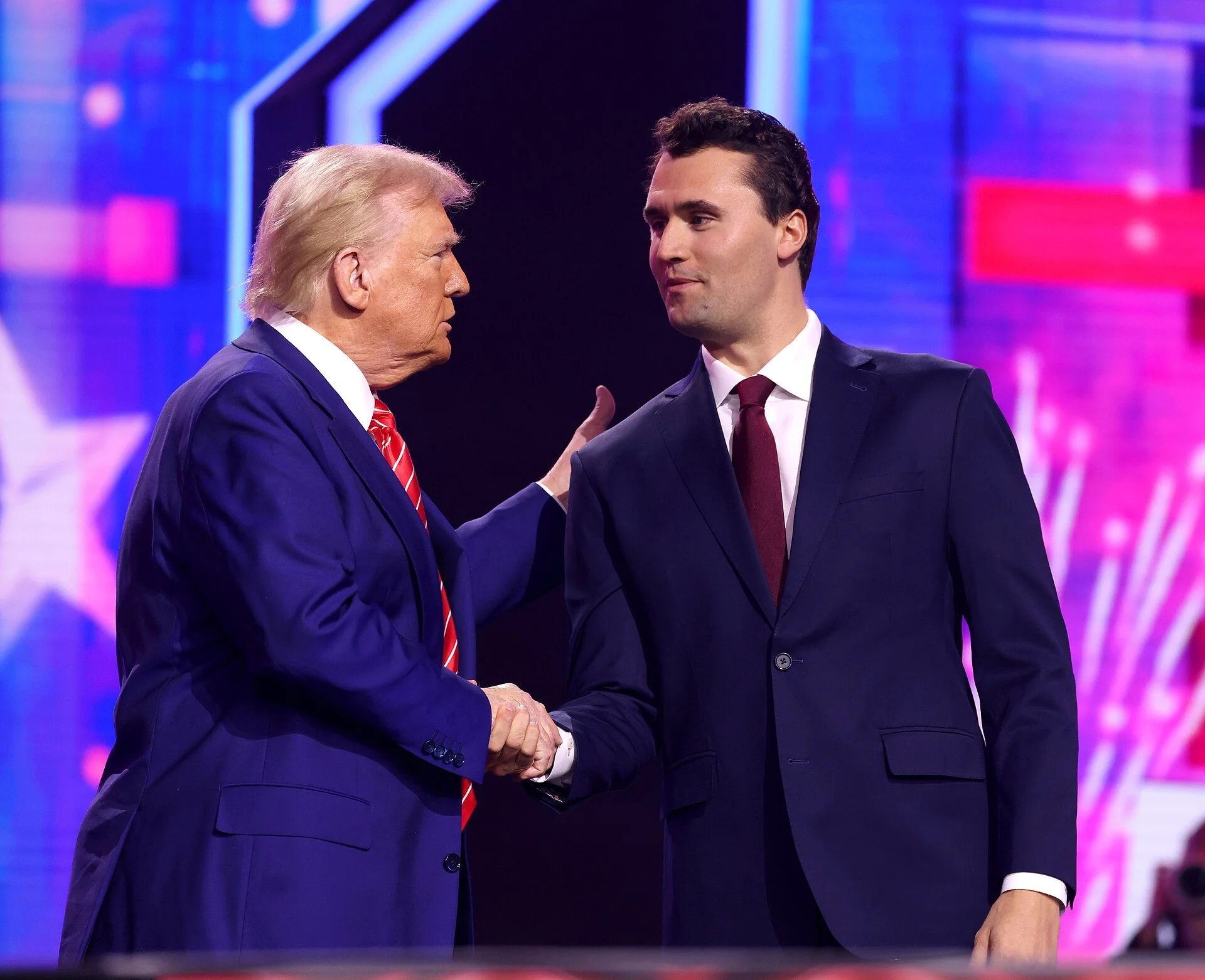
Donald Trump shaking hands with Charlie Kirk at AmericaFest 2024. Kirk was a key spokesperson for the Make American Great Again (MAGA) movement and made his career debating students on university campuses with his organization, Turning Point USA.
Photo Credit: Gage Skidmore
“We can do this the easy way or the hard way,” U.S. Federal Communications Commission (FCC) Chairman Brendan Carr warned following Kimmel’s pointed comments about Kirk. Hours later, ABC suspended “Jimmy Kimmel Live!” Carr, a Trump appointee, wasn’t so strict even just a few years ago. In 2022, when a “conservative parody site” was banned from X, Carr intervened in its defense, declaring that “political satire is one of the oldest and most important forms of free speech.” But in 2025, Carr contradicted himself by disparaging Kimmel’s discussion of the Kirk assasination, framing it as intentionally misleading and operating against public interest. He made these statements on the podcast of Benny Johnson, a prominent right-wing commentator who has been repeatedly criticized for spreading misinformation to the public.
NPR described Carr as wielding the FCC to “[wage] war against the free speech of those who have reported on, criticized or satirized the president.” His critique of Kimmel, they wrote, was his “most blatant” action because it bullied ABC into suspending “Jimmy Kimmel Live!” On September 17, two days before this NPR story was published, Carr was interviewed by FOX News and repeated his claim that networks with broadcasting licenses have the “unique obligation to operate in the public interest.” In January 2026, the FCC yet again wielded the “public interest standard” to require talk shows to provide balanced air time to Democrat and Republican guests in an attempt to combat the perceived left-leaning bias of shows like “Jimmy Kimmel Live!” and “The Late Show With Stephen Colbert.” Thus, evidence of selective censorship reveals the current administration’s desire to redefine “public interest” to fit their own plot.
Due to its unpredictable head, however, the Trump administration is struggling to outline what is “moral,” in the public interest, versus “immoral,” against public interest. In a December CNN article, political reporter Aaron Blake suggested that Trump constantly undermines his administration, creating a “moral high ground [that] is extremely unsteady terrain.” For example, after months of the administration condemning celebratory or unapologetic comments on Kirk’s assassination, Trump turned around and berated actor and filmmaker Rob Reiner, who was tragically murdered on December 14. Reiner had been vocally anti-Trump, a stance which Trump himself referred to as a “mind crippling disease” and blamed as the reason for Reiner’s death in a post to Truth Social.
The actual impact of this “unsteady terrain” is unclear, as Trump and his administration seem to function outside of their own “moral” standards. In October, Trump circulated an AI-generated video of himself dumping sewage from a plane onto No Kings protestors. Speaker of the House Mike Johnson defended the video as Trump “using satire to make a point.” The use of satire, then, is a privilege only reserved for some Americans.
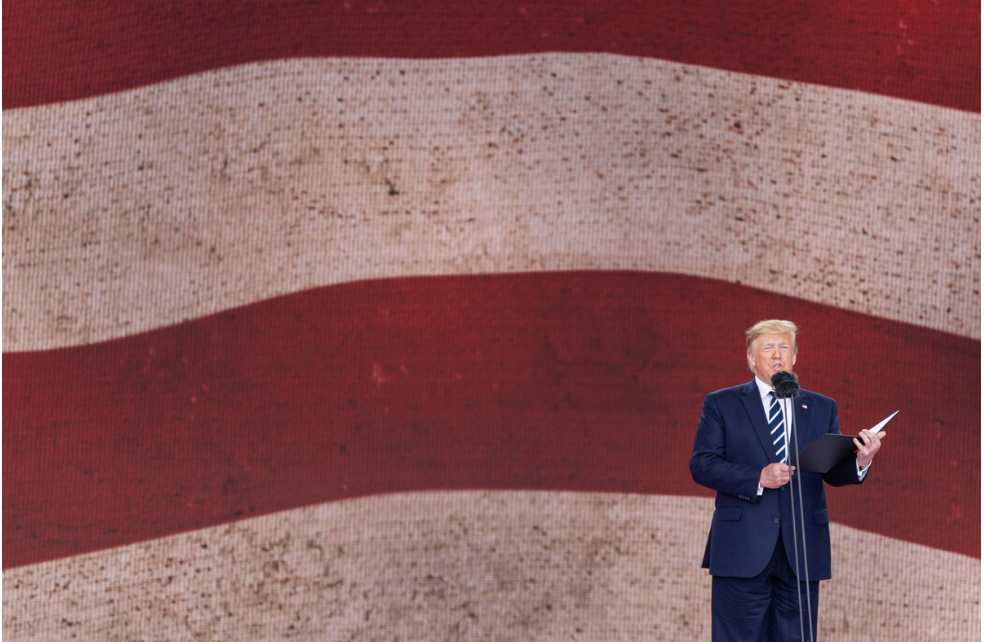

Donald Trump speaking at the 75th anniversary D-Day National Commemorative event in 2019, during his first term. After returning to office in 2025, Trump relaunched his attacks on the press and the wider media. His crackdown on anti-administration rhetoric is evocative of the post-Cold War Red Scare.
Photo Credit: Official White House Photo by Andrea Hanks
The “morality” argument completely falls apart when we remind ourselves that Bushart and Mikkelsen — a former police officer and a Norwegian tourist, respectively — are not public figures. Thus, they are not obligated to function in the public’s interest in the same way that Kimmel, under the FCC, must. The startlingly strict legal actions taken against both men are reminiscent of the McCarthy-era witch hunts, the highly publicized federal investigations into alleged “communist infiltration” that occurred during the Red Scare circa 1950. But while McCarthyism targeted politicians, intellectuals and others deemed as potential communists, the Trump-era censorship is creeping into everyday Americans’ social media usage.
Celebrities have also recognized this historical parallel. In October, a group of more than 500 stars relaunched the Committee for the First Amendment, which was initially created during the McCarthy era. The committee recognizes that the “forces [of repression] have returned” and are actively targeting public figures and average Americans alike. The reach of the administration’s repression has even expanded to anyone setting foot on American soil, citizen or non-citizen, as evidenced by Mikkelsen’s case.
Under the Trump administration, it appears that being an active participant in the proliferant internet culture of memes and other forms of political satire designates one as a threat to the American public. The resulting censorship, of course, is extremely selective. The act of intimidating internet users into silence for fear of legal repercussions gives the Trump administration the ability to manipulate internet culture “with serious state power,” as political historian Nicole Hemmer explained to CNN. In such a political climate, there is potential for police to show up at your door the day after you post a meme satirizing the president, while the nation’s leaders are held to no such standards.