Power Plays: The Politics of Sports
Photo Credit: Jan S0L0, Bundesarchiv, Korea.net, Pixfly
In 1969, a soccer match triggered a war between El Salvador and Honduras. Within a few days, this “Football War” had caused 4,000 deaths and 300,000 displacements, acting as a catalyst for conflict over land reform and immigration. This extreme incident reveals how benign games can have significant ramifications. Although international sports are often intended to be an escape from the harsh political realities, they commonly become pseudo-battlefields. Teams represent their governments and fight to establish dominance as the world watches. With the upcoming 2026 World Cup, it is worth examining how rising global tensions are played out by sports being utilized as stages of both diplomacy and conflict.
One of the earliest modern examples of the politicization of sports was the 1936 Berlin Olympics, hosted by Nazi Germany. The newly built infrastructure and nationalist ceremonies were meant to showcase Aryan superiority, an intent that was foiled by African-American Jesse Owens, who won four gold medals in track and field. This Olympics, however, succeeded by highlighting the new German regime’s power and wealth. Dr. James Ivey, a history professor at the University of California San Diego, explained how sports matches are extremely important in setting the reputation of the host country.
“You have control of the world's attention and you can choose to show that however you direct that attention however you want. [The plan was,] ‘Everyone comes to Berlin and everyone thinks Nazism is amazing.’ The Olympics certainly left a positive impression on most visitors about a well-organized system and allayed many fears about Nazi anti-semitism, which was covered up during the Games,” Ivey said.
Later, during the Cold War, the Olympics were the Soviet Union’s opportunity to establish itself as a new global superpower. The USSR reportedly opened up almost 60,000 new gymnasiums and invested heavily in talent recruitment. This obsession proved successful, earning the USSR the most medals in six out of the eight Olympic games it competed in. In this environment, the nation entered hostile national rivalries with the U.S. and its own unwilling satellite states. This was evident in the infamous 1956 Olympic “Blood in the Water” water polo match between the USSR and Hungary, which ended with bloody eyes, broken noses and ruptured eardrums.
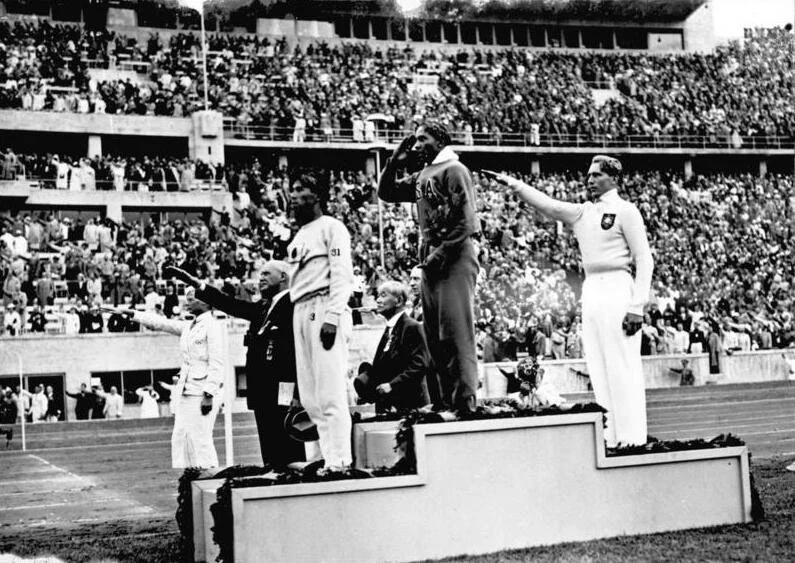
American track athlete Jesse Owens stands on the podium after receiving the Olympic gold medal, while surrounding athletes do the Nazi salute. This environment highlights how Jesse Owens’s success was highly politicized during the 1936 Berlin Olympics.
Photo credit: Unknown
Even in the modern day, bloodshed still follows sport matches between rivals. In 2014, the Union of Europe Football Association qualifying soccer match between Serbia and Albania was supposed to be a step towards normalcy after decades of bitter conflict. It was meant as a lead-up to the Albanian prime minister’s visit to Serbia for the first time in 68 years, which would have taken place the next day. Instead, during the game, a drone flew over the field with a flag bearing a Greater Albania map, which claimed for Albania much of the territory of its neighboring countries, including Serbia. Serbian players tore down the flag, inciting fighting both in the stands and on the field. Fans threw chairs at each other until the referees ended the game. The most important consequence of this game was not the point total or the soccer itself, but rather the acts of terror undertaken by civilians because of the nationalist tensions surrounding the match. This included multiple cases of arson and hospitalized attacks between Serbian and Albanian diasporas across several countries in the following days.
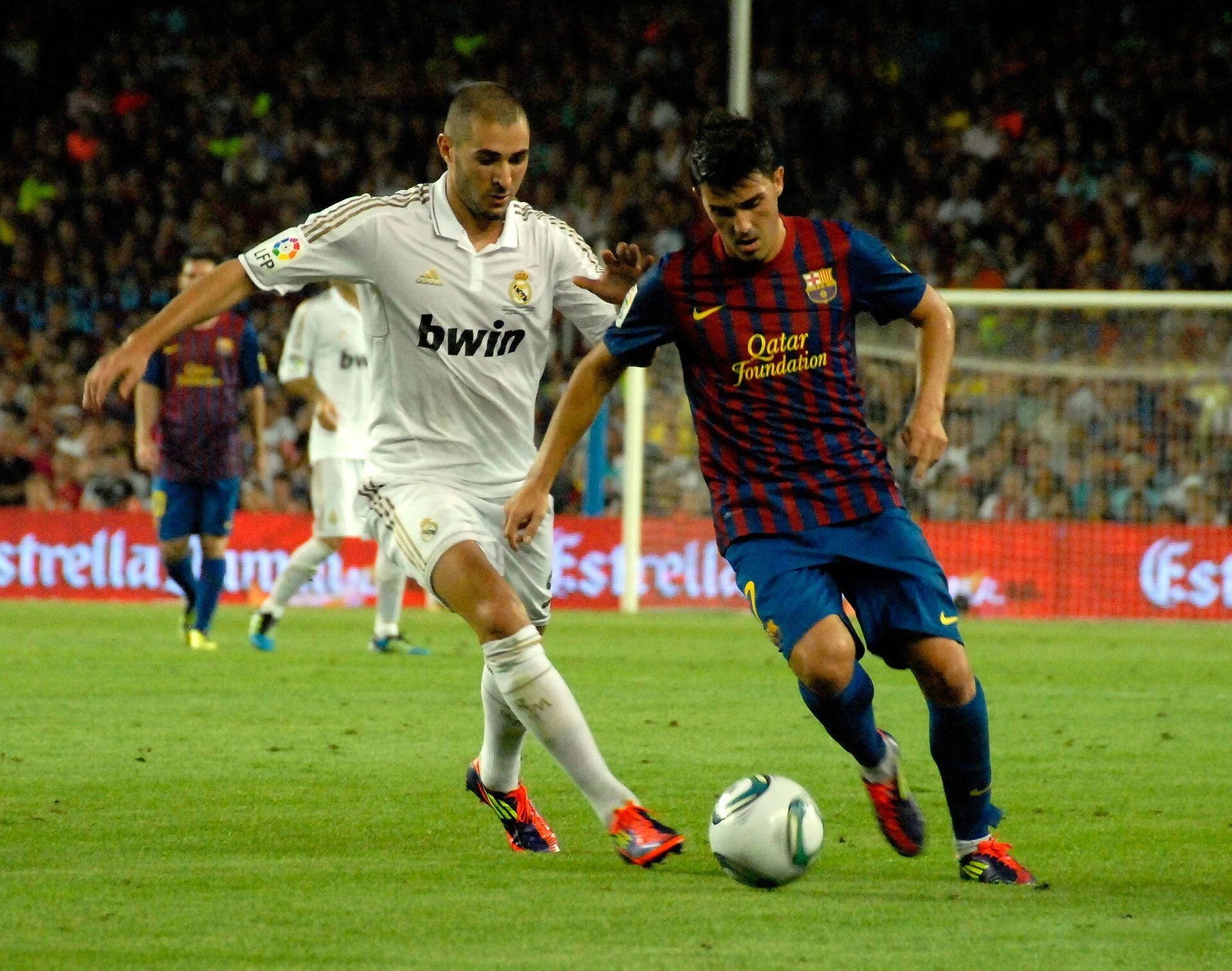
The 2011 “a Supercopa d'Espanya” against Royal Madrid (pictured left in the white) and Barcelona (on the right) in an intense faceoff that extends beyond the field. This was the final of the tournament and Madrid’s first win in 18 years.
Photo Credit: Xavier Rondón Medina
In Spain, “El Clásico” is a passionate soccer match that carries the weight of the nation’s history and represents the tension between central and local political power. This match is played between Real Madrid (Royal Madrid) and Barcelona, the teams of Spain’s two major cities with strong political ideologies attached to their names. Barcelona represents the separatist movement for Catalonia, a region in Spain that asserts its independent identity because of its separate Catalan language, culture and history. The Catalan separatist movement was crushed by Spanish dictator Francisco Franco during the Spanish Civil War (1936–1939), where he attempted to unify Spain by banning the Catalan language and inclusion of their culture in education. Franco, and subsequent Spanish rulers, have put their support behind Real Madrid, using soccer as an arena for fighting out the nation’s differences. By backing Real Madrid, these Spanish leaders support Spanish unity and implicitly deny Catalan’s right to independence. This rivalry is one of the most anticipated matches in the world, and in 2025 viewership reached 600 million during the La Liga competition, Spain’s top professional men’s soccer league. Beyond the spectacle, these matches still serve as an outlet for tensions between competing desires for centralization and separationism without direct conflict.
Apart from being avenues for proxy conflict, sports are also used for diplomatic cooperation. Ekecheiria, the “Olympic Truce,” reveals the original intent of international sports competitions. The first organized sports matches between different nations were in Ancient Greece, where, for 1,168 years, sports games were marked by a period of peace, in which participating city-states would set down their arms for the sake of cooperative entertainment.
During the Cold War, “Ping-Pong Diplomacy” proved a driving factor in the reconciliation between the Chinese and United States (U.S.) governments. In the late 20th century, relations between China and the U.S. were nearly non-existent and contact between the two countries was rare. It was not until an American table tennis player serendipitously got on the national Chinese table tennis bus during an international competition that China reached out to the U.S. for an official visit—for a ping-pong match between the two nations. This invitation was monumental and led to the U.S. removing its travel ban to China. The American Table Tennis team took a long trip to China to play “friendly matches” of ping-pong and toured China’s greatest monuments while getting showered with gifts. This sports campaign marked the first joint venture between the U.S. and China in decades and the beginning of the thawing of their relationship.


.jpg)
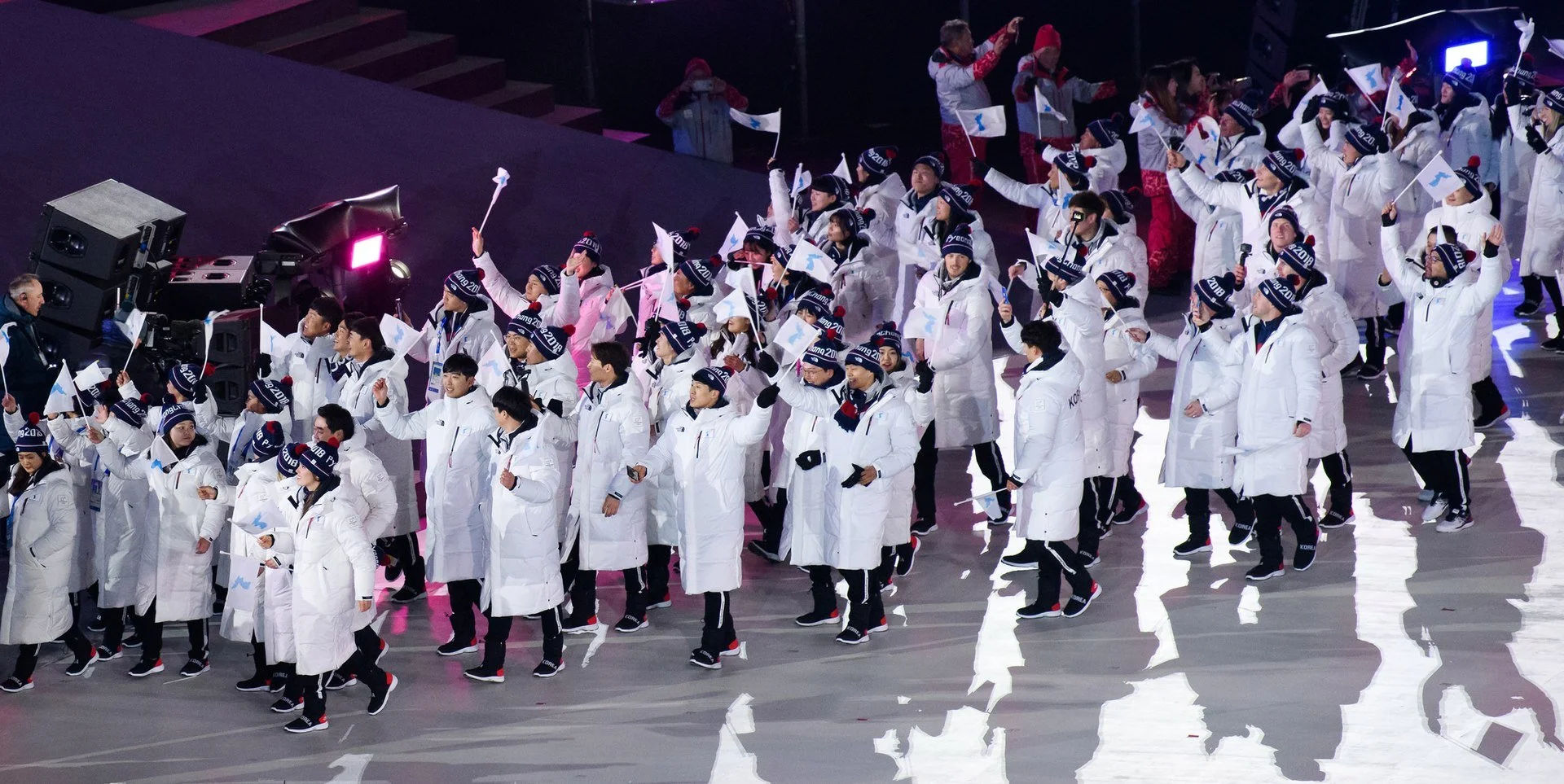
North and South Koreans march waving a unified Korea flag during the 2018 Olympics opening show. Serving as a bridge between the two countries, this event showcased the diplomatic ability of sports.
Photo credit: Korea.net

Another tremendous feat of sports diplomacy was in the 2018 Pyeongchang Olympics with the unification of the North and South Korean teams. In 2017, global tensions were rising with North Korea, as the U.N. sanctioned the country for illegal oil shipments and the continuation of its nuclear missile program. In light of this, North Korea surprised the world by extending an invitation to South Korea to join together for the 2018 Olympics under one unified flag. As a result of this reliance, South Korea had made numerous concessions to the international sanctions placed on North Korea such as allowing planes and ferries to travel between the two nations. During the games, North and South Koreans marched hand in hand with each other under a single national anthem. Even more remarkably, they joined their hockey teams as one “Korean” team, and Kim Jong Un’s sister attended the match, marking the first time that the leading North Korean family had set foot in South Korea since the Korean War in the 1950s. This remarkable display of unity demonstrates the power of sports as a low-stakes way to practice diplomacy and ease into cooperation.
Politics and sports appear increasingly intertwined, with nations continuing to use sports as a show of soft power. Ivey said that countries often opt for sports instead of traditional diplomacy due to its increased appeal.
“Traditional diplomacy is rather boring. It doesn't have a level of emotionality to it that gets people involved, gets people interested in the events. You don't win hearts and minds, you don't win over a population in the same way that sports allows you to,” Ivey said.
Additionally, athletes have been utilized as informal ambassadors for their nation because of their easy access to a world platform. Their visibility in sports make them more recognizable than actual political figures as they build the reputation of their country
“Do you know who the Serbian prime minister is? No, but definitely Nikola Jokic, Alexander Mitrovic, Djokovic. You’ve got all these athletes who are coming out of this country that we all know and can associate with that country. In a way, we know more about them than we do about the political leaders, or even the countries themselves. That’s where our attention is, and that’s what interests us,” Ivey said.
This summer the world will watch present geopolitical tensions play out on the soccer field during the 2026 World Cup, hosted by the U.S., Canada and Mexico. Among things to look out for will be Iran’s soccer team, who plans to “boycott the U.S.” by petitioning to have all their games played in Mexico because of the U.S.’s ongoing attempt to topple their regime through missile attacks. As conventional war becomes less and less prevalent in the modern day, nations will rely on sports arenas as a common battlefield where competition and rivalries reflect attempts to bolster diplomacy and nationalism.