Lima Liars: How Peru Went Through 9 Presidents in 10 Years, and Why The Cycle May Continue
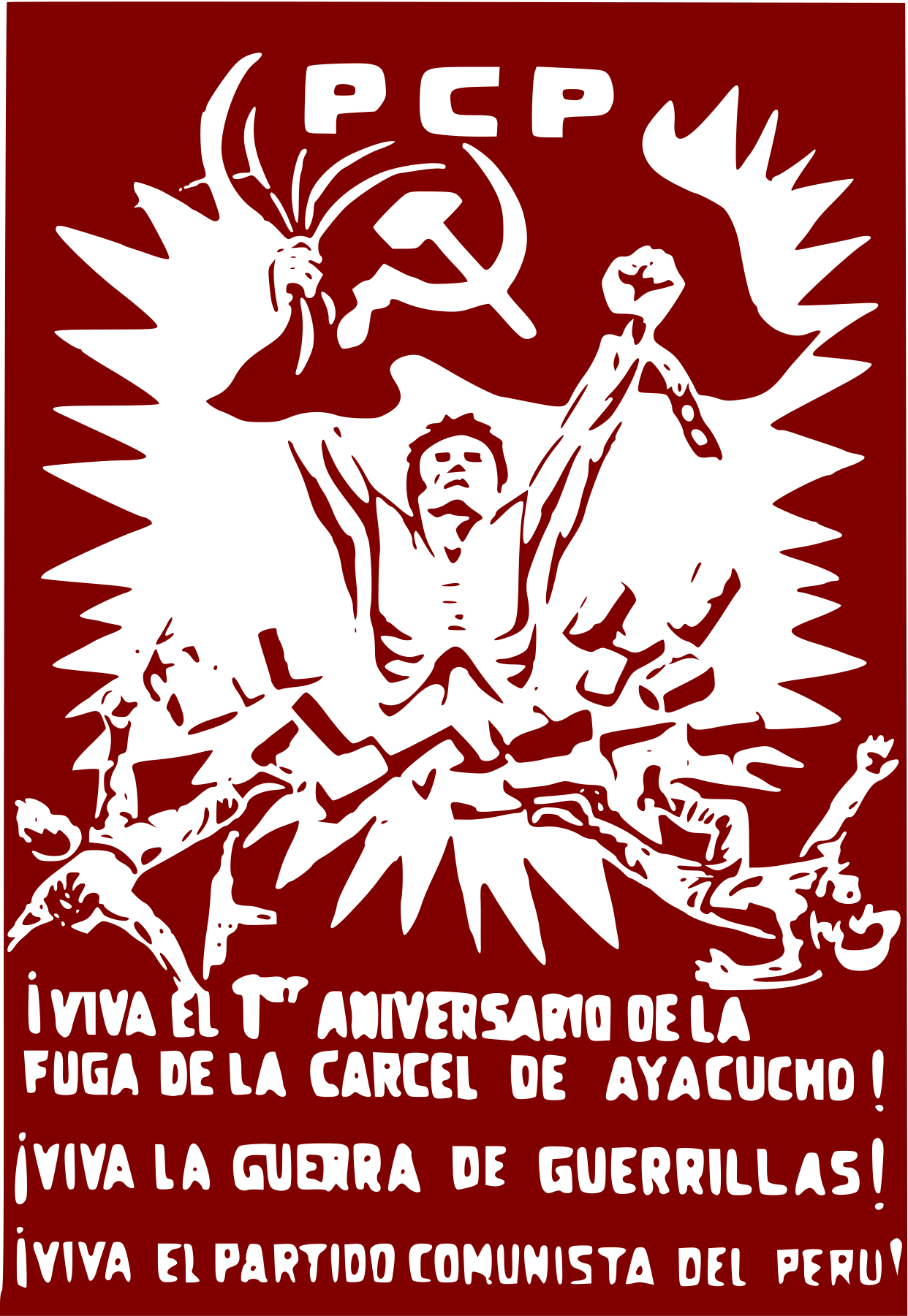
A rally poster for the communist militant group Shining Path (Sendero Luminoso) commemorating the one year anniversary of the Ayacucho prison break in 1982. Shining Path would serve as a thorn in the side of successive Peruvian governments from the 1980s to the early 2010s.
On February 17, Peru’s interim president José Jeri was censured by Congress on corruption charges, resulting in his removal from office. Jeri had been filling in as President of the Congress, so publicly reprimanding him to force his removal was easier than impeaching him as President of Peru. In his place, Congress elected José María Balcázar, a senior member of Congress. Balcázar is Peru’s ninth president in the last decade, a period where the historic trends of corruption, organized crime and protests have become evermore persistent. These pressing systemic issues are the result of widespread inequality that spans centuries.
Early History
In pre-colonial times, Peru was ruled by the theocratic Inca empire before the Spanish conquest in the 16th century. In the ensuing genocide of the Inca, the Spanish established the encomienda system, in which native Andeans were forced to work as laborers, extracting silver and paying it to the Spanish as tribute. Additionally, they established a race-based caste system where Europeans held power and authority, and the Indigenous peoples were relegated to second-class status. The Spanish created the Viceroyalty of Peru, which ruled from Lima for the next three centuries.
Indigenous populations opposed the colonial regime in Peru, most notably in 1780, when José Gabriel Condorcanqui led a rebellion against Spanish rule. Condorcanqui was a mestizo of mixed Inca and Spanish ancestry and descendant of the final Incan ruler Túpac Amaru I. Adopting the name Túpac Amaru II, he advocated for the liberation of Peru’s Indigenous peoples and the abolition of slavery in the colony. Spain swiftly and violently suppressed the rebellion before executing Amaru and his family. Despite the revolt’s failure, it cemented a deep-seated desire for autonomy among the Indigenous population.
The Napoleonic invasion of Spain in 1808 led the nation to recall its military forces to defend the homeland, creating a power vacuum in its South American colonies. This included Peru, which declared independence in 1811. After a 15-year-long armed struggle, Peru became fully independent in 1826. Throughout the 19th century, the nation experienced a series of crises, including civil wars, military juntas, revolutions and even the loss of its southern coast to Chile, cementing instability throughout the country.
A Banana Republic is Born
In 1895, Peru, fresh from one of the military dictatorships, installed Nicolás de Piérola as president, who transformed the country into an oligarchy. Known as the “Aristocratic Republic,” the state propped up rubber and mining barons and corralled its peasants through the gamonales for the next two and a half decades. The gamonales acted as feudal lords in the Andes in a system similar to the encomienda. While the wealth of the country boomed, it was concentrated in the wealthy elite.
The Civilista Party, which created the Aristocratic Republic, was voted out in 1919. However, the victor, Augusto B. Leguía, soon launched a self-coup to establish a military dictatorship. This regime was a fascist junta that suppressed any dissent while financing mass infrastructure projects, the funds for which went directly to those in power. After Leguía’s regime was deposed in 1930, two more military juntas ruled before democratic elections were held in 1956.
While the democratically elected government made efforts to address the widespread poverty of the Indigenous population, widespread protests broke out when the Standard Oil Company of New Jersey purchased the La Brea y Pariñas oil fields in 1968 from President Fernando Belaúnde. These fields were very profitable, and the company received tax exemptions from the Governor of Peru’s Central Bank, Pedro Pablo Kuczynski, angering the public. At the same time, the population increasingly looked to the recent Cuban Revolution as inspiration for a new government. The arrangement between the government and Standard Oil did not last, however, as another military coup occurred.
Unlike other right-wing military coups in Latin America at the time, the 1968 coup in Peru was not supported by the United States (U.S.). Instead, the leader of the new Revolutionary Government of the Armed Forces, Juan Velasco Alvarado, nationalized the nation’s oil fields, prompting U.S. outrage. While Velasco used the profits from nationalization to reduce the power of semi-feudal hacienda lords and adopt agrarian reforms that transferred power to the Indigenous Quechua, the 1973 global oil crisis nullified these gains and sent the country back into economic crisis.
In 1975, Alvarado was deposed in a coup led by his main deputy Francisco Morales Bermúdez. Morales Bermúdez reversed the nationalization of the oil industry and began participation in Operation Condor, a U.S.-backed program to prop up military dictatorships in South America. The increase in military repression resulted in the Lost Decade, a period of severe economic stagnation and a national housing crisis. Elections in 1980 replaced the junta with a democratic system limiting presidents to one five-year term. While former president Fernando Belaúnde and Congressman Alan García won the first two elections, the third became the most consequential, since this newfound U.S. influence was caused by the push for neoliberal economics in the election.
Memento Fujimori
In the 1980s, domestic armed conflict greatly increased. Beginning with a 1980 ballot burning incident, the Maoist militant group Shining Path became a major player in Peruvian politics, engaging in guerilla warfare from the countryside. This violence was compounded by Shining Path’s animosity towards the more militant Indigenous nationalist groups. In 1983, however, the turning point in their battle with the government came; in retaliation for the killing of one of their officers, Shining Path slaughtered dozens in the town of Lucanamarca. Presidents Belaúnde and García responded with crackdowns on dissent.
The ensuing climate of fear and repression made the 1990 election so important and surprising. The frontrunner was famed writer and future Nobel laureate Mario Vargas Llosa, who ran on a conservative platform. However, the incumbent government’s failure to contain Shining Path violence led voters to select a dark-horse candidate: engineering professor Alberto Fujimori.
Fujimori, a political outsider born from Japanese immigrants, had strong connections to Peru’s military and intelligence agencies through his confidant, Vladimiro Montesinos. Together, they drafted Plan Verde, which outlined efforts to drastically change Peru’s culture and economy. The plan was threefold. First was the creation of a deregulated neoliberal economy. To this aim, and with guidance from economist Hernando de Soto, Fujimori implemented “Fujishock,” a large-scale austerity program that slashed pricing regulations and privatized hundreds of publicly owned corporations, causing massive inflation. Second was media control. To achieve this, Fujimori launched a self-coup in 1992, dissolving Congress and the courts. Once restored, they were filled with “Fujimoristas,” loyalists of Fujimori who enforced tight restrictions on the press. Third was the attempt to militarily crack down on drug trafficking, in an effort to secure greater funding from the United States. Since Montesinos himself had strong ties to drug cartels, they needed a scapegoat to refocus the nation’s attention. They consequently decided to heavily associate Indigenous peoples with poverty, in an effort to portray them as more likely to turn to drugs and to sympathize with the Shining Path.
Shortly after Fujimori’s inauguration, Montesinos created El Grupo Colina, a paramilitary death squad, using $10 million he received from the CIA. During Fujimori’s first term, El Grupo Colina committed various human rights abuses, including kidnappings, murders and the use of torture against alleged Shining Path members. Soon after, the government established the National Population Program, which forcibly sterilized over 300,000 Indigenous women and men under the pretense of public health. Eventually, the government deployed armed forces into rural areas to combat Shining Path, resulting in even more extrajudicial killings.
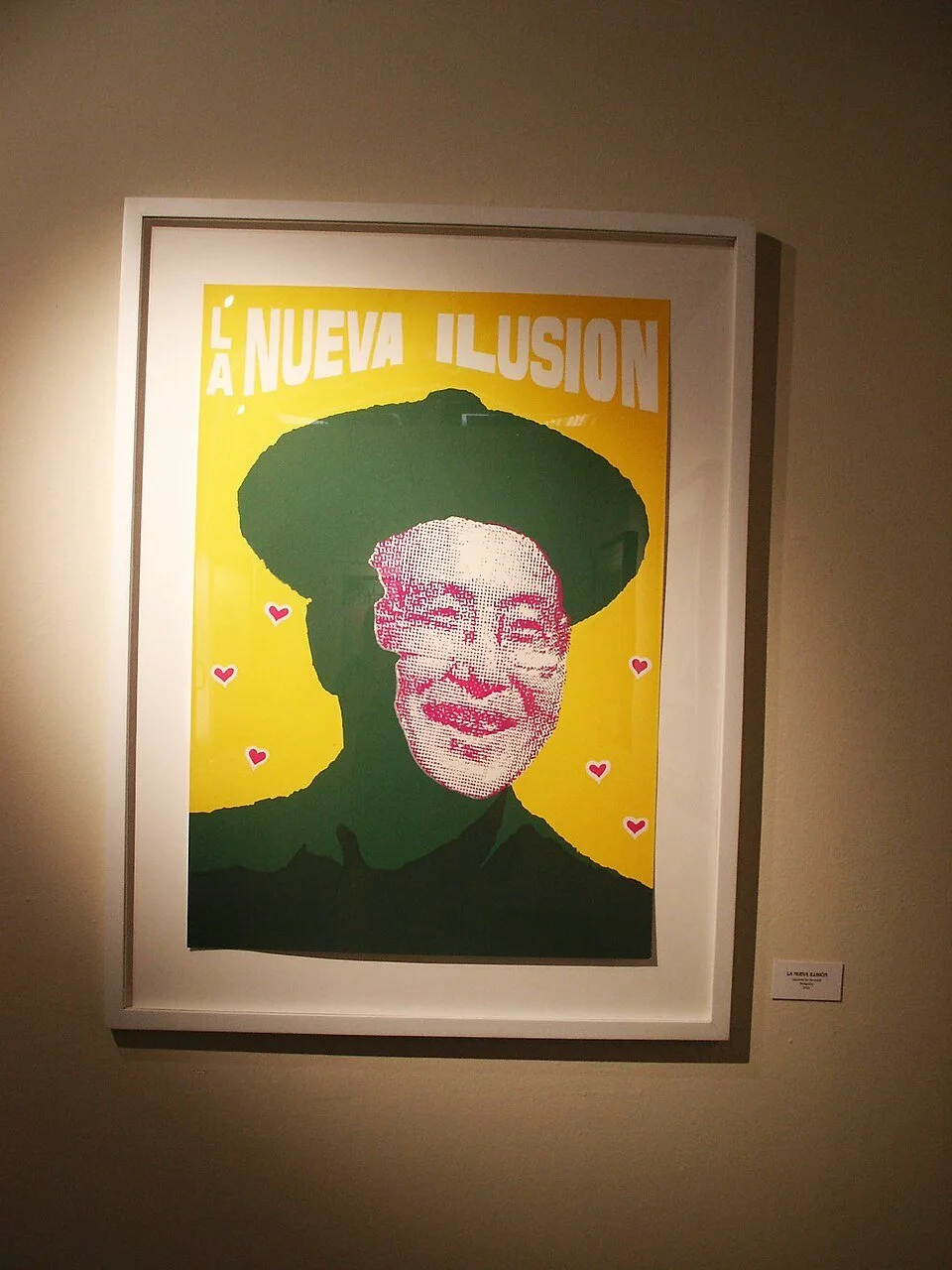
A campaign poster created by supporters of Alberto Fujimori. The photo was specifically intended to depict him as a pop star, reflecting the growing cult of personality in the Fujimorista movement.
Photo Credit: Ray_LAC
Peru in the 21st Century
Despite facing scrutiny for his crimes, Fujimori was widely expected to be a shoo-in for reelection to an unconstitutional third term in 2000. That was until the smoking gun came out: the “Vladivideos,” which showed Montesinos bribing prominent officials using embezzled funds for trafficking drugs to manufacture a case against the Shining Path. In the face of this hat-trick of illegal activity, Montesinos resigned, though it was unclear how the election would be affected. He merely served as the fall-guy for Fujimori, who remained in his role.
Fujimori ultimately won the runoff with 75% of the vote, though widespread fraud was committed at the expense of his opponent, Alejandro Toledo. Pressure mounted and Fujimori attempted to resign, only to be impeached and removed from office before fleeing to Japan. He and Montesinos were ultimately convicted of numerous crimes against humanity and received significant prison sentences, with Montesinos still incarcerated to this day.
In the 2001 snap elections, Toledo was victorious, marking the first victory for the Peruvian opposition in nearly two decades. Toledo, who was of Indigenous descent, promoted national development and reversed some of Fujimori’s policies. However, he was incredibly corrupt and left office with an 8% approval rating. He was particularly scrutinized for receiving bribes from the Brazilian corporation Odebrecht as part of “Operation Car Wash,” which implicated a variety of Latin American politicians, including dozens of Peruvians. Toledo received a 20-year prison sentence for his conduct.
Toledo was succeeded in 2006 by former President Alan García. During his first term, García had laid the foundation for Fujimori’s regime, hyperinflating the value of the sol while establishing death squads to execute suspected Shining Path members. In his second term, he continued many of the same policies, including unsuccessfully calling for the death penalty for Shining Path militants and allowing mining and logging companies to operate in the Amazon Rainforest. In fact, he took a page out of the Fujimori playbook when he allegedly ordered police to murder and dump the bodies of Indigenous protestors opposing the corporate takeover into the Amazon River, paralleling the suppression of Túpac Amaru’s uprising centuries later. Additionally, he enacted legislation that helped government and military officials accused of wrongdoing fight off cases brought against them by non-governmental organizations. After leaving office in 2011, García was caught up in the same “Operation Car Wash” bribery scandal, but killed himself before he could be prosecuted.
The 2011 election was won by García’s main political adversary, Ollanta Humala, a former military officer and strong anti-Fujimorista. Not only had Humala attempted a military coup against Fujimori, but he defeated Fujimori’s daughter, Keiko, in the runoff. Despite his left-wing background, he governed as a centrist, continuing tax exemptions for both foreign and domestic mining companies while deregulating the industry. He left office in 2016 and holds the dubious honor of being the most recent President of Peru to serve a full term in office; he too was caught up in “Operation Car Wash” and sentenced to 15 years in prison for accepting bribes.
The 2016 election was a fierce contest between Keiko Fujimori and the slightly more moderate candidate — Standard Oil’s favorite economist, Pedro Pablo Kuczynski. While Kuczynski narrowly won, the Fujimoristas gained control of Congress as part of a global far-right surge. Both candidates firmly agreed to preserve Peru’s neoliberal status quo.
At first, Kuczynski’s presidency was fairly inoffensive, but it was soon revealed that he received bribes from Odebrecht as part of “Operation Car Wash” when serving as Minister of Finance. Congress impeached him, but did not have the votes to remove him from office. Shortly after, he issued a humanitarian pardon for Alberto Fujimori, who was serving 25 years for human rights abuses, murder and kidnapping. Mass protests subsequently broke out, with outrage centered on the fact that Fujimori’s son, Congressman Kenji Fujimori, had been crucial to Kuczynski’s survival of the first impeachment vote. .
In early 2018, this scandal reached a fever pitch following the release of another smoking gun: the “Kenji-videos,” similar to the “Vladi-videos” that had brought down his father. The video depicted a meeting between Kenji Fujimori and Kuczynski where Fujimori offered to kill the removal efforts in exchange for both the pardon of his father and approval of construction projects in his district. Faced with a second impeachment and almost certain removal, Kuczynski resigned. He was succeeded by his Vice President Martín Vizcarra.
Vizcarra promoted anti-corruption reforms, most of which were blocked by the Fujimoristas. In late 2019, amidst tension with Congress, he invoked a Constitutional clause calling for early Congressional elections, for which Congress attempted to impeach him. Ultimately, the Constitutional Court ruled that Vizcarra had acted legally, although some of his allies began to turn against him; in fact, his Second Vice President Mercedes Aráoz resigned.
Anti-Vizcarra parties lost several seats in the snap elections, but remained the largest alliance. Under new President of Congress Manuel Merino, Congress began investigating tapes that allegedly implicated Vizcarra using state funds to pay kickbacks to singer Richard Cisneros. In September 2020, Congress successfully impeached Vizcarra, but the removal vote failed. In October, however, Vizcarra was impeached again and successfully removed, for corrupt dealings during his time as governor of Moquegua. Merino became the new President, but many viewed the removal as a coup, prompting mass protests and prompting Merino’s resignation five days later. For the remainder of the term, centrist economist Francisco Segasti served as President. Throughout 2020, the COVID-19 pandemic devastated Peru; the national poverty rate increased to 30%, exacerbated by the Fujimori-imposed neoliberal framework.
The 2021 election was also highly contentious; the runoff pitted Keiko Fujimori, in her third presidential run despite having been arrested for money laundering as part of “Operation Car Wash,” against socialist teacher Pedro Castillo. Castillo prevailed narrowly. His relationship with Congress was complex; he supported socially conservative policies akin to those of the Fujimoristas, yet strongly rejected their economic policies. The Fujimoristas attempted to impeach him multiple times. In early 2022, tensions from increasing fuel prices and striking mining communities, who opposed Castillo’s economic policies, caused severe economic hardship and widespread protests. Facing the threat of impeachment, Castillo attempted to invoke the same constitutional provision as Vizcarra, but was immediately removed by Congress and arrested.
When Castillo’s Vice President Dina Bolaurte ascended to the presidency, she denounced Castillo and aligned herself with the Fujimoristas in Congress, despite having served under a relatively left-leaning administration. When protests inevitably broke out against her perceived complicity in Castillo’s removal, she declared a state of emergency and sent the military to violently repress them, ending in the murder of 51 civilians. She targeted the largely Indigenous inland provinces, which remained Castillo strongholds given his Quechua background and Indigenist policies. Boularte subsequently cemented her authoritarian trajectory by appointing as her intelligence chief Juan Carlos Liendo, who had described Castillo and his supporters as terrorists. Calling detractors “terrorists” was a long-time tactic of the Fujimoristas, and Boularte’s administration wasted no time labeling protestors as such. Soon after, soldiers began indiscriminately killing protestors in Ayacucho and Juliaca. While Boularte wanted to resign, her defense minister convinced her to stay so that they could be immune from prosecution.
Despite this, the Attorney General announced that Boluarte would be investigated for genocide, though she remained defiant. She took two weeks off from the presidency to receive plastic surgery and began to publicly wear newly acquired Rolex watches. The human rights abuses against protestors, increasingly naked corruption and rise in organized crime resulted in a disapproval rating of 92%, which began to alienate even the Fujimoristas. In October 2025, she was impeached and removed from office. Her replacement, Congress President Jose Jerí, lasted four months in office. His brief tenure was ineffective at reducing the widespread discontent and was marred by accusations of sexual assault, embezzlement and bribery.
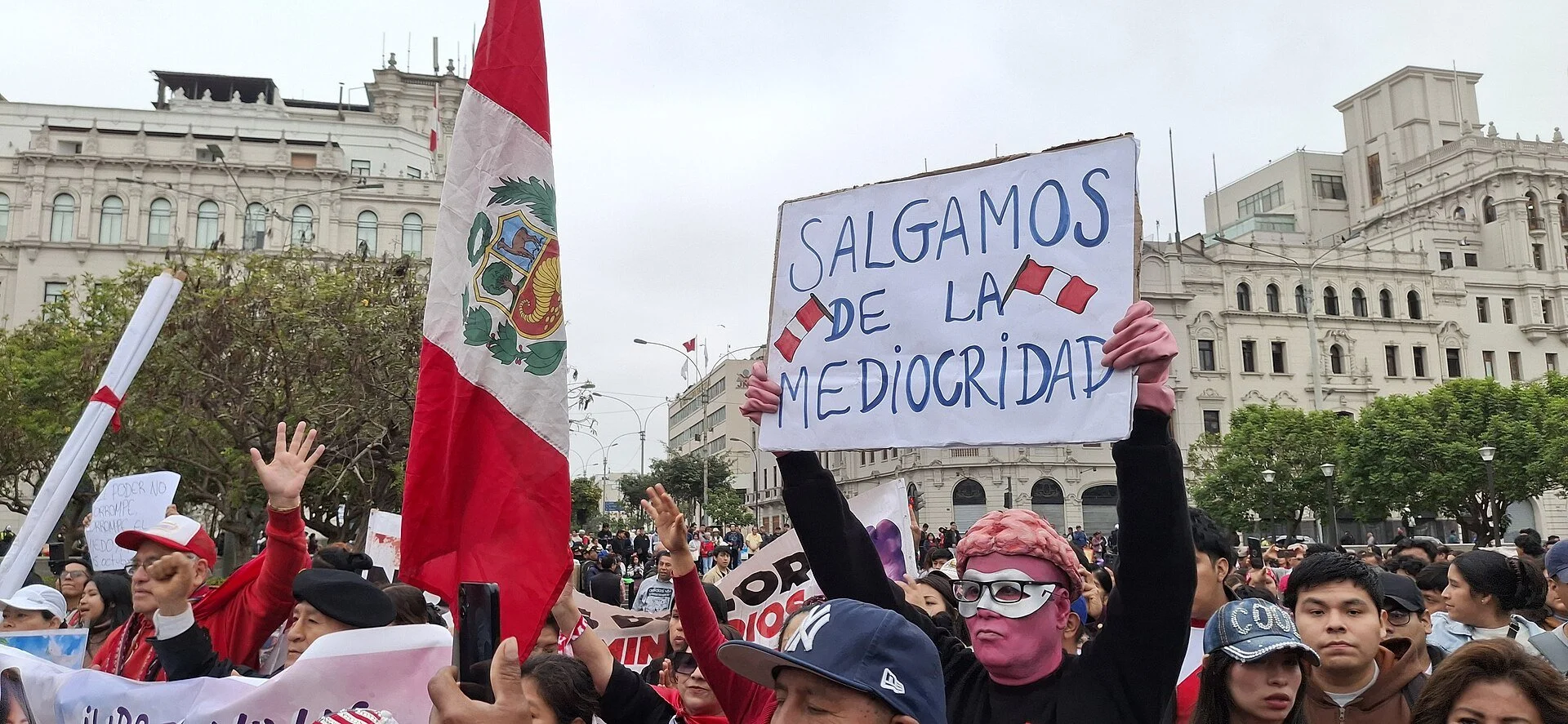

Colorful protesters taking to the streets against the Boluarte administration. The signage reads “salgamos de la Mediocridad,” meaning “let’s leave the mediocre,” reflecting broad dissatisfaction with the government, especially from younger Peruvians. The leaders of the protests explicitly aligned with the goals of the worldwide Gen Z Protests.
Photo Credit: QM Keen

Conclusion
The incumbent Balcázar has followed in the tradition of Humala and Boluarte by rejecting his left-wing history upon entering office, sometimes in exceedingly bizarre ways. He endorsed sexual relationships between young girls and their teachers and appointed Hernando de Soto, the godfather of Fujimorista economics, as his first Prime Minister. However, Balcázar is 83 years old and has opted to retire after the 2026 elections, which will conclude with a runoff on June 7.
In the first round held on April 13, the ubiquitous Keiko Fujimori placed first in her fourth bid for president; her father had wanted to run after his pardon, but died in 2024. Another arch-conservative, Rafael López Aliaga, was initially second in the vote count, but was overtaken by progressive Congressman Roberto Sánchez. Certification of the results was delayed when López Aliaga alleged voter fraud and launched a disinformation campaign to convince Peruvians to pressure election officials to overturn the results. He has been particularly vocal about his disdain for the elections chief.
These bizarre antics have led to López Aliaga being charged with inciting civil disorder, though they have also led to affinity with Keiko Fujimori, as she has signaled her willingness to advocate for his accusations in court, seemingly to prevent Sánchez from advancing to the runoff. This election has all the hallmarks of chaos that have plagued Peru for decades. Only time will tell if Peru can achieve stability and equality for its citizens in the future.