Legacies of Dictatorships: Brazil’s Latest Police Crackdown
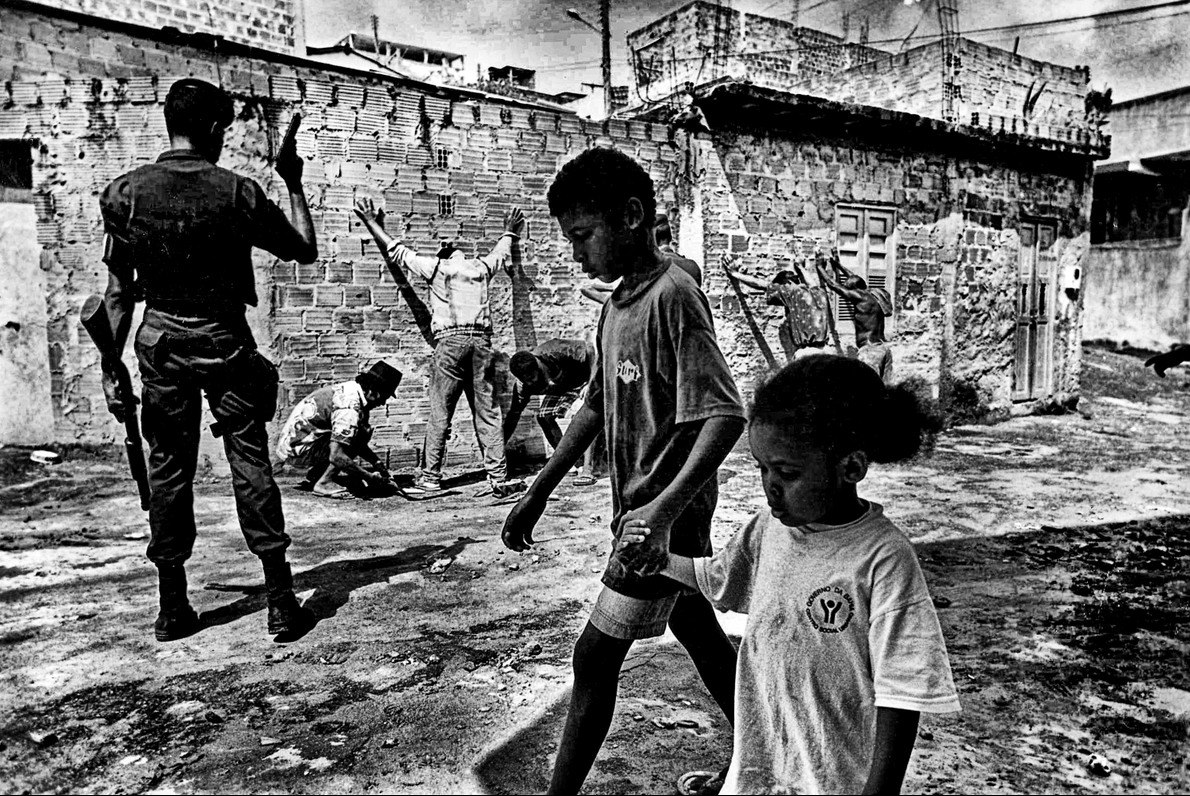
Two children walk through a military police raid in the neighborhood of Beirú in Salvador de Bahía in 1996. This is one example of the long history of raids and prolonged police presence in Brazilian favelas and their impact on civilians' daily lives.
Photo Credit: Delmi
On October 28, the Rio de Janeiro police led one of their deadliest operations yet in the Penha and Alemao favelas killing at least 120. While only the latest in the Brazilian government’s intensive efforts to end narco-trafficking that mimics the United States’ (U.S.) hardline strategies against cartels, the police apparatus that carries out these operations traces its repressive origins to Brazil’s 1964-89 military dictatorship.
The drug cartel the police claimed to target in the October operation is called the Red Command, or Comando Vermelho. It was first formed in the Ilha Island prisons as a self-protection group for prisoners struggling in the harsh conditions of military prison during the 1970s. Many of the initial members were supposed parts of left-wing militant groups targeted by the regime while others were ordinary criminals. Eventually, the organization grew powerful enough to spread into the streets, maintaining networks inside and outside of the prisons. Although they had already been engaged in criminal activity, the Red Command became involved in the growing drug trade with other transnational organizations.
Because the organization primarily operates in the favelas, or informal settlements, of Rio, the police concentrate their efforts on those areas. However, the favelas’ existence are the result of long-standing high levels of economic inequality. During the initial stages of Brazil’s military dictatorship from 1964-67,, the new regime aimed to attract foreign investment by freezing wages, crippling unions, and lowering taxes on foreign firms. While this led to the so-called “Brazilian Miracle,” where the economy grew an average of over 10 percent per year from 1968-74, real wages stagnated and economic inequalities became increasingly stark. When oil prices rose in the mid 1980s, Brazil’s macroeconomic gaps were at the forefront of politics as the country attempted to return to democratic governance. Although the government issued decrees beginning to limit foreign investors in an attempt to mitigate the economic situation, inflation stayed above 100% from 1981 to 1994. In 1994, the finance ministry introduced a fixed exchange rate policy. This succeeded in bringing down inflation, but continued to expose the country to global capital flows. In a country with one of the highest Gini coefficients, or a measure of income inequality, in the world, this economic policy has exposed some of the most vulnerable in Brazil’s population to uncertainties they cannot afford.
Operating in low-income areas, organizations like Red Command often provide employment or services for those shut out by the economic system or state infrastructure. As a result, the police claim that by targeting these communities, they are targeting the militias of these groups. However, UN reports on Brazilian law enforcement reveal a long history of excessive force within recent years. Between 2021 and 2024, at least 211 people were killed in police operations across five states. The report specifically notes that these killings were both extrajudicial and not isolated acts of violence, but rather “an alarming pattern pointing to a deeply rooted systemic problem.”
Furthermore, the UN has noted a culture in the police of repression and hyper-toxic masculinity, a striking feature of the dictatorship-era moral framework. Morality was a central tenet of the dictatorship’s internal security doctrine, as perceived subversion of the dominant social order of the established social order became a political priority following the passage of Decree-Law 1077. This legislation made attacks on moral and sexual customs an assault against national security similar to war. Part of this push came in the form of embracing fundamentalist gender roles. Attempts to break outside of the traditional family structure came to be perceived as a sliding scale into communism, necessitating governmental intervention. It comes at no surprise then, that the police forces born out of this political environment embodied the ideal of masculinity, expressed through violence and power.
This most recent crackdown, however, represents the largest loss of life out of all previously mentioned police operations. The police’s stated objective was to capture the Red Command’s top leaders, but it failed to do so. This disconnect between goals and implementation has increased public outcry, as none of the deceased matched any of the 68 leaders on the suspect list provided by prosecutors. Additionally, community members say that their daily lives have barely changed with the gang maintaining control over the same areas. The complexes’ demographic composition also highlights the racialized nature of police brutality. In 2023, 83.2% of the killings by police were people of African descent. And, local reports state that many victims bore signs of extrajudicial execution, such as having their hands tied behind their backs and shots from behind or to the back of the head. All of these factors raise the question of whether these crackdowns actually serve their alleged purpose, or if they are simply the latest in a long history of the criminalization of the working class communities of Brazil.
Brazil’s police strategies reflect the cultural legacies of their decades-long military regime. Although not obvious from immediate inspection, examination of the deeper forces behind their actions reveal that these underlying notions must be addressed in order for Brazilian policing to be both more effective and rely less on violent repression.