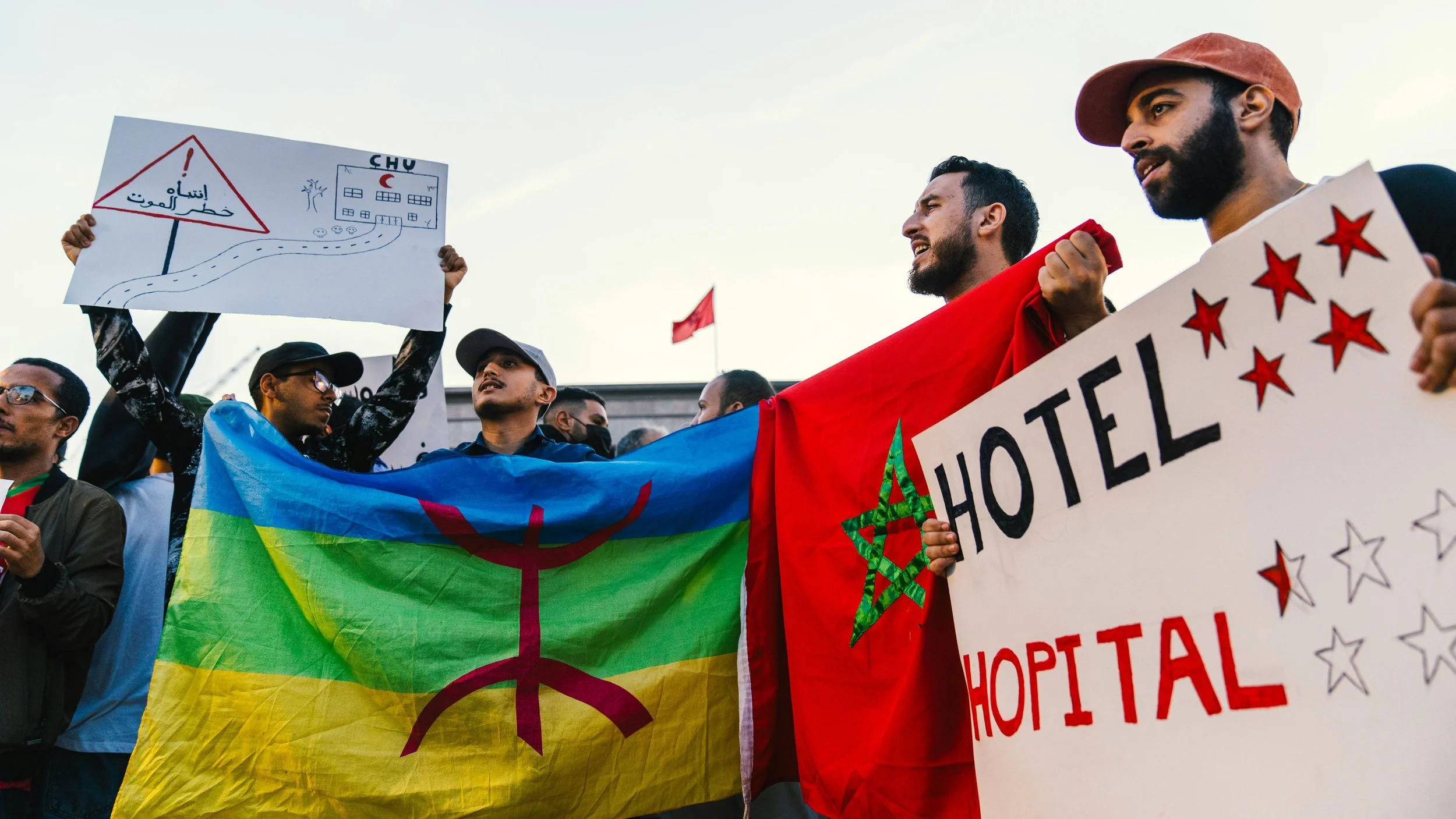
Protestors hold up an indigenous Amazigh flag, a Moroccan flag and posters during a demonstration in September 2025. The poster on the left speaks of hospitals as “deadly dangers,” while the poster on the right critiques government spending on tourism and other externally focused initiatives, such as 5-star hotels, rather than public services such as hospitals, which they rate 0.5/5 stars.
Photo Credit: Youssef El-Belghiti
In four years, Morocco will co-host the 2030 FIFA World Cup, drawing the world’s eyes to its newly constructed, modern stadiums. Six months ago, eight women tragically died during childbirth in the city of Agadir in obsolete hospitals with austere services. The Hassan II Regional Hospital, frequently referred to by citizens as the “Death Hospital,” was not part of the country's external renovations for the tournament. These injustices were brought up in mass, youth-led protests demanding better health and education services as well as an end to corruption. Across the country, they chanted “stadiums are here, but where are the hospitals?”
The deaths in Agadir, a coastal city in southern Morocco, created waves of general outcry. Citizens’ calls for help quickly became a nationwide push for healthcare reform in response to visible and serious deterioration in hospitals across the country, some reaching near-total collapse.
The mounting pressure for social reforms, including those in healthcare and education, resulted in civil unrest and the largest protests in Morocco since the 2011 Arab Spring. These demonstrations were met with widespread, violent repression by security forces as well as the arrest of thousands of minors and activists.
State of Healthcare Services in Morocco
Doctors at hospitals across the country frequently report equipment and staff shortages, noting the absence of proper sterilization instruments and resources, with many driven to reusing gloves. In Agadir, locals posted videos to social media in late September displaying the state of the hospitals, which showed men laying on the dirty floors of empty hospital rooms and stray cats wandering down the halls. Doctors themselves assert that “the state of the hospitals is enough to make you sick.”
Hassan II Regional Hospital, the city’s main healthcare provider, was visited by Morocco’s Minister of Health and Social Protection, Ameen Tahraoui, following the deaths and subsequent citizen outcries. Tahraoui acknowledged that the issues citizens call out are real and visible, and that the hospital’s failings included equipment shortages and inadequate services. Tahraoui additionally confirmed a government investigation to determine who or what services in the hospital led to the mothers’ deaths. However, his statements and visit were diluted by the fact that he proceeded to fire and place key hospital workers on administrative leave, depleting an already insufficient number of staff.
This perceived hypocrisy was further exacerbated by the hospital’s purchase of new machines prior to the minister’s visit, alleged by hospital staff and reporters to be an attempt to “cover up” their most obvious failings.
Despite adopting the Abuja Declaration in 2001 as a member of the African Union, Morocco has failed to meet the required 15% minimum of national budget spending towards healthcare, spending only around 7.2% since the declaration’s signing.
From a recent World Health Organization (WHO) analysis, 21.8% of healthcare funding in Morocco comes from government revenues and 19.1% from social health insurance contributions, meaning public funds make up to 40.9% of Morocco's healthcare funding. This is less than the 43% of funding that comes out-of-pocket from patients' households. The remaining 16.1% of funding comes from private health insurance or foreign governments.
The deficit in government contribution is exacerbated by an additional human resources crisis. Morocco has only 7.7 to 7.8 doctors per 10,000 inhabitants, significantly lower than the WHO-recommended minimum of 23 to 25 doctors. Half of the nation’s practicing doctors are located in the two most populous cities, Rabat and Casablanca, causing increasing sparsity. The country's public health sector also operates with only an approximate 2,300 doctors, despite the population requiring around 32,000 doctors. Not only do the country's public health services operate at drastic levels, but they lose approximately 600 doctors annually to emigration as they seek further success and opportunity abroad.
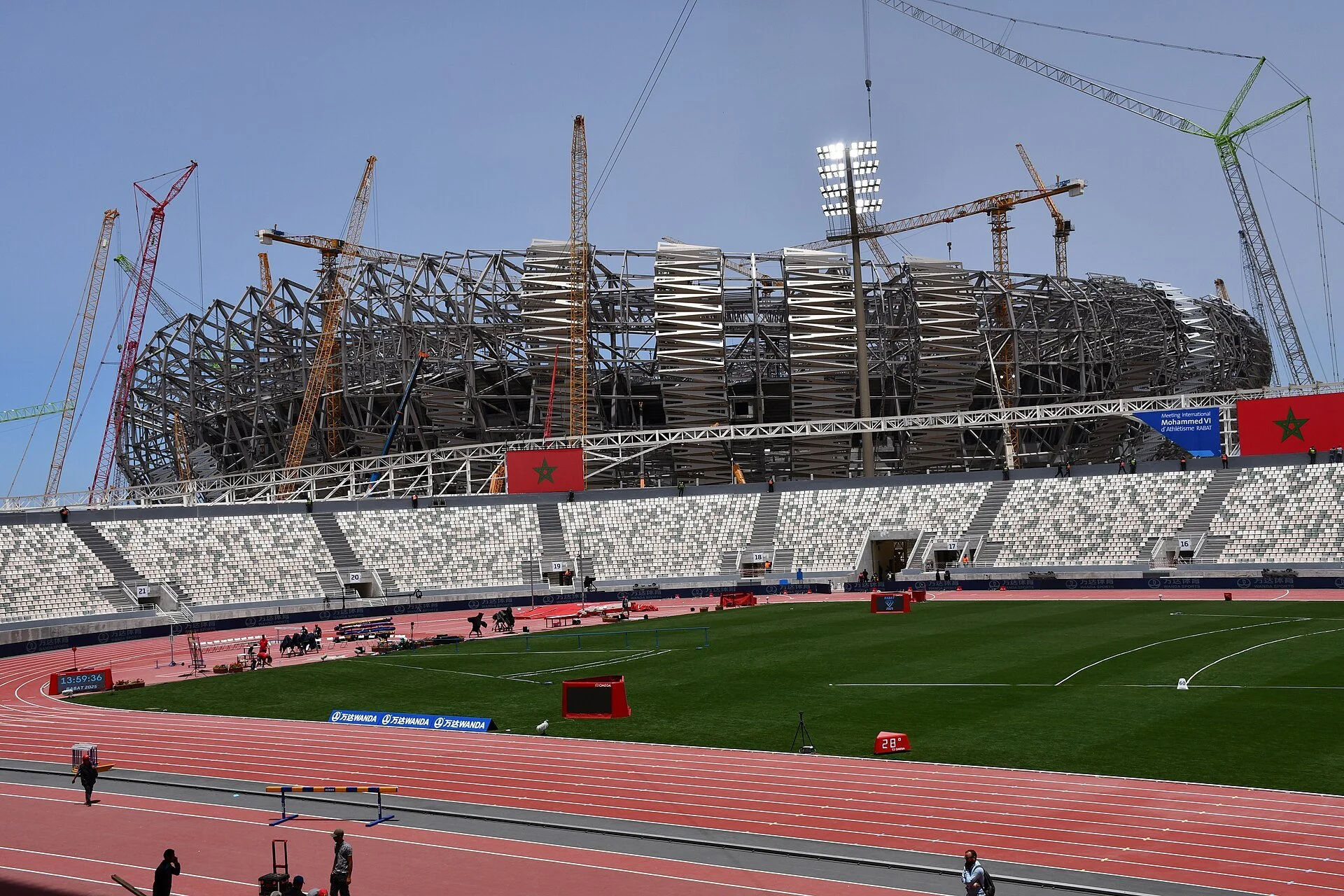
The Olympic Stadium in Morocco’s capital, Rabat, overshadowed by the new Prince Moulay Abdellah Stadium under construction in May 2025. Construction lasted only 18 months, making it a World Record contender for the fastest built stadium. It will host multiple matches during the 2030 FIFA World Cup, including a semi-final.
Photo Credit: Reda Benkhadra
Reputation-Building Through Display & Potential Conflicts of Interest
The Prince Moulay Abdellah Stadium in Rabat was built in a world-record 18 months and cost an estimated $75 million, highlighting the country's current developmental focus. This is only a fraction of the estimated $5 billion Morocco has spent to host both the 2030 World Cup and the 2025 Africa Cup of Nations, an event that attracted visitors from all across the African continent last December. This $5 billion is being spent on the construction of various stadiums, sports complexes, hotels and highways. These projects include the Hassan II Stadium, which will be the largest soccer stadium in the world. The stadium is expected to finish construction in 2028 and will boast a capacity of 115,000 spectators.
These development projects come at the cost of local residences. Neighborhoods are evicting residents in cities like Rabat, the country's capital. According to the municipality, these evictions and demolitions are intended to improve living conditions and create an aesthetic, cultural “hub attracting increasing investment,” focusing on boosting tourism and commerce.
Development projects such as this come when Morocco still feels the effects of two recent crises. Morocco only partially recovered from the economic crisis caused by the COVID-19 pandemic in 2020 and from the tragic 2023 Al Haouz earthquake. The Al Haouz earthquake destroyed in part or in full 50,000 homes and led to the death of nearly 3,000 people, injuring another 5,700. The issues stemming from these crises have not yet been fully addressed, given government focus on “aesthetic” initiatives.
State of Education & Employment in Morocco
66% of 10-year-old Moroccan children are unable to read or comprehend simple text. 23.4% of rural girls drop out by grade six, meaning that one in every four girls leaves school by age 12. Across the country, over half a million students dropped out of school in 2015. Additionally, Morocco’s latest PISA reading score is only 339, almost 100 points below the international average of 436.19.
In an attempt to combat the declining state of education, the Moroccan government, with the aid of NGOs, has launched reforms to expand access to education. The World Bank financed a total of $750 million by 2023 for Morocco’s Education Support Program to support the government's Strategic Education Roadmap. This approach aims to expand early childhood education, invest in teacher training and reduce learning poverty.
According to numbers provided by Morocco's High Commission for Planning, in the second quarter of 2025, the unemployment rate in Morocco decreased from 13.1% to 12.8% nationally. Despite this, the unemployment rate remains high among young people aged 15 to 24, with an estimated 35.8% lacking work. This issue is especially salient due to the fact that half of Morocco’s population is under 30.
Even if young Moroccans successfully reach higher education, they are increasingly affected by these high unemployment rates, leading many to emigrate. The unemployment rate for those with higher education degrees in Morocco reached 19% in the second quarter of 2025 and total unemployment rates increased in some regions to 47.9%.
.jpg)
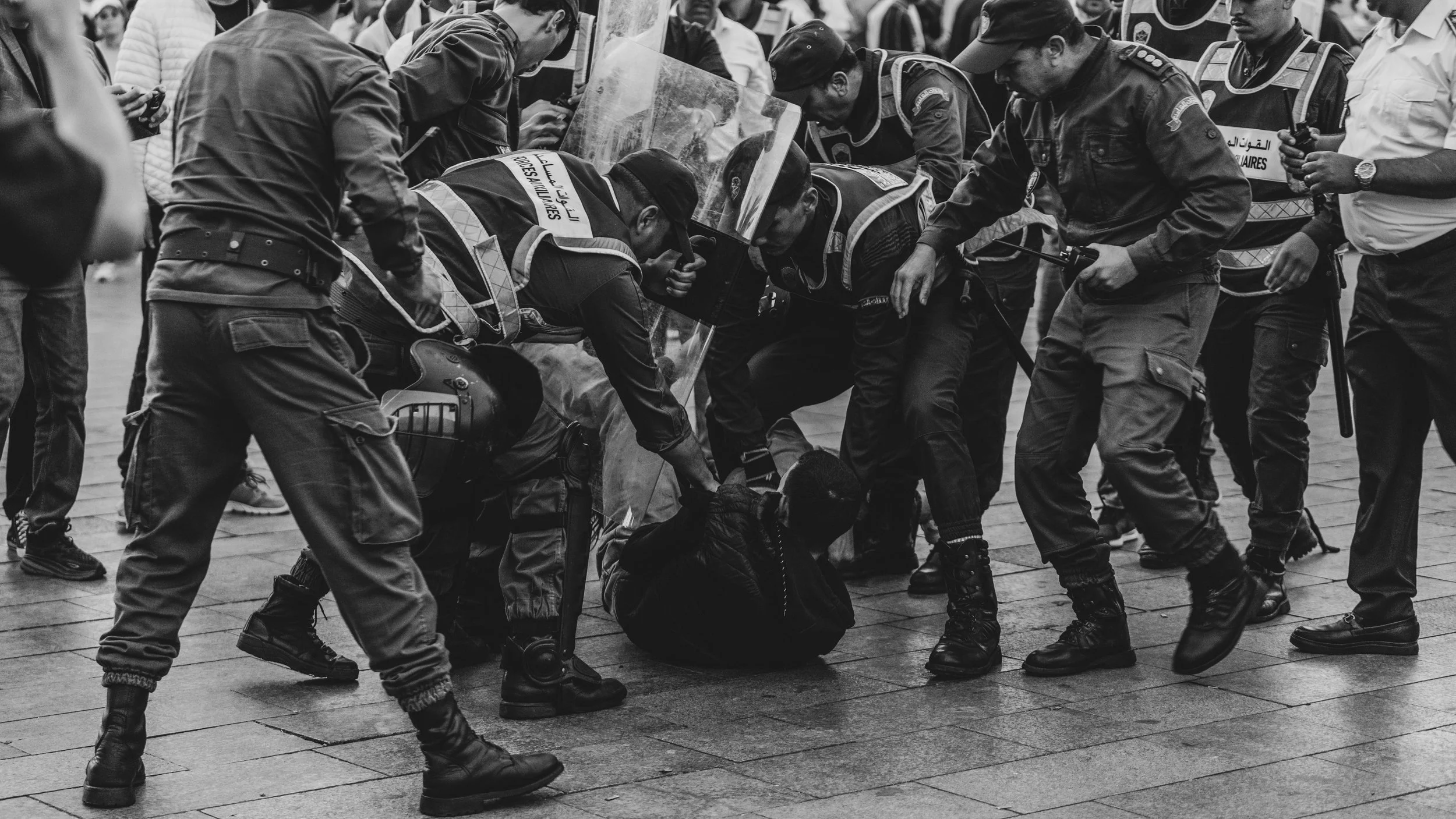
Security forces arrest a protester, throwing him to the ground in Rabat. Abuse and excessive usages of sometimes lethal force were a widespread issue during the 2025 protests, garnering international attention from INGOs such as Amnesty International, who condemned the violent crackdowns on freedom of speech.
Photo Credit: Youssef El-Belghiti
2025 Youth-Led Protests
The aforementioned large-scale development projects come as youth grow aware of how the country's increasingly internationally focused policies target external audiences and tourists, leaving essential health, education and employment crises to continue to deteriorate.
In late September, as a result of mounting social dissatisfaction with public services and the death of eight mothers during childbirth, widespread protests began across the nation. According to the Interior Ministry of Morocco, at least 70% of these protestors were minors. While the protests began in Agadir, they quickly spread from the south to a multitude of cities, culminating in a nationwide social movement.
Some protestors additionally called for the resignation of the Prime Minister, Aziz Akhannouch. Akhannouch is one of Morocco’s wealthiest businessmen, with a reported net worth of $1.6 billion. He has been under increased scrutiny, as his political opponents decry alleged conflicts of interest between his personal business dealings and state projects. Akhannouch is the majority owner of the Akwa Group, a multibillion-dollar conglomerate which, in 2024, won a contract for a large desalination project in the Casablanca-Settat region. The estimated value of the project is around 6.5 billion MAD ($650 million USD), however, Akhannouch claimed this project was an initiative to tackle Morocco’s dire water crisis.
During these widespread protests, police forces opened fire on demonstrators in the town of Lqliâa near Agadir, resulting in three deaths. One of those killed was a cinema student who was filming altercations between protestors and security forces before being shot in the head. Morocco’s Ministry of the Interior claimed that the three protestors shot and killed had been attempting to seize police weapons. However, no witnesses confirmed this statement. The incident instead appears to be a case of severe police misconduct.
One month later, 2,480 people had been charged with crimes, including armed rebellion, insulting and exercising violence against security forces while on duty, as well as incitement to commit felonies. Sentences ranged from one to 15 years, with the majority of protestors being university students or part of the working class.
According to the Moroccan Association of Human Rights, some female protesters were even victims of acts of inappropriate touching and harassment, as well as sexist remarks. There have been testimonies of torture while in police custody, with a mother saying her son and his friend were beaten with electrical wires on their legs, which left marks lasting weeks.
Human rights organizations such as Amnesty International condemned the Moroccan security forces “use of excessive force following crackdown on youth protests.” They additionally spoke to protestors from Casablanca who said that the police had “specifically [targeted] anyone who spoke to the media [and] rush[ed] towards a person who was giving an interview to two journalists, he was speaking into the microphones when the police came from behind him and forcibly carried him away.”
Clearly, the youth-led demonstrations and government response have involved serious abuses of protestors’ life, rights, due process and repression of their freedoms of expression.
Conclusion: Current Developments & Continued Struggles
Morocco’s rapid construction of the Prince Moulay Abdellah Stadium stands as a haunting metaphor for a nation prioritizing international prestige over internal survival. While $5 billion is channeled into the 2030 World Cup’s veneer of progress, the reality within “Death Hospitals” reveals a systemic collapse where mothers die in childbirth and patients lie on dirtied floors.
The 2025 protests and subsequent crackdowns proved that the Moroccan state would rather cast electrical wires and bullets against its youth than properly address rising unemployment rates or astounding literacy gaps among children. Morocco’s development remains hollow, built upon the displacement of its residents and the repression of those demanding basic dignity. As the country prepares for a billion eyes in 2030, the invisible cost is the lives lost to neglect and the silenced voices of a generation.
As Hanan Salah, associate Middle East and North Africa director at Human Rights Watch, said, “If the government can fund state-of-the art football stadiums, it can afford to fund its healthcare system, and those calling for a fair chance for their future should not be met with lethal force and repression.”