A New Monroe Doctrine: Renewed U.S. Gunboat Diplomacy and Economic Coercion
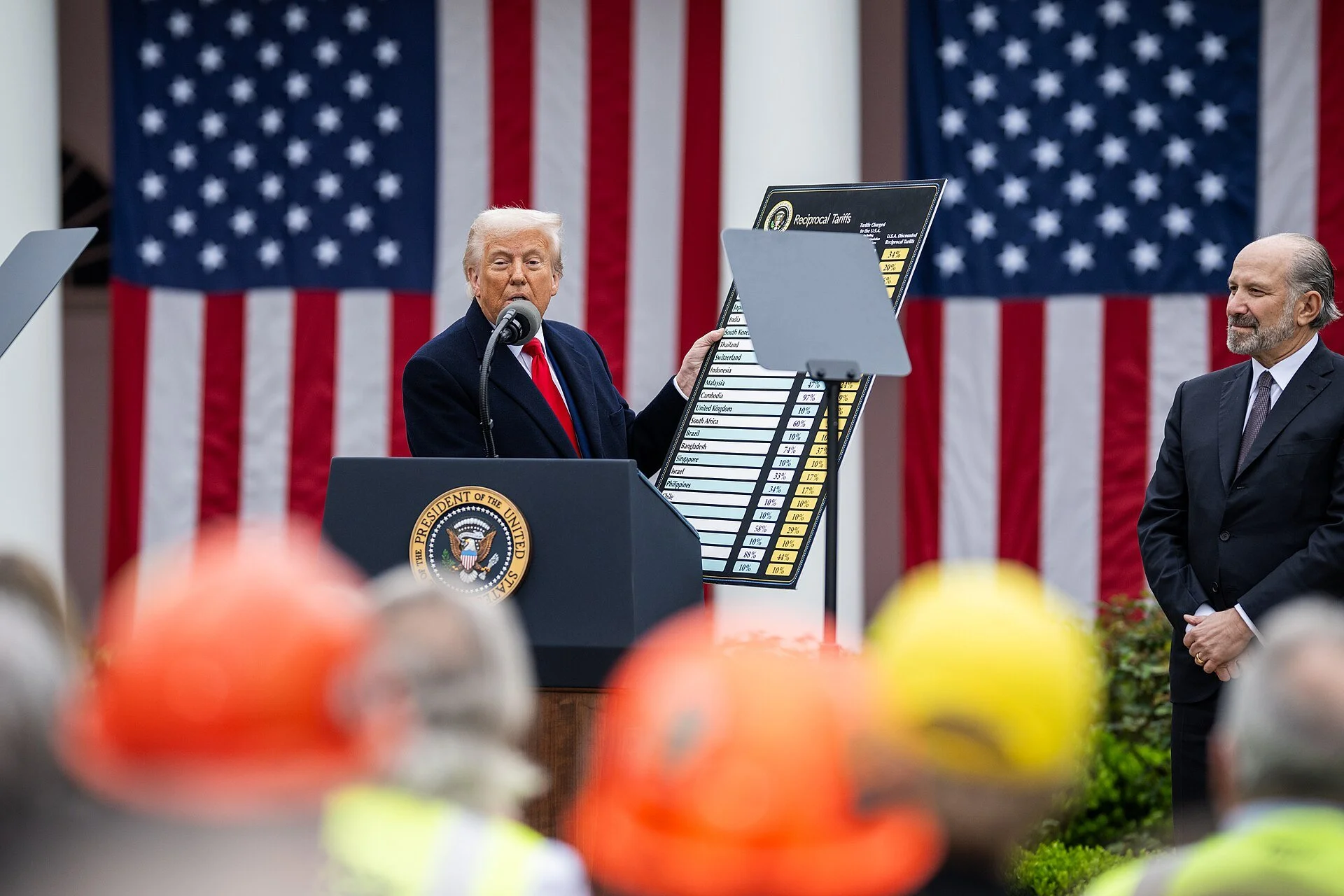
President Donald Trump announces reciprocal tariffs and their rates on numerous nations, April 2, 2025. Most addressed recipients reacted with concern to these rates, viewing them as unreasonable and aggressive.
Photo Credit: The White House
United States (U.S.) President Donald Trump’s second administration’s revival of a protectionist and belligerent foreign policy has raised questions about global economic stability and the nation’s relations with allies and enemies alike. Specifically, the U.S. has aligned itself closer with policies prioritizing its economic interests at home and strategic interests in Latin America, departing from the post World War II order.
Policy analysts like Columbia University professor Jeffery Sachs have compared the current administration’s behavior to the original Monroe Doctrine of 1823. This document, originally from the War of 1812, positioned the Western Hemisphere as the country’s sphere of influence, warning European nations against meddling in the region. This set a precedent for the U.S. to justify later interventions in Latin America.
The Monroe Doctrine would live on well into the 19th and early 20th centuries, seen especially in President Theodore Roosevelt’s Roosevelt Corollary. This extension to the Monroe Doctrine established the U.S.’s right to intervene in Latin American countries to maintain economic and political stability within the region. An evident example was General John J. Pershing’s expedition into Mexico during the Mexican Revolution, which generally reflected the ideas of the Corollary by bringing stability and restoring order to Mexico. During the Cold War, U.S. covert activities became more widespread in the region, with the CIA conducting containment activities in Cuba, Brazil, Chile, and Nicaragua. Additionally, support for Operation Condor and the 1989 invasion of Panama to arrest General Manuel Noriega further demonstrated U.S. desire to assert influence in the Western Hemisphere.
As the world entered the 21st century, the Monroe Doctrine continued to influence U.S. foreign policy. While the end of the Cold War and the emergence of the U.S. as the foremost global superpower saw a shift toward deployments across the Atlantic, the U.S. never lost an interest in its backyard — the War on Drugs, which was implemented during the Nixon administration, has remained a key priority in maintaining American influence over Latin America through the justification of combatting drug cartels. With growing multipolarity and the re-election of Donald Trump in 2024, the Monroe Doctrine’s influence is more prevalent in 21st century U.S. foreign policy than ever before, with a return to aggressive Latin American politicking.
Upon election, the second Trump administration immediately positioned the U.S. as the arbiter of Latin American affairs. Trump spent an extensive portion of Inauguration Day laying out a vision for America First in Latin America, especially regarding security at the Southern Border and the Panama Canal. And once in office, he signed a variety of executive orders rethinking international agreements, confronting cartels and changing names. This included Executive Order 14157, which designated cartels as foreign terrorist organizations; Executive Order 14159, which tightened border security and authorized sanctions on countries that refused to accept nationals deported by the U.S; and Executive Order 14172, which renamed the Gulf of Mexico to the Gulf of America on U.S maps.
The initial actions of the Trump presidency raised considerable uncertainty about the implications of future policies on Latin American nations; yet, this was only the beginning of escalating involvement in the U.S.’s backyard. March 2025 saw the first real action of the U.S.’ president’s strong words — El Salvador’s President, Nayib Bukele, allowed the U.S. to use the country’s prisons for their own detainees. As April rolled around, President Trump announced Liberation Day tariffs. A baseline 10% tariff was levied on all U.S. imports, harming Latin American trade relations with their close neighbor. Additionally, Venezuela, Guyana and Nicaragua were all subject to additional reciprocal tariffs, facing 15%, 38%, and 18%, respectively. Even though these tariffs were eventually lowered, the mere action of imposing harsh tariffs soured Latin American relations with the U.S. To further fan the flames, American airstrikes began targeting the Caribbean in September of last year, all in the name of curtailing drug flow into the U.S.
Furthermore, the U.S.’s dealings with individual countries in the region have followed a similarly decisive route. While Argentina, a critical U.S. ally under President Javier Milei, received a bailout for its farmers in October, other countries, like Venezuela, have seen an increase in U.S. military presence without proportional humanitarian aid. Increasing belligerence towards traditional allies, such as Mexico and Colombia, raises questions about whether these alliances will continue, especially in light of U.S.-China competition for allies. Trump has floated the idea of bombing cartels and violating Mexican sovereignty to prevent the flow of drugs into the U.S., causing concerns within the Mexican government over an invasion of the country, similar to interventions in the 1910s. Regarding Colombia, boat strikes in the Caribbean appeared to have hit Colombian vessels, prompting Colombian President Gustavo Petro to call these actions a violation of Colombian sovereignty, leading to a suspension of subsidies and a revocation of Petro’s visa to the U.S. Then, in Venezuela on January 3, the U.S. abducted President Nicolás Maduro to stand trial in the U.S. for charges of narco-terrorism. While the Trump administration claims that this covert operation will help bring about democratic regime change, similar to its justification of interventions in Panama, the future of the country is uncertain.


U.S. military aircraft return following actions in Venezuela.
Photo Credit: Senior Airman Katelynn Jackson

The Trump administration’s aggressive Latin American diplomacy has not gone unnoticed by non-American powers. In fact, this conduct solicited attention from China, where Trump’s hawkish policy attempted to assert U.S. superiority in the country’s power struggle with China. In efforts to curb trade imbalances caused by Trump’s Liberation Day tariffs, China sought alternative strategic and trade partnerships to bypass U.S. pressure on its export-based economy. By doing so, Beijing has expanded its initiative in Latin America. However, the U.S. operation in Venezuela curbed Chinese strategic partnerships and interests in the region, projecting an American show of force and global power.
As the global community reacts to an increasingly influential America First message, the future appears to be growing more and more uncertain. For years the U.S. has mounted itself as a guarantor of Western economic and political security, but as the Trump administration severs its ties with allies and enforces harsher policies on adversaries, the global community lacks a guiding light to follow.
The erosion of alliances breeds uncertainty in Europe especially, as NATO’s largest benefactor finds itself less willing to contribute its vast resources to its allies. This is especially true with the ongoing Russian operation in Ukraine, as the U.S. view of NATO as a transactional alliance results in NATO’s European members, especially those in the European Union, seeking new strategic agreements. Adversaries in Europe may see this as an opportunity to capitalize on NATO’s faltering cohesion, with Russia growing bolder in attacks on Ukraine and demands at the negotiating table.
When considering trade, tariffs corrode the strong bonds of the global economy that have been developed since the end of the Cold War. The U.S. ceasing its role as a world leader in free trade results in fewer goods and services being traded on a global scale, leading to less productive societies and an overall economically poorer world. Despite the U.S. Supreme Court striking down the tariffs as unconstitutional, Trump’s aggressive agenda will undoubtedly lead to more turbulent times.